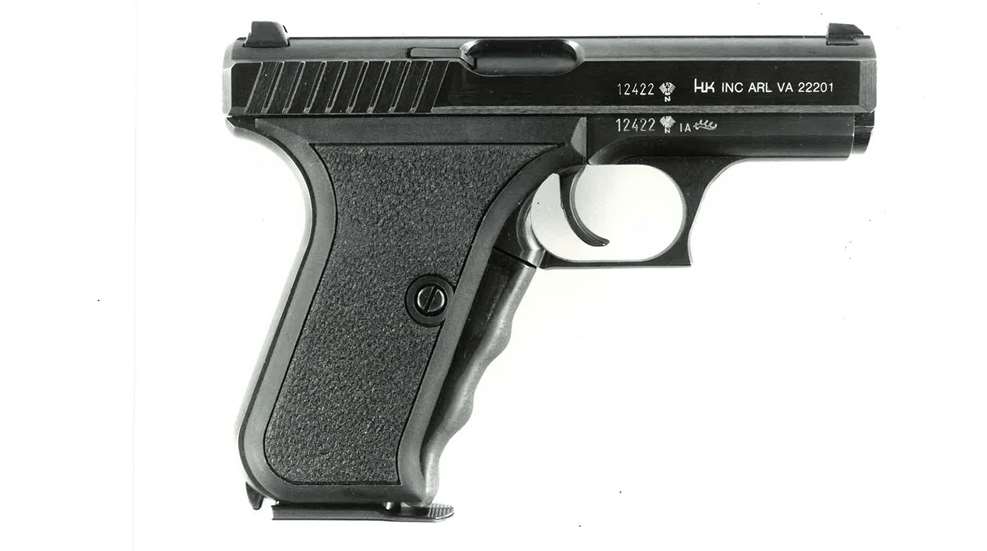
The Heckler & Koch P7, which initially fell under the company’s PSP (Police Service Pistol) designation, is unusual in design, function and even manual of arms. Its squeeze-cocking mechanism sets it apart from virtually every other semi-automatic pistol, and the finger-grooved cocking bar on the grip’s gives the handgun a distinct profile.
American Rifleman explained how the system worked in 2010. “In lieu of a fixed front strap the gun uses a finger-grooved cocking bar/lever that initially requires 13 pounds of pressure to make the gun ready to fire. While that might seem overly stiff, it is actually rather easy to apply because three fingers are at work. Also, once the squeeze cocker’s spring is compressed, only 1 1⁄2-lbs. of pressure is required to keep the gun ready to fire. Aside from this cocking lever/grip safety, there are no other external safeties….The cocking lever cocks the hammer and acts as a decocker, grip safety and slide release. The only other external controls are a slide stop, a magazine release and a take-down latch.”
The P7 had a 3 7/8" barrel and was one of the first guns to adopt polygonal rifling. The semi-auto first appeared exclusively in 9 mm Luger, although .22 LR, .380 ACP and .40 S&W versions appeared later. In original form ,magazine capacity was eight cartridges in a single column. A subsequent P7 M13 increased that count to 13 in a double-stack configuration.
It used a gas-delayed blowback system of operation to mitigate recoil, an approach that included a piston pinned to the slide. As a result, Heckler & Koch could build the gun lighter than traditional 9 mm blowbacks and keep the weight well within the police and military contract specifications. The original design appeared in 1976, but the German government officially adopted the pistol in 1978. The sheer volume of that order delayed models becoming commercially available until 1981. In 2008, the pistol was discontinued. You can expect decent used versions to run more than $2,000. Those in top shape can command at least double that price.