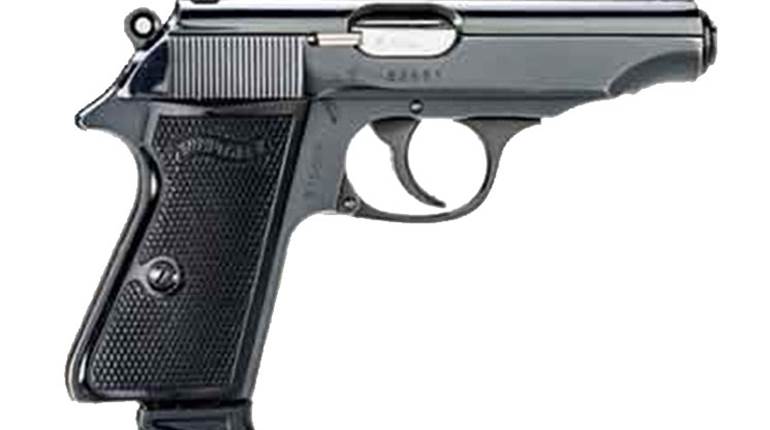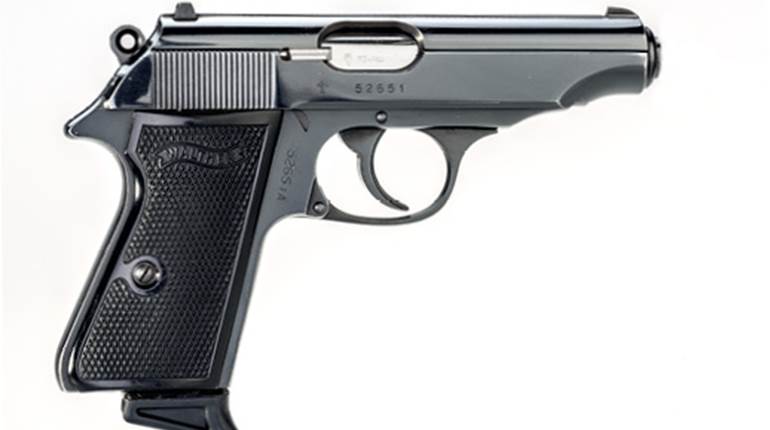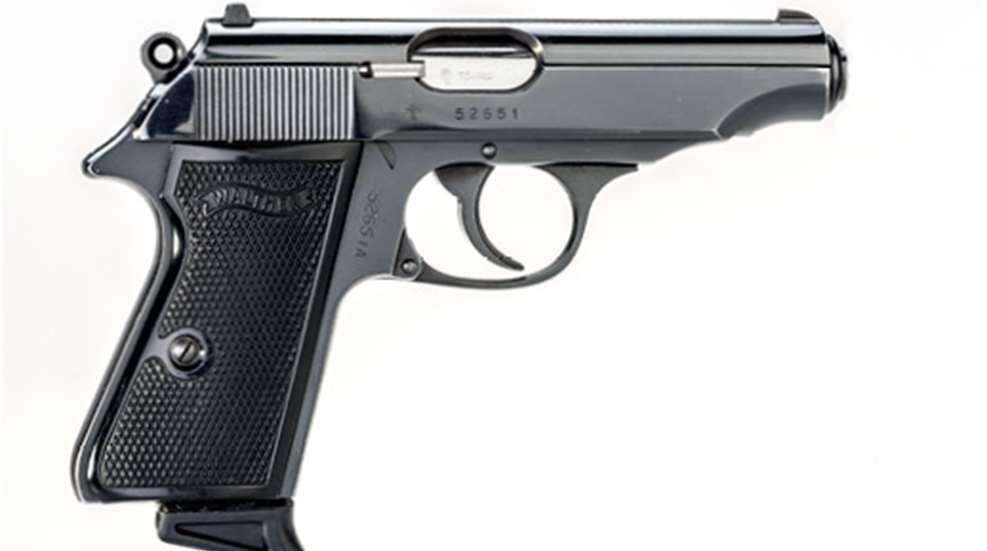
Very simply put, the Walther PP is one of the most influential handguns ever and, together with its variants, tops the pocket pistol popularity list. Introduced in 1929, Carl Walther’s PP (Polizei Pistole) was by no means the first double-action semi-automatic ever designed—several had appeared since 1905—but unlike most of the earlier attempts it worked, and worked well.
The basic platform owed some thanks to the earlier single-action Model 8, but also incorporated a whole new set of proprietary features. Initially offered in 7.65 mm Browning (.32 ACP), and eventually chambered for 6.35x16 mm (.25 ACP), .22 Long Rifle and 9 mm Kurz (.380 ACP), the PP was sleek, user-friendly and, particularly in pre- and post-war incarnations, extremely well-made.
Featuring a blowback, unlocked mechanism, the gun had a slide secured to the frame by the front lugs of a hinged trigger guard, which could be easily lowered and pushed to the side to allow the slide to be pulled to the rear and lifted off the frame. The barrel, around which the recoil spring was sited, was fixed to the frame to provide stability for the slide, thereby preventing the slide from inadvertently coming loose and, ostensibly, allowing for better accuracy than a removable barrel.
The double-action mechanism consisted of a simple disconnect that kept the pistol from firing more than one shot each time the trigger was pulled by using a trigger bar that was pushed down as the slide moved rearward, dropping below the position where it disengaged the sear from the hammer.
Other features included a loaded-chamber indicator pin on the 7.65 mm and 9 mm Kurz models (eliminated on some of the rougher, wartime PPs) and an automatic safety, which prevented the hammer from contacting the firing pin when forward. That allowed the pistol to be carried with a loaded chamber and the hammer down, even if the slide-mounted hammer-drop/safety lever was in the “off” position. When on, the safety catch secures the firing pin by means of a steel cylinder that rotates around the pin, locking it to the rear.
In 1930 the PP spawned an attenuated version of itself, the PPK (Polizei Pistole Kriminal) which, as its name implies, was also initially intended for police use. Both handguns were also readily adopted for civilian and military use.
An issue sidearm with the Germans during World War II, after the war Walther made an agreement with Manhurin in France to continue production of the pistol. Eventually manufacture was resumed by Walther in Germany, and models and variations have been made under license in the United States. The PP is still a serious contender in the pocket pistol field, one that is user-friendly, rugged, reliable and simple to dismount.
Disassembly Instructions
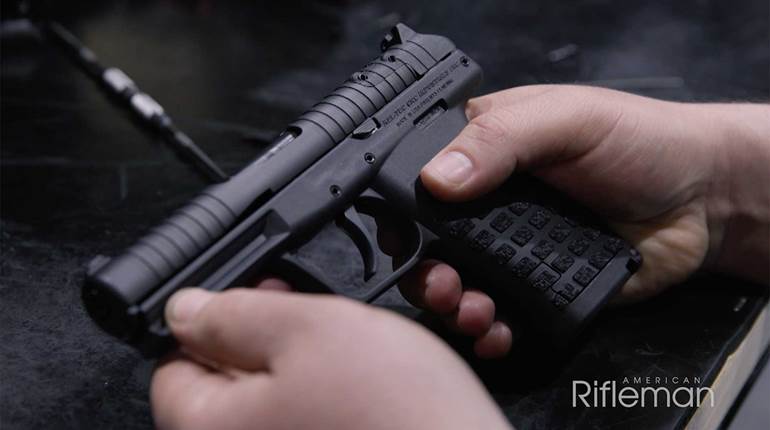
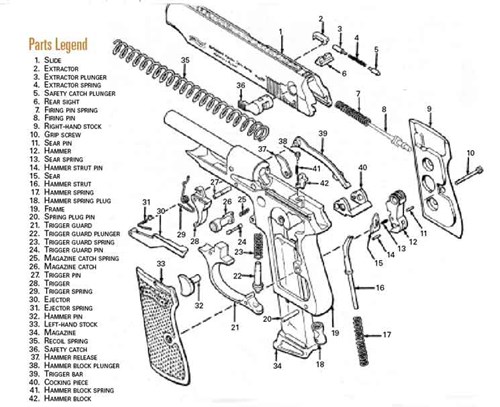
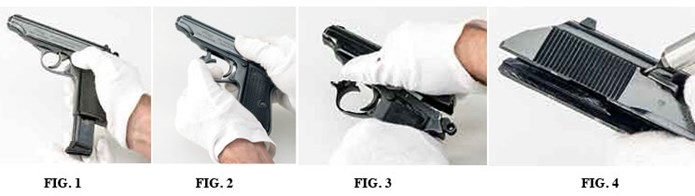
Disassembly for routine maintenance and cleaning is as follows: Remove the magazine (34) and empty the chamber (Fig. 1). Pull down the front end of the trigger guard (21) and push it to the right. It will rest against the frame (19) and remain open (Fig. 2). Pull the slide (1) to the rear as far as it will go.Lift up and ease it forward off the frame (19) (Fig. 3). Remove the extractor (2)by depressing the extractor plunger (3) well below the edge of the slide. Use a thin awl or a jeweler’s screwdriver as shown (Fig. 4), and rotate the extractor toward the firing pin.
After removing the extractor spring (4) and safety catch plunger (5) remove the safety catch (36) by first rotating it to the off position. Then, while pushing the firing pin deep into the slide, lift out the safety catch.
Finally, the magazine catch (26) is retained by the trigger guard plunger (22). Removing the plunger and spring (23) is not recommended unless it is absolutely necessary as they are under strong tension. If it is necessary, first push out the trigger guard pin (24). Again, it is not advisable to remove the trigger bar (39) or cocking piece (40) unless absolutely necessary. If so, do not pry out the trigger bar; rather, remove the cocking piece first.
Reassembly is in the reverse order. For instructions on detail stripping the PP, which can obviously be tricky, visit americanrifleman.org/walthertips.
Most Popular