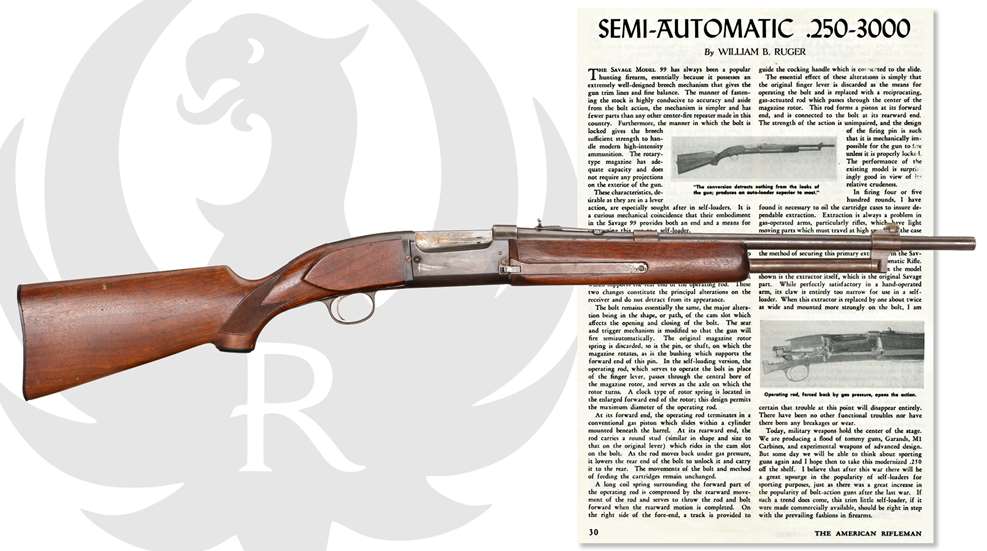
Ruger may be celebrating its 75th anniversary in 2024, but the first firearm designed and built by William Batterman Ruger, the semi-automatic Savage Model 99 conversion seen above, came some 10 years before the Standard Model debuted in 1949.
 At that time, though he had yet to embark on his career as a firearm designer, he was fascinated by the mechanical nature of guns, and he was especially enamored with the Savage Model 99 lever-action rifle. In Ruger & His Guns, Bill Ruger told author R.L. Wilson about his early exposure to firearms, saying, “I remember seeing them in the store windows, and they looked so beautiful, particularly the Savage 99 and the Winchester lever-action. The mechanics were so artistically designed. They absolutely thrilled me. I associated them with great adventure and great art.”
Ruger returned to the Savage Model 99 as a college student and endeavored to make something more of it. Ruger recalled that the conversion was done “sometime during 1938 or ’39 by the hacksaw and file method” and involved replacing the manually operated action lever with a gas-operated, reciprocating rod that passed through the center of the magazine rotor and cycled the action.
Despite acknowledging some issues with his gun’s extractor, Ruger considered the design to be an improvement over the original Model 99 and offered it to Savage Arms, which turned him down. Ruger later found employment with the Springfield Armory and then Auto-Ordnance during World War II, developing machine-gun prototypes that never came to fruition, but the Savage remained in his mind. In December 1943, he highlighted his conversion in a single-page article for The American Rifleman, concluding that “... after this war, there will be a great upsurge in the popularity of self-loaders, just as there was a great increase in the popularity of bolt-action guns after the last war.”
Ruger’s first commercially successful self-loader came, of course, in the form of a rimfire handgun rather than a centerfire rifle, first advertised in the August 1949 issue of The American Rifleman (seen below), but he kept the semi-automatic Savage. After Ruger’s death in 2002, Bill Atkinson, one of Ruger’s closest friends, was allowed to select a single gun from Ruger’s personal collection. He chose the Savage and immediately donated it to the NRA National Firearms Museum, where it remains on display today.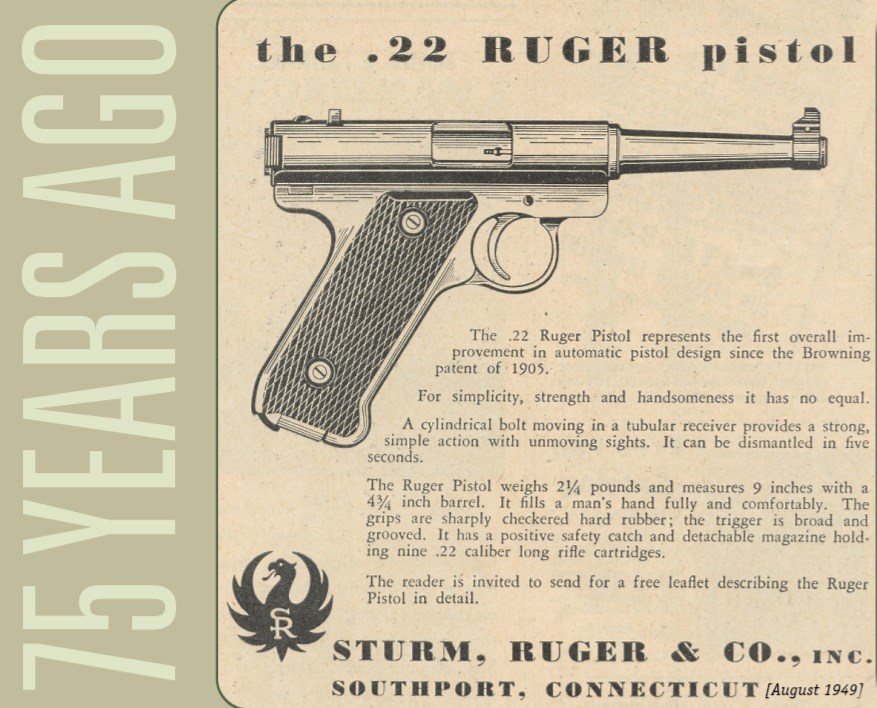
Most Popular