Colt’s 1949 announcement to discontinue its Single Action Army (SAA) inspired a few entrepreneurial individuals to fill the void left by the Peacemaker’s departure. Consequently, in 1953 (prophetically, the same year that Bill Ruger introduced his Single-Six), former aircraft engineer William Wilson, with investors including Los Angeles Rams owner Dan Reeves, established the Great Western Arms Co. at 9001-7 Miner St. in Los Angeles, to produce a full-scale, American-made replica of the SAA. Wilson, who had no previous firearm manufacturing experience, was company president.
The first guns, blued or casehardened and priced at $97.50, were assembled in May 1954 and admirably duplicated the Colt SAA. In fact, many parts were interchangeable, with exceptions such as the hammer, which was reconfigured to accommodate a Christy Gun Works floating firing pin (later, a Colt SAA fixed firing pin hammer was offered as an $8 option). Frames came from Arwood Precision Investment Casting—the same company initially used by Ruger. Barrels were supplied by Weatherby, which also provided testing facilities. Assembly and polishing were done in-house, according to the book, Great Western Firearms Company by John C. Dougan and Jim Hoobler (Andrew Mowbray Publishers, 2012). Although the first guns were rough in function (many were returned), eventually quality improved dramatically, inspiring Elmer Keith to praise the guns as better than “… any we have seen from Colt.”
Burbank, Calif., firearm dealer Hy Hunter became a distributor and promoted Great Western so aggressively that many erroneously assumed it was his company. Guns were presented to such notables as Audie Murphy, fast-draw champion Dee Woolem (who created a Fast Draw version), and John Wayne, who used his engraved pair of Great Westerns in “The Shootist.”
Unfortunately, in 1955 the simultaneous appearances of the Ruger Blackhawk and re-introduction of the Colt Peacemaker foreshadowed doom for Great Western, compounded by ongoing financial problems and changing corporate ownerships. In 1963 the company folded, having made approximately 22,250 guns, from Sheriff’s Models to Buntlines, plus do-it-yourself kits, and ranging in chamberings from .22 Long Rifle to .45 Colt, including the proprietary .357 Atomic.
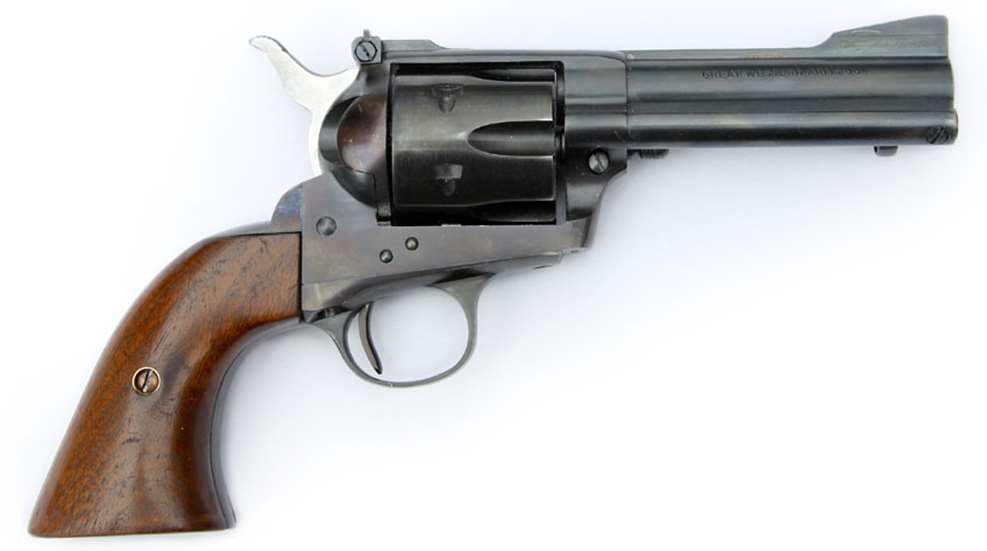
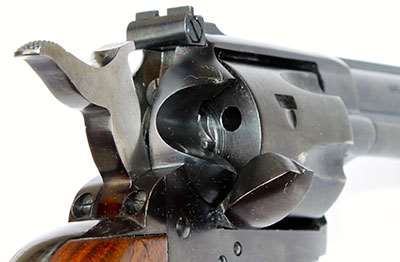
One of the rarest, with less than 100 produced, was the 4"-barreled “The Deputy,” featuring adjustable Micro rear and Bauman ramp front sights, a lowered hammer spur and some re-designed internal parts. Prices ranged from $75 to $137.50, according to chambering. Today, values are between $1,200 to $1,500, depending on condition. This 60 percent condition blued version in .22 rimfire was recently auctioned by American Gun Works, Glendale, Calif., (americangunworks.net) for $1,450. The gun was made in 1960 under Ferro Cast ownership, as no “GW” serial number prefixes were used from 1957 to 1960.
Most Great Western single-actions sported Porter plastic faux “stag horn” stocks. Due to lack of company records it is difficult to confirm if these walnut stocks are factory original. Note: Great Western single-actions were American-made, not to be confused with later Italian versions. Great Western also produced copies of the Remington Double Derringer.
Gun: Great Western “The Deputy” Single-Action
Manufacturer: Great Western Arms Co.
Chambering: .22 Long Rifle
Serial No.: 186XX
Manufactured: 1960
Condition: NRA Good/Very Good (Modern Gun Standards)
Value: $1,450*
* The Deputy carries a 100 percent premium over standard Great Western Frontier Six Shooters, which normally sell for $450-$600 in similar condition.
Most Popular