While the majority of revolvers used by the Yankees and Rebels during the American Civil War were single-action, a surprising number of double-actions, both foreign and domestic, also took to the field.
Some, such as the British Beaumont Adams and American Cooper, featured mechanisms that worked virtually the same as those seen today. The user could, in one motion, pull the trigger to cock, rotate the cylinder and fire the gun or merely cock the hammer by thumbing it back for more deliberate shooting.
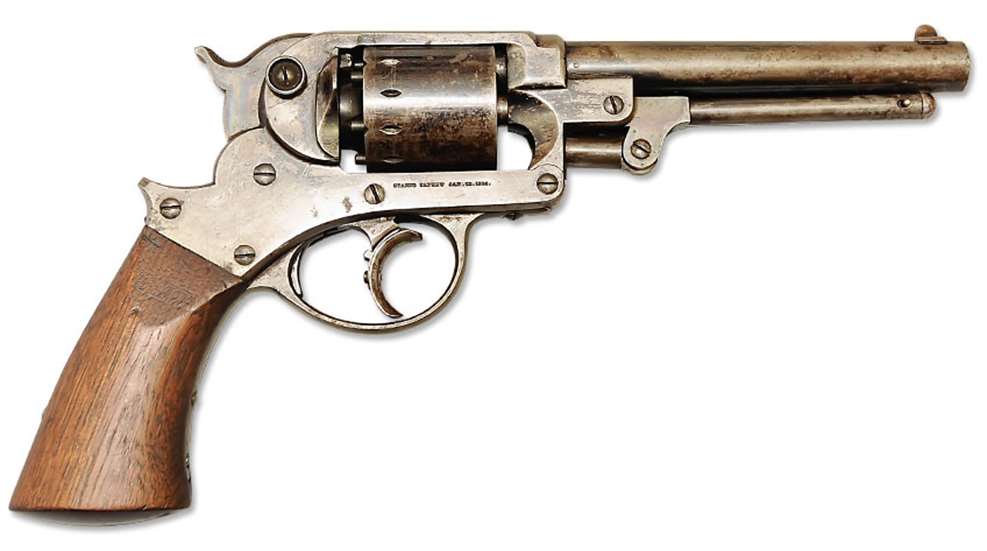
A few others, such as the Savage, Tranter and this month’s featured gun, the Model 1858 Starr, employed more Byzantine mechanisms to achieve single-action/double-action operation.
As its name eponymously implies, this six-shot percussion revolver was the brainchild of Ebenezer T. Starr, the scion of a well-known American armsmaking family dating back to the early years of the republic. As well as his revolvers, Starr was responsible for other interesting arms, including a breechloading carbine that enjoyed considerable popularity during the Civil War.
His revolver design was unique, though perhaps a bit too clever for its own good. Rather than a simple trigger pull or hammer manipulation, the Starr employed two controls, a forward “firing-lever” (which today we would see as a trigger) and back-mounted “trigger” which really was more like a sear.
Well-made and reasonably robust, the gun’s finish was blued and casehardened, and the stocks were of one-piece walnut. Its cylinder could easily be removed by unscrewing a knob at the rear of the frame and tipping the barrel assembly downward.
Starr’s manual explained the revolver’s quixotic operation in the following manner: “When loaded and capped, let the hammer down midway between the nipples, release the firing lever, and the cylinder will be securely locked and effectually guarded against any accidental discharge.
“The small slide on the [rear of the] firing lever being pushed up, the arm is ready for rapid firing by simply drawing back the lever to its extent. Then letting it go forward to its place, the operation can be repeated until all the chambers are discharged.
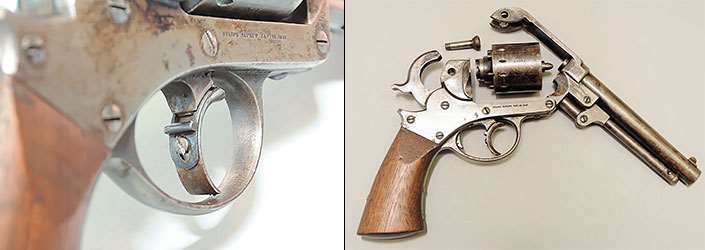
“When firing at leisure, move the slide down on the firing lever. The arm may then be cocked and the cylinder rotated as before by the lever, which being released, the discharge is effected by a fine trigger behind.
“The same may be also effected by drawing back the hammer and pressing lightly back at the same time on the firing lever to disengage it from the cylinder; and when at full-cock the hammer will be held by the trigger, or sear.”
If this sounds complicated and fussy, the author’s experience firing a Model 1858 verifies that it is. Still, around 20,000 “Army” (.44 cal.) and 1,900 “Navy” (.36 cal.) versions were eventually purchased by the Federals. Civilian sales were also undertaken.
Clever as the 1858 was, authorities preferred issuing simpler single-actions, so Ebenezer Starr was inveigled to produce an “improved” Model 1863 version of his handgun that dispensed with the double-action feature—not exactly a great testimonial to the efficacy of the original product.
The specimen we see here is in superb mechanical condition, has a pristine bore and retains at least 40 percent of its original finish. Accordingly, it is easily worth $2,500.
Gun: Model 1858 Starr Army
Manufacturer: Starr Arms Co., New York, N.Y.
Caliber: .44
Manufactured: c. 1861
Condition: NRA Fine (Antique Gun Standards)
Value: $2,500
Most Popular