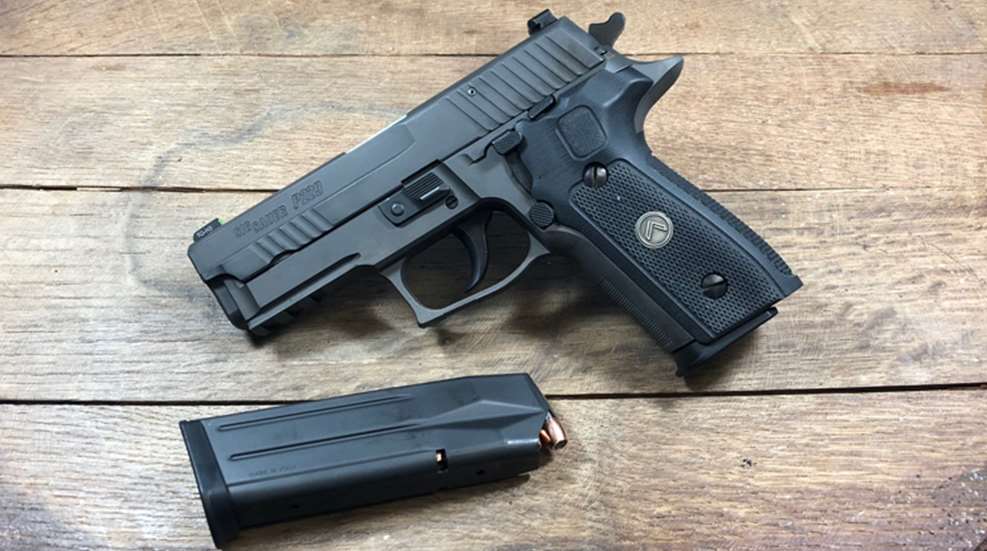
Recently, Sheriff Jim Wilson posted his thoughts regarding the practice of purchasing and carrying “pricey” firearms for personal defense, and I’d like to offer my perspective to the conversation. In particular, I’d like to address the pervasive sentiment—on anonymous Internet forums, at least—that it is foolish to buy or use expensive firearms because it may need to be used in a defensive shooting, and would subsequently be held as evidence by the police.
This is pure “Web Warrior” B.S. of the first degree, in my opinion, and here’s why. Let’s just say you own and carry a $1,500 firearm … Scratch that, let’s make it a $4,000 gun … Heck, let’s call it a full-custom, gold-inlaid, unicorn-tear-lubricated $15,000 one-of-a-kind pistol. Now, let’s just say you use said firearm to successfully defend yourself and your loved ones. Sure enough, the pistol is collected as evidence, and you have no way of knowing when or if you will see it again, or what condition it will be in once returned.
Even if you never see that gun again, that $15,000 was the best investment you’ve ever made. That tool empowered you to save your own life and the lives of your loved ones—frankly that’s a bargain, don’t you think? Especially when you consider that personal defense was probably a primary reason for buying the gun in the first place. Regardless of the price, when you buy a tool for a specific task and it performs as expected and gets the job done, that’s money well spent.
Regardless of the price, when you buy a tool for a specific task and it performs as expected and gets the job done, that’s money well spent.
Now, there is a different question that also informs this issue, and that I think many of the keyboard ninjas are trying—unsuccessfully—to convey, which is, “Do you NEED an expensive gun for self-defense?” The answer here is clearly, “No.” Used and maintained properly, a $250 gun is absolutely a defensive force multiplier. And I would much rather have a $250 gun in place of nothing, if those are the only choices my budget allows. All of this coincides perfectly with Jim’s assertion that you should buy and carry the best quality handgun that you can afford—and, yeah, higher quality commands higher prices.
In my experience, when dealing with reputable arms makers, guns that cost more feature higher-quality components and tighter tolerances of quality control yielding products that break and malfunction less. (Let’s be honest, every maker and every model experiences failures, but quality guns from reputable makers fail less and should be trusted more—reputation matters.) Beyond reliability, additional outlay might provide “quality of life” enhancements—better sights, better triggers, more ergonomic designs—which can help the user shoot faster or more accurately.
For those who are just getting started in defensive shooting, or gun owners looking for the “best” or “greatest,” I would recommend, instead, purchasing a “good,” reliable firearm from a reputable maker. Perhaps look at what law enforcement agencies are using, as a starting point. A good, service-grade defensive handgun will probably set you back $500 to $800. After that—and before you start looking for your next gun, or hundreds of dollars’ worth of upgrades and accessories to hang on your pistol—you should consider spending the same amount, or more, in range time, practice ammunition and quality training (again, reputation matters when it comes to instructors). I promise, if you put in the hours and ammunition to become proficient with a “good” gun, you are going to learn for yourself what you want in a “great” gun that will better suit your needs. And that gun, at any price, will be a good value if it performs reliably, and enhances your ability to defend yourself and those dear to you.
Most Popular