This year marks the 100th anniversary of America’s most significant combat in World War I, which introduced millions of “doughboys” to the bolt-action repeater, among other military innovations. After the Armistice, vast numbers of surplus 1903 Springfields were released onto the civilian market at enticingly affordable prices.
This gave birth to a new generation of early 20th century gunsmiths who began creating customized bolt-action sporting rifles out of what had been America’s much-respected service rifle. Names such as A.O. Niedner, Frank Hoffman and Ludwig Wundhammer became popular among a small cadre of serious sportsmen.
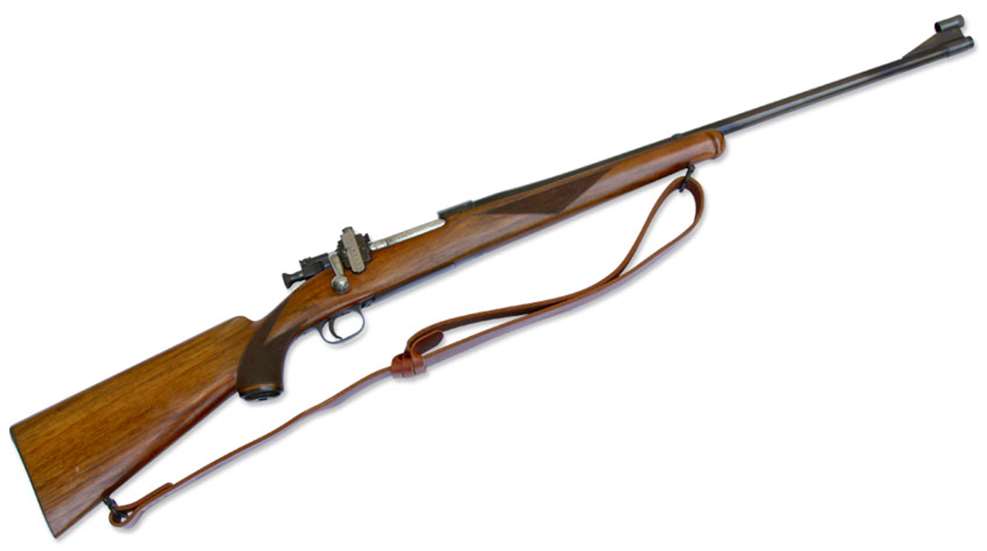
One of the more obscure craftsmen from this period was Reginald F. Sedgley, a Philadelphia gunsmith who formed R.F. Sedgley, Inc. in 1916, a company that remained under his ownership until his death in 1938. Sedgley was known for buying pre-existing actions—such as the remaining stock of Winchester High Wall receivers—and rebarreling and restocking them. His most prolific claim to fame, though, was purchasing Springfield actions, grinding off the markings, annealing and re-heat treating them, then rebarreling them with Winchester barrels. The barrels were stamped “R.F. SEDGLEY. INC. PHILA, PA. U.S.A.,” along with his circled “S” proofmark.
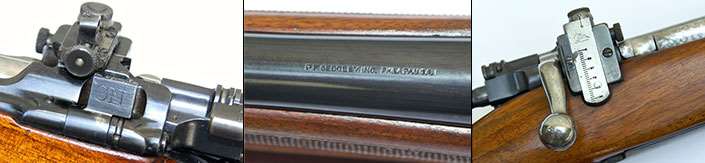
Sedgley rifles were stocked with attractive, but not overly fancy, European walnut. A typical Sedgley sporter was chambered in .30-’06 Sprg., had a 26" barrel, a distinctive hooded, ramp-based front sight, a Lyman No. 48 rear sight and sold for $65. A schnabel fore-end, checkered steel buttplate and hard rubber grip cap were standard, although rifles with fancier-grained stocks with a cheekpiece could be special-ordered for $150. Sedgley rifles have unceremoniously been called “the poor man’s Griffin & Howe,” but this does an injustice to an excellent custom hunting rifle of the period.
Although the late Michael Petrov, author of Custom Gunmakers of the 20th Century (Volumes 1 and 2), wrote that the highest Sedgley serial number he had ever encountered was 1621, the Sedgley rifle shown here is No. 7447. Chambered in .30-’06 Sprg. and with all the correct features (albeit with a modern aftermarket sling), it remains in excellent condition for a pre-war custom rifle. In March 2016 it sold at Lock, Stock & Barrel online auctions (lsbauctions.com) for $1,455, although similar Sedgleys have sold in the $1,650-$2,500 range, and rifles in chamberings other than .30-’06 Sprg. often bring higher prices. But with the growing awareness of early 20th century gunmakers such as Sedgley, values of these customized Springfield sporters may well increase.
Gun: Sedgley Springfield Sporter
Chambering: .30-’06 Sprg.
Manufactured: Pre-World War II (1920s-1930s)
Serial Number: 7447
Condition: 98 percent – NRA Excellent (Modern Gun Standards)
Value: $1,455: Lock, Stock & Barrel online auction price as of March 2016
Most Popular