Anyone who’s served in the U.S. military within the last 35 years or so should be familiar with the M16 rifle and the M9 pistol. Both are a standard for the American serviceman and both have worked well, albeit with some refinements along the way. It appears, for now at least, that the M16 will continue to serve on into to the future, but the Beretta M9’s time in service will soon be ending.
So what was wrong with the M9 and why was it replaced? Pistol training and technology has changed quite a bit since the 1980s when the M9 was adopted. Striker-fired pistols, uncommon 30 years ago, have become the norm, and for good reason. The striker system is generally more sealed with no exposed hammer slot that allows dirt and debris into the action. Without the hammer and related hammer strut and spring, the grip circumference can be reduced, thereby accommodating shooters with smaller hands. 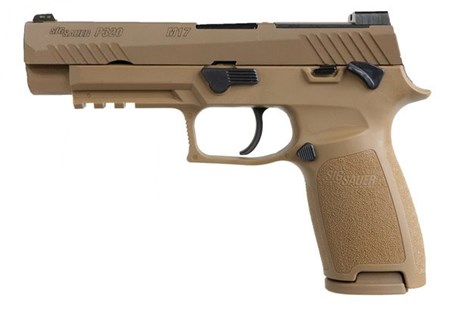 Additionally, the striker system usually results in a better and more consistent trigger. No more double action/single action transition after the first shot. The M9 uses an aluminum frame. Aluminum or steel frames were the norm in the 20th century but these materials have largely been replaced with polymer, which reduces weight and lowers cost. Another big minus for the legacy M9 is its lack of a frame rail. Without a rail there’s no easy way to mount a light or laser. With all this in mind, the Army had wanted to replace the M9 for quite some time. Other efforts, solicitations and trials have come and gone but the Army finally got it done and in 2017 finally announced the SIG Sauer P320, called the M17 in Army guise, as the M9’s successor.
The Army sought a replacement as part of its Modular Handgun System (MHS) trials. The goal was to replace the M9 with a modern pistol that could fill a number of roles. While the M9 might work fine for a tanker, infantry platoon leader or pilot, the same gun might not work well for a criminal investigator, general officer or soldier assigned to a plain-clothes assignment. In theory, the modular handgun should meet any mission requirements with a simple change of parts rather than the procurement of another handgun system. I've commented on SIG’s modular concept before and believe it offers a good deal of flexibility and options for those who need or want a pistol that can be scaled up or down or converted to different calibers based on personal preference, duty assignment or mission requirement. Along these same lines, plastic grip frames that are cracked or damaged from abuse or neglect can be replaced. A cracked plastic frame on most competing designs means the gun is bound for the trashcan. 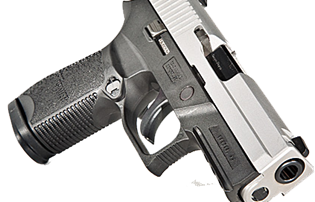
The P320 is actually an outgrowth of an earlier SIG firearm called the P250. Externally the two pistols look very similar. The P250 was the beginning of SIG’s venture into a truly modular handgun with the P250’s removable frame chassis. This chassis is the serialized component of the pistol and is considered to be the firearm by the BATFE. This chassis can be removed from the frame’s plastic grip shell, allowing the user to change grip length or girth with no tools or without buying another firearm. Like the P250, the P320 is also completely modular.
The P250 is a hammer-fired pistol and was introduced at a time when consumers were trending away from hammer-fired guns. SIG engineers, realizing the chassis system gave them a unique firearm in the marketplace, set about converting the P250 into a striker-fired gun, with the P320 being the result. SIG Sauer launched the P320 line in 2014 and it has quickly become the issued sidearm for numerous American law enforcement agencies, including the Texas Department of Public Safety and U.S. Immigration and Customs Enforcement. The pistol was also recently selected by the Norwegian government for military use. 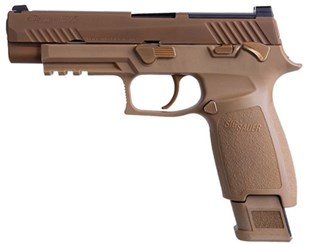
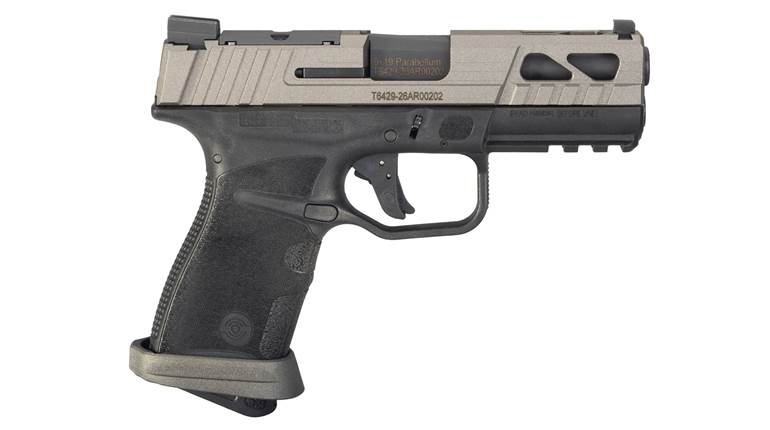
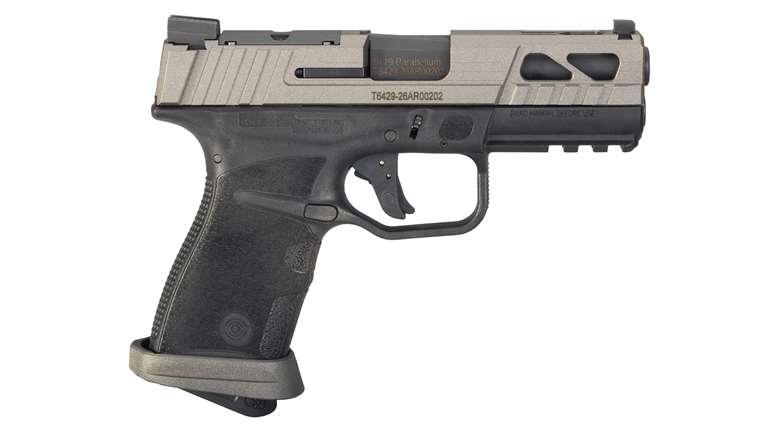
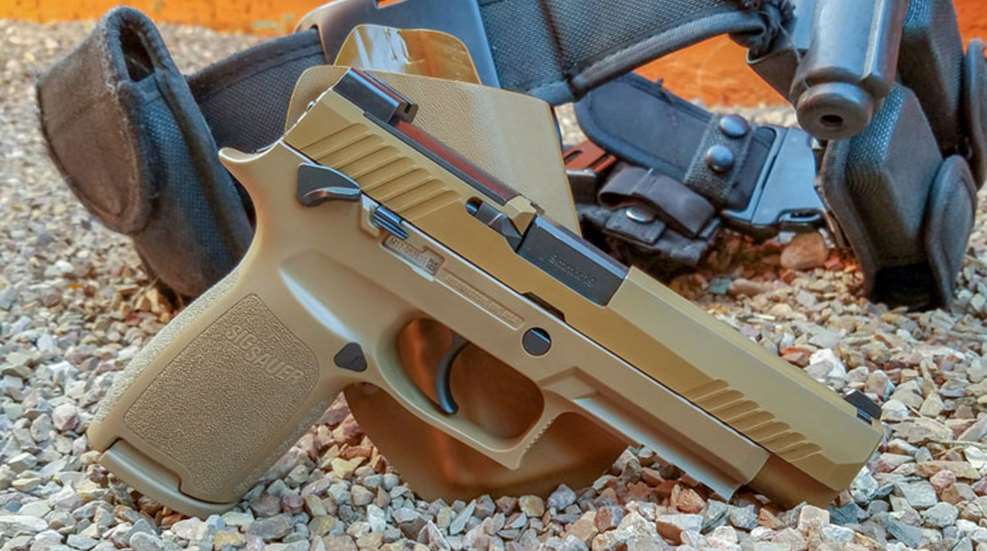
The SIG M17 civilian pistol is being offered in two different forms. The first model is called the M17 Commemorative (right) and has a limited run of only 5,000 pistols. The second is a standard production model called the P320-M17. The P320-M17 (top) looks quite a bit like the Commemorative, with a few differences. The most obvious difference between the two pistols is the color of the controls. The Commemorative has coyote tan controls while the P320-M17 comes standard with black controls. There are a few other minor differences such as slide markings, serial number format and style of red dot sight mount but the two pistols look very much like the Army M17 after which they are patterned.
As a student of the service handgun, the P320-M17 appeals to me. Being a standard catalog item, there is no concern about devaluing a limited production collector gun. It is a model that can be purchased, shot and enjoyed. Not to take anything away from the Commemorative, but I prefer handguns that can be used as tools rather than display pieces. 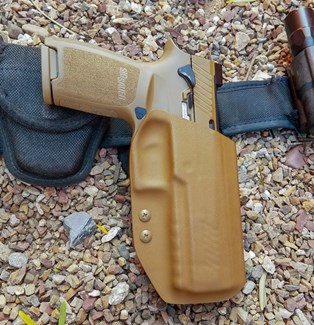
I was very pleased with the P320-M17’s accuracy during range testing. The pistol functioned perfectly off the bench and during shooting drills and produced consistently good groups in the process. As can be seen from the accompanying table, the pistol’s overall average was less than 2” from a distance of 25 yards. This level of accuracy is quite impressive for a “duty” handgun.
Fury Carry Solutions provided one of its range holsters for use with this review. The holster is nicely shaped and molded and fits the SIG well.
I did have an initial concern about the pistol’s frame-mounted thumb safety. The safety sits closely behind the slide catch lever. I was worried that shooting with my right thumb resting on top of the safety might interfere with proper operation of the slide catch. Fortunately that wasn't the case. Shooting the pistol with either the right or left hand with a high thumb grip caused no issue. Of course shooters who do not use a high thumb grip will have no worries at all.
Interestingly, we’re now seeing a return to our roots, as it were, with the M17 and its frame-mounted safety. America’s first and probably most recognized semi-automatic, the 1911, featured a frame-mounted safety that allowed the pistol to be carried in Condition One with a round in the chamber and the safety on. A quick downward flick of the thumb released the safety and prepared the pistol to fire. This thumb safety was replaced by the slide-mounted decocking lever on the M9. The decocking lever, in my experience, sits too high on the pistol to be easily manipulated. Furthermore, grasping the slide to chamber a round or clear a malfunction invariably forces the decocking lever down and renders the M9 inoperable until the lever is flipped back up. I’ve never been a fan of the M9’s slide-mounted lever and am glad to see the Army go with a more ergonomic choice.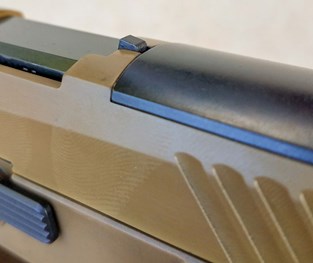
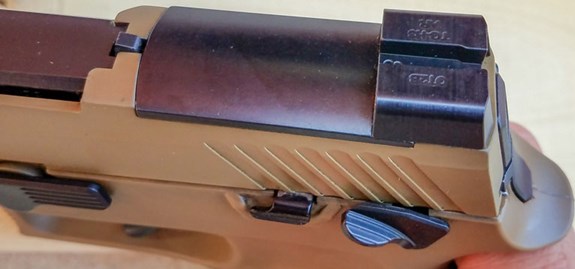
I do find it somewhat contradictory that SIG has departed, to a certain extent, from the modular concept with the P320-M17. With the addition of the frame-mounted thumb safety, the plastic grip module can no longer be swapped out with many of the size or color options on the market. The addition of the loaded chamber indicator in the slide means that a standard P320 barrel won’t fit without modification. These items will likely be dealt with both by SIG and the aftermarket, and I’m sure we’ll see threaded barrels cut to work with the loaded-chamber indicator and grip modules in various colors and sizes that are notched to work with the thumb safety. As a side note, SIG is offering two additional pistols that are inspired by the P320-M17. One is the P320-M17B, which shares the same specs and features but is finished in black rather than coyote tan. The other model is the 320F-9-M17, which is finished in coyote tan but lacks the manual thumb safety.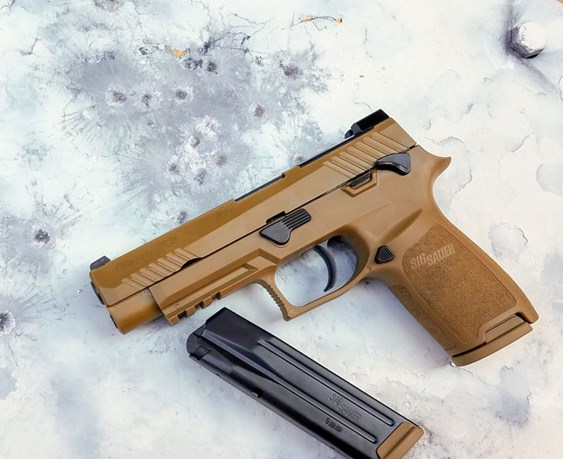
I’ll admit to being skeptical when I heard that the U.S. Army wanted to replace the M9 with the M17. Who could blame me? It seems nearly every week some news outlet or firearms blog is reporting that the Army is looking to replace one firearm in inventory with this, that or the other. Some of these stories are probably wishful thinking on the part of the author while others are probably half-truths or rumors started on the firing range or around the gunshop counter. There are a number of stories circulating now indicating that the Army is going away from 5.56 NATO in favor of some type of new 6.8 mm cartridge. Will this mean the end of the M16 or will this new 6.8 cartridge fizzle and be nothing more than some ideas on paper? We just don’t know and probably won’t for yet a few years. In addition, there had been several earlier attempts to replace the M9 with a different handgun but these efforts were unsuccessful for one reason or another.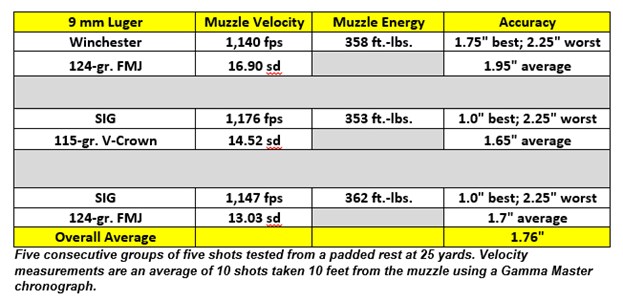
Detractors of the Army’s new pistol are quick to point out that the P320 is an unproven design that should have been passed over in favor of a more time-proven handgun. It is true that the M17 is new, but to say that the P320 is untested isn’t exactly correct. It may not have yet seen widespread combat use but it has, so far at least, proven reliable and accurate in police circles. Some other polymer-framed pistols on the market do have an enviable track record for reliability. But have the makers of these other designs rested on their laurels? Has a company like SIG outdone the rest of the pack with the P320? I think so. The Army has chosen and chosen well.
Specifications:
Manufacturer: SIG Sauer
SKU: 320F-9-M17-MS (other models available)
Caliber: 9 mm Luger
Action Type: Striker-fired
Sights: 3-dot tritium with removable optic plate
Slide Finish: Coyote tan PVD stainless steel
Barrel Length: 4.7”
Overall Length: 8”
Overall Height: 5.5”
Magazine Capacity: 17+1
Weight: 1.85 lbs.
MSRP: $768
Additional Reading:
In the Company of Soldiers: The U.S. M17 & M18 Modular Handgun Systems
M1152 & M1153: The Army's New 9 mm Luger Loads
Known But to God: The Unknown Soldier and the U.S.S. Olympia
NRA Gun Gear of the Week: U.S Army's New Pistol
Most Popular