Broad interest in the .45-70 Gov’t has waxed and waned repeatedly during its 130-year existence, but this bruiser of a cartridge has never died out completely thanks to support by a small but dedicated group of die-hard big-bore aficionados and to the range of interesting firearms chambered in it. From trapdoors to lever guns, single-shots to Gatlings, many different actions have played host to the .45-70 over the years.
But while most of these platforms have long since come and gone, Marlin’s Model 1895 is not only still alive and kicking, it remains one of the company’s best sellers. Over the decades, many iterations of the Model 1895 have been produced—varying mainly in terms of their barrel lengths, capacities and features—but in 2015, Marlin introduced what it designed to be the toughest, most weather-resistant variant yet: the Model 1895GSBL.
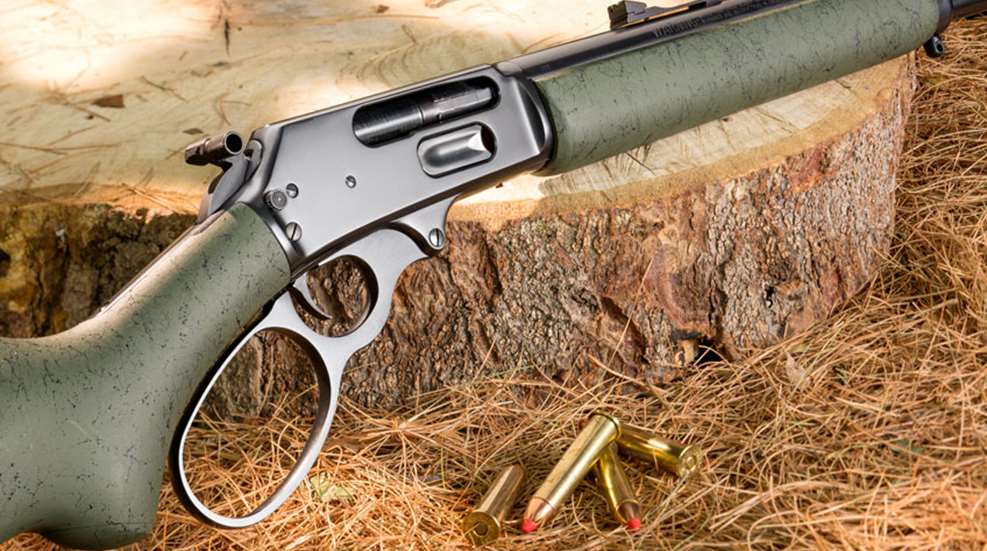
Although the green-and-black color scheme of the 1895GSBL may seem a bit unorthodox to many lever-action fans (traditionally a very orthodox bunch), the gun’s internals will be very familiar to those who have experience with other modern Model 1895s. Rather than start from the ground up with the GSBL, the engineers at Marlin chose instead to make a number of tweaks and improvements to the company’s already successful SBL model.
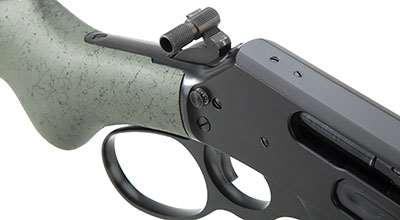
Remarkably similar to the design first introduced back in 1895, the GSBL is a lever-action repeater that functionally resembles Marlin’s Model 336. Cartridges are fed into the rifle via a loading port on the right side of the stainless steel receiver and are housed inside a tubular magazine mounted beneath the barrel. The magazine extends to just shy of the muzzle, and has room for six .45-70 rounds. The lever’s downstroke drops the locking block and draws the cylindrical bolt rearward, simultaneously cocking the hammer while the bolt-mounted extractor pulls the spent case from the chamber and the ejector expels it through the right-side ejection port. Concurrently, a cartridge is released from the magazine and is loaded onto a carrier. During the upstroke, the carrier lifts the cartridge into position where it can be pushed into battery by the returning bolt.
Like the rest of Marlin’s big-bore series, the Model 1895GSBL features a solid-top receiver, which makes for much simpler mounting of an optic compared to the various open-top lever-action designs, and the rifle’s receiver is drilled and tapped for such a purpose. An off-set hammer spur comes standard with the gun, and permits cocking of the hammer without potential interference from a low-mounted scope.
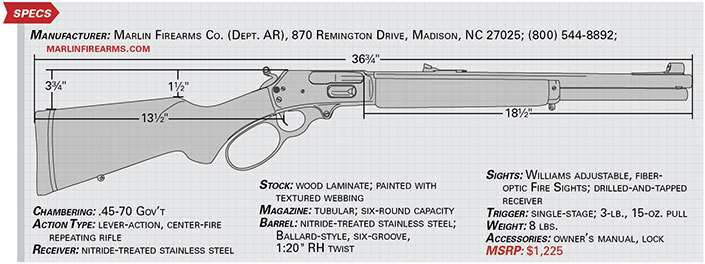
The gun’s round barrel measures 18.5", giving the GSBL a compact overall length of less than 37". A big loop lever provides plenty of room for shooters with large hands or those wearing gloves, and the pistol grip stock is ergonomically contoured to place the wrist in a comfortable position. The firearm’s 3/4" rubber buttpad is slightly curved in order to hug the shoulder and is checkered to provide a non-skid surface. All Marlin center-fire lever-actions since 1984 have had a crossbolt safety in the rear of the receiver above the trigger, and the GSBL is no exception.
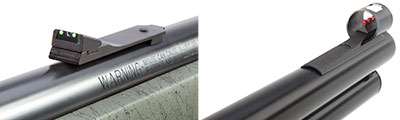
The Model 1895GSBL’s metal parts owe their blackened finish to a ferritic nitrocarburizing (FNC) process that further hardens the stainless steel, while also increasing its corrosion resistance. As it is a case-hardening process and not a coating, the FNC treatment has no impact on part tolerances. Whereas the SBL model utilized a ghost-ring rear sight and a scout rail, Marlin decided to supply the GSBL instead with Williams Fire Sights to help facilitate quick target acquisition and low-light use. The light-gathering, green fiber-optic rear sight (located forward on the barrel so as to not preclude the use of a receiver-mounted optic) is windage adjustable, and the hooded, red fiber-optic front sight is a fixed post.
In keeping with the theme of maximizing toughness, Marlin chose to go with a laminated hardwood stock and fore-end on the GSBL. Laminate is heavier than walnut, but it is also stronger, and the additional weight will be appreciated when it comes time to fire the gun. The wooden parts have been painted with a weather-resistant, proprietary green paint, and the standard checkering has been replaced with textured black spider web accents.
Some transitional Marlins—Remington bought the company in 2007—had problems with substandard fit and finish, but our evaluation gun exhibited no such issues. Wood-to-metal fit was well-executed, and the operation of the action was easy and smooth. The single-action trigger broke crisply at just under 4 lbs., with no discernible take-up.
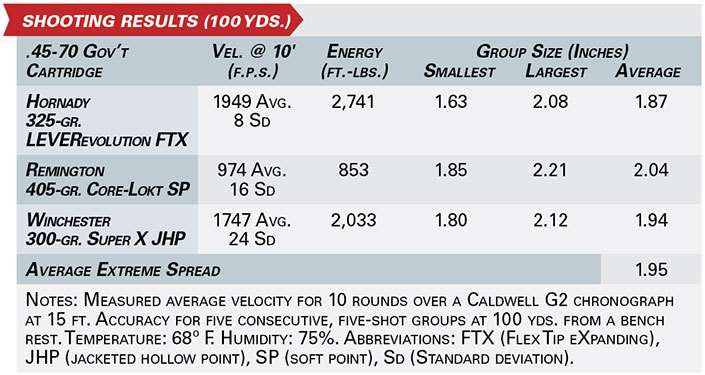
Function testing of this firearm was conducted using several different weights of .45-70 Gov’t loads and the 1895GSBL’s iron sights. The gun ran 100 percent regardless of bullet length or type. We then installed a Weaver Super Slam 1-5X 24 mm scope (mount sold separately) in order to conduct the formal accuracy testing. The rifle managed an average extreme spread of 1.95" at 100 yds., which is more than accurate enough for hunting deer, moose and similar-size big game at the ranges for which the .45-70 Gov’t is intended.
In regards to general handling, we found the Model 1895GSBL to be well-balanced, quick-pointing and, at 8 lbs., relatively lightweight. Recoil of the formidable .45-70 through the rifle is significant, but not uncomfortably so given the gun’s dimensions. The tactile spider web accents do provide some purchase on the gun during recoil, but we questioned whether the GSBL might be better served instead by more traditional checkering. All in all, the gun makes a handy, yet potent, choice for big-game hunting in thick cover.
The Marlin Model 1895’s history with the .45-70 Gov’t dates back to the days when it was still a black-powder cartridge, and while the GSBL variant is probably the most unconventional member of that venerable line, it is also likely the hardiest.
Most Popular