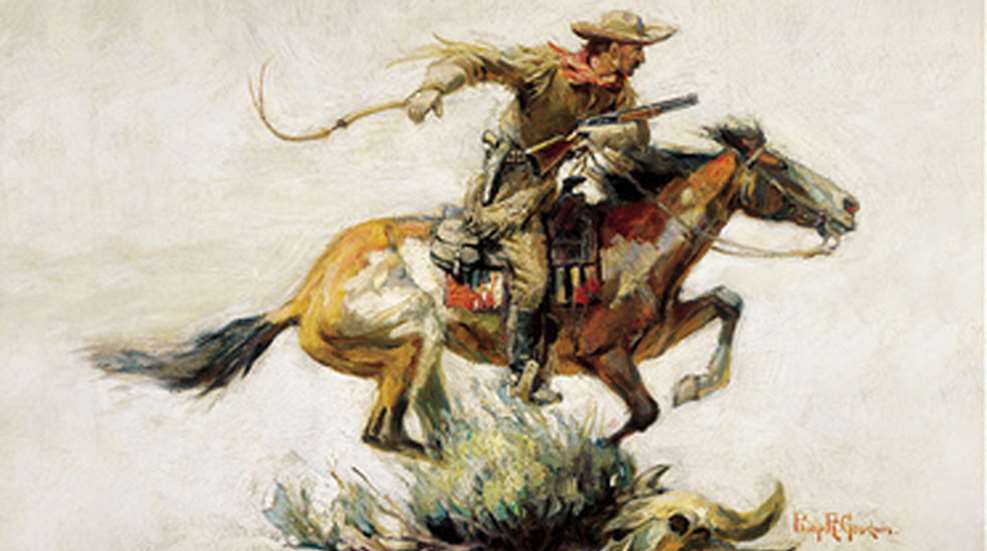
Three Hundred Words: Winchester's Horse and Rider

posted on January 18, 2016
** When you buy products through the links on our site, we may earn a commission that supports NRA's mission to protect, preserve and defend the Second Amendment. **
winhorseandrider.jpg

Somewhere along the Bow River near Banff, Phillip Goodwin sat with a sketchbook on his lap, trying to capture the ethereality of the mountain scenery. He’d been successfully painting wildlife scenes for years already but had never actually painted them in the outdoors. He was in the Canadian Rockies at the invitation of his friend Carl Rungius, a German who’d fallen in love with the North American West. Carl gave Philip the sage advice of an experienced outdoorsman: “As sure as you bring your paintbrush, bring your rifle, you’re bound to run into game on the day you don’t. “

Philip had forgotten his rifle. But that didn’t occur to him until he saw the Grizzly come up from the river some 40 feet from him. They both stood at the same time. A short staring contest ensued before both turned tail and ran in opposite directions. The fortunate ending to this surprise meeting influenced a later series of paintings by Philip revolving around unexpected predicaments, several involving bears.

Just a few short years later, the world went to war, an unexpected predicament of the likes that humanity had never seen, that brought the modern technological marvels of trench warfare, tanks, mustard gas, machine guns, airplanes, minefields, and shell shock. When it ended and 4 million doughboys began flooding home, America was suffering from fatigue and ready to turn back inward to find the good within itself.

The Winchester Repeating Arms Company, which made the arms for the Allied armies that won the war, was also ready to refocus. In 1919, they sought after and found the perfect symbol of a hopeful and resilient American spirit in Philip Goodwin. His painting of the horse and rider, cradling a Winchester rifle, has lasted as the Winchester (and American) symbol ever since.
Latest

Colt Detective Special Ihtog 1

I Have This Old Gun: Colt Detective Special

One of the iconic revolvers of the early 20th century is Colt's compact Detective Special, which became popular on the commercial market and was featured widely in film noir from the 1930s until the 1950s. But the road to the Detective Special wasn't the typical route for a new firearm.
The Real Deal: Mauser's M98 Das Original

In a world of modularity and strict cost-cutting, fine wood and machined steel firearms like the Mauser 98 are disappearing. The Mauser company is making sure the design lives on with the M98 Das Original.

’Merica! | America 250th Products from the Firearm Industry

From guns to knives to storage and beyond, show how your heart beats true for the red, white and blue as we celebrate 250 years of independence, liberty and patriotism with this assortment of commemorative products.

I Have This Old Gun: Witness to the Revolution

It is likely this Long Land Pattern Brown Bess was surrendered by British troops at Saratoga, then used to arm Americans in their fight for liberty before subsequently falling into private hands. Today, it remains as one of a scant few British muskets with a direct tie to the events of the American Revolution.

Rideout Arsenal Leaves Virginia

Rideout Arsenal recently announced it would be leaving the hostile political environment of Virginia for the Second Amendment-friendly state of Georgia.

The Guns of the American Revolution

Contrary to popular perception, the American Revolution wasn’t all muskets, bayonets and Mel Gibson running around with a tomahawk.

Interests


Get the best of American Rifleman delivered to your inbox.