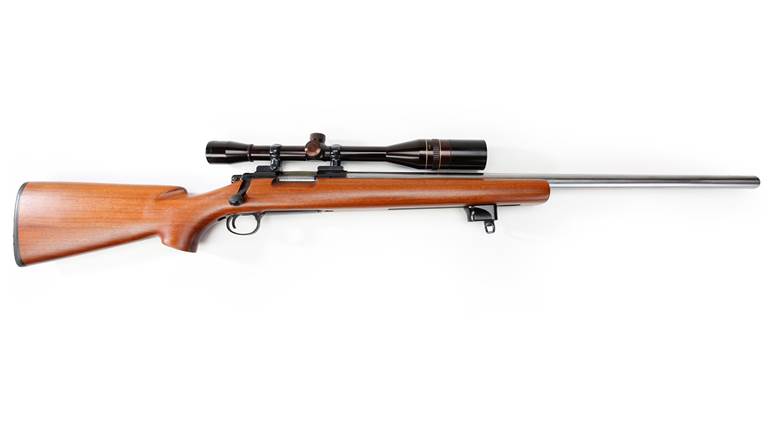
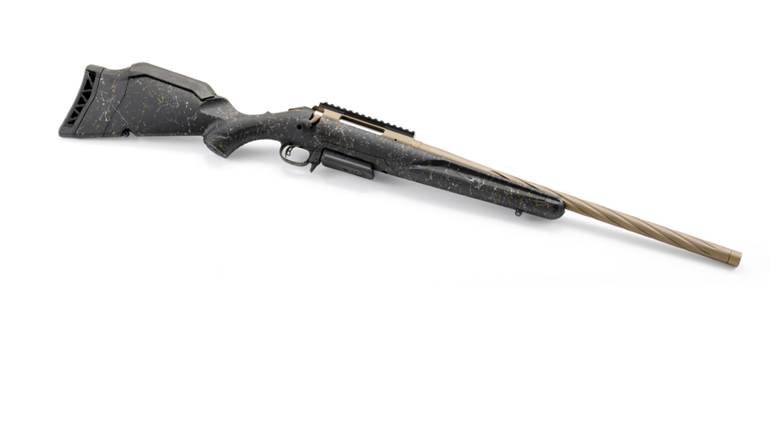
Kimber, with its Adirondack rifle in .300 Blackout, may have created the perfect tool for shooters and hunters preparing for a long, hard stretch in the wild with minimal gear. The Adirondack is a recent addition to Kimber’s bolt-action family, and by far the lightest at around 4 lbs., 12 ozs. The trim little rifle sports a stainless-steel 18" fluted barrel, and, attractive to fans of the increasingly popular Blackout cartridge, it comes with a threaded muzzle for suppressor compatability. While every conceivable ounce has been shaved from the platform, features that made the Kimber 84/8400 series a winner in big-game circles are here, including: controlled-round-feed action with full-length claw extractor; adjustable, clean-breaking trigger; and three-position Model 70-style safety. Despite the light weight, Kimber rifles are known for accuracy thanks to match-grade chambers and barrels. As with previous Adirondacks, the new variant is equipped with a tough Kevlar/carbon fiber stock dressed in Optifade Forest digital camouflage pattern, and that treatment is also used on factory-mounted Zeiss Conquest scopes in a special package offering. The .300 Blackout has proven both efficient and versatile in home defense, survival and hunting applications. While it typically burns less powder than standard 5.56x45 mm NATO loadings, available factory rounds in the 115- to 125-gr. range outperform the 7.62x39 mm at longer distances. As a hunting caliber, it has been compared with the .30-30 Win., and recent bullet technology improves what that once meant. Alternately, Blackout shooters can opt for subsonic, heavy-bullet (240-gr.) loads for close-in work. kimberamerica.com
Most Popular