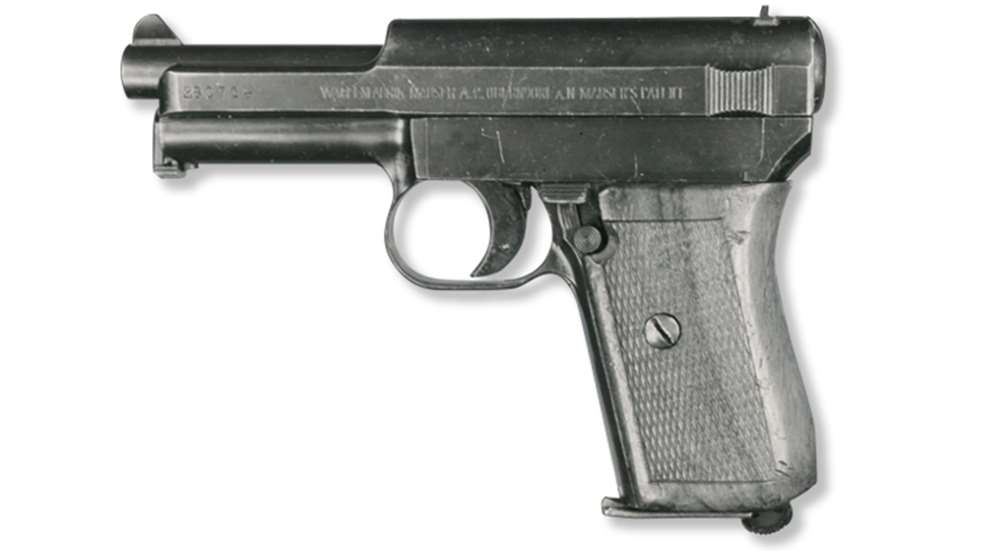
Q: I am looking for some help with a pistol I inherited from my grandfather. One of his brothers brought it home as a souvenir after World War II. The gun has no Nazi markings. To the best of my knowledge, my grandfather never fired it. Am I the lucky owner of something awesome or just fortunate to have inherited grandpa’s gun?
A: Your pistol is a Mauser Model 1914, which is chambered in 7.65 mm Browning (the American .32 ACP) cartridge. It is a slightly larger version of the .25 ACP Model 1910. The Model 1914, like the Model 1910, is a striker-fired, blowback-operated pistol. The Model 1914 has a 3.42" barrel and an eight-round-capacity detachable box magazine with its release on the frame’s heel. The rear of the striker protruded through the back of the slide, serving as a cocking indicator. There is a manual safety on the frame’s left, and the slide locks back on an empty magazine.
These guns were made from 1914 until 1934. A change to the shape of the grip frame resulted in the .32 ACP Model 1934, and the design was gradually replaced by the double-action Mauser HSc. The Model 1914 was a popular commercial gun in its day and was used through both world wars by various German police agencies and military units.
To me, any gun with a family connection is “awesome,” but you are fortunate in that the Model 1914 is a very interesting pistol.
From the thousands of questions and letters on guns, ammunition and their use that American Rifleman receives every year, it publishes the most interesting here. Receiving answers to technical and historical questions is a privilege reserved to NRA members.
Questions must be in the form of letters addressed to: Dope Bag, NRA Publications, 11250 Waples Mill Road, Fairfax, VA 22030-9400; must contain the member’s code line from an American Rifleman or American Hunter mailing label or membership card; must be accompanied by a stamped, self-addressed, legal-size envelope; and must be limited to one specific question per letter. Non-members may submit a question with a membership application. We cannot answer technical or historical questions by telephone, e-mail or fax, and we cannot place even an approximate value on guns or other equipment. Please allow eight to 10 weeks for replies.
“Questions & Answers” is compiled by staff and Contributing Editors: Bruce N. Canfield, Garry James, Charles Pate, Charles E. Petty, Matt Sharpe, John M. Taylor and John Treakle.
Most Popular