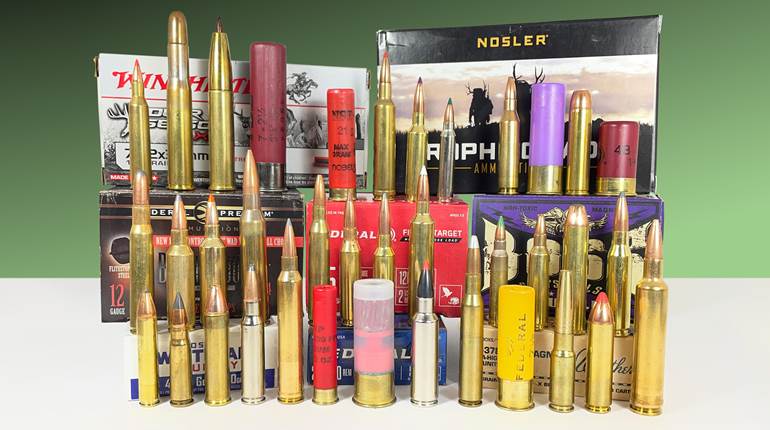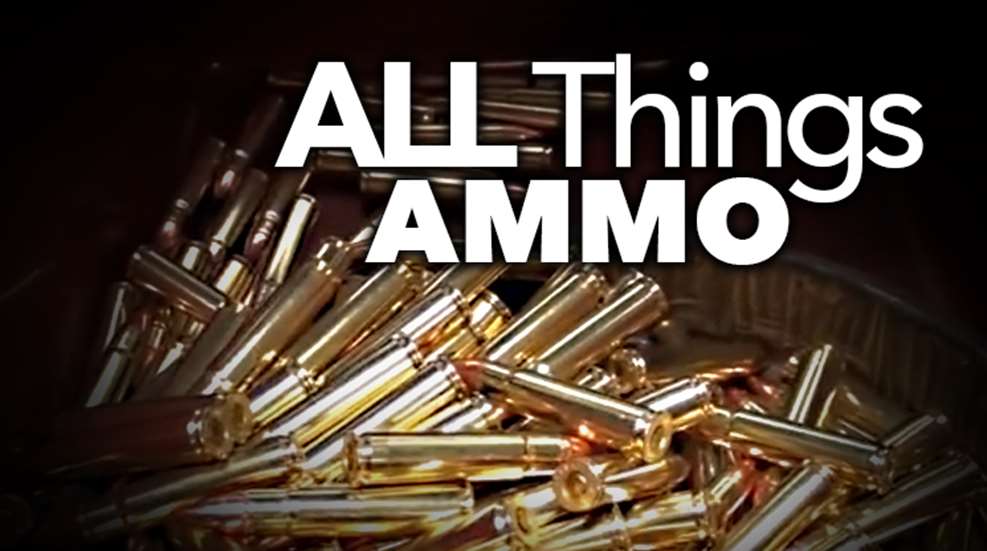
Manufactured by Sellier & Bellot in the Czech Republic and sold by Sidney, Neb.-based Cabela’s, Herter’s Select Grade Brass Case ammunition is an economical alternative to the traditional, cost-conscious “bread-and-butter” offerings. Available in most mainstream rifle and handgun chamberings, as the name suggest, the line features brass cases. Brass’ relative softness makes it “friendlier” than steel cases on critical firearm parts, such as extractors and ejectors, as well as offering reloadability. The latter alone should endear the ammunition to handloaders. Why? As with ammunition, so too has the cost of components increased; in fact, MidwayUSA sells 50-count boxes of new Winchester .30-’06 Sprg. component brass for $24, which equates to $0.48 per cartridge case. Cabela’s lists 20-count boxes of Herter’s Select Grade Brass Case .30-’06 Sprg. 150-gr. SPCE (soft-point cutting-edge) ammunition for $18, or $0.90 per round. So, for an additional $0.42 each, the rifleman gets a good-quality, reloadable brass case and time at the range or in the field.
As for projectiles, most of the rifle offerings feature standard, no-frills cup-and-core bullets in the soft-point configuration; however, there are more exotic offerings available, too, such as the aforementioned SPCE bullets. The .338 Lapua Mag. load has the “premium” 250-gr. Sierra MatchKing. Two bullet options are found in the handgun line; the 9 mm Luger, .40 S&W, and .45 Auto loads have full-metal-jacket bullets, whereas the .44 Mag has a 240-gr. soft point. Given the appropriate chambering is selected (i.e. .243 Win. or larger in most states), the soft-point loads would be sufficient for taking most North American big-game species-especially the commonly pursued whitetail deer.
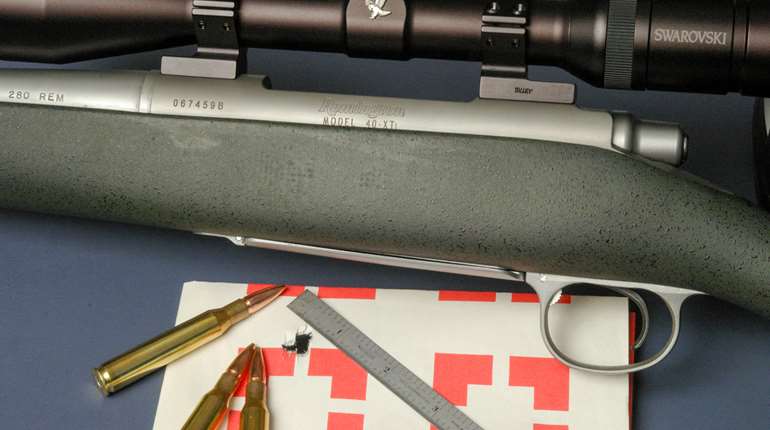
Desiring to evaluate the quality of Herter’s Select Grade Brass Case and share the findings with followers of americanrifleman.org, I requested three boxes of the 150-gr. SPCE .30-’06 Sprg. and spent an evening sending it downrange. The results: first, the Oehler Model 36 chronograph revealed that, from the match-grade-tolerance chamber and 24” barrel of a Kimber Sonora, the load averaged 2898 f.p.s. and the standard deviation was 19; the latter could be considered consistent with, if not slightly better than, other “value-priced” ammunition. As for accuracy, five-shot groups ranged from 7/8” to 1 3/16” at 100 yds.; 5/8” to 13/16” groups are pretty much “par for the course” with this rifle, so the groups produced by the Herter’s Select Grade Brass Case ammunition was slightly larger. Still, unless you’re a Camp Perry participant or “long-range” hunter, the load was sufficiently accurate. There were no failures to function, and the ammunition seemed to be no dirtier than any other brand.
This was by no means an exhaustive examination of the Herter’s Select Grade Brass Case ammunition line; however, having not experienced any reliability problems (as mentioned in several one-star reviews on Cabela’s website), and based upon the aforementioned results, as well as given its price, I consider it to a good, economical choice.
Most Popular