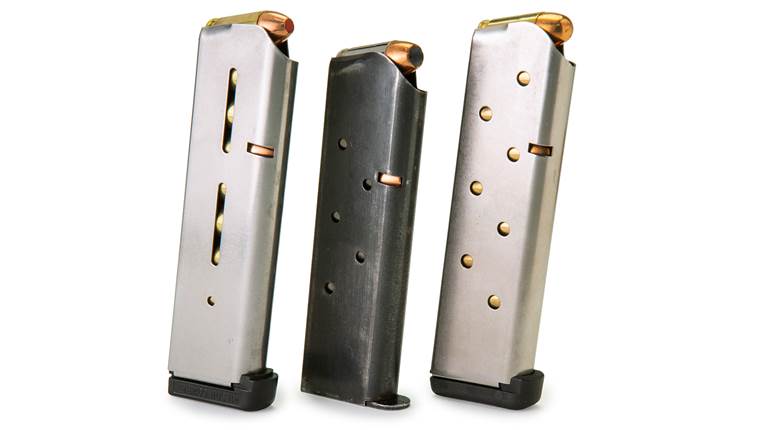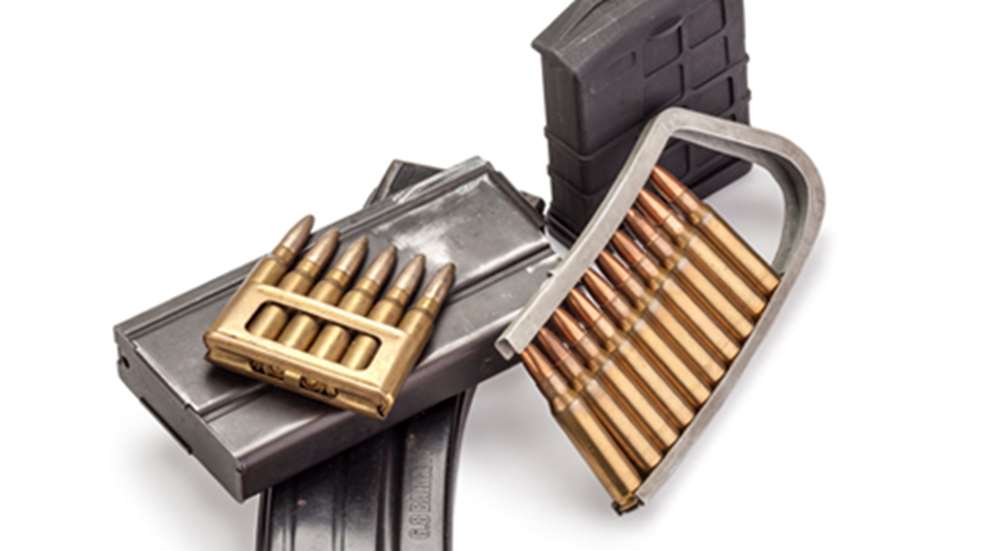
While at the range with some friends recently, the question was raised about the difference between a clip and a magazine. Some of the guys were very picky about this, insisting you should never call a magazine a clip. So what is the difference between a clip and a magazine? Which came first and how long have these terms been used?
The word “magazine” has been used for centuries to describe a place in which ammunition or gunpowder is stored. According to the Oxford English Dictionary the term defined as “A place in which a quantity of arms, ammunition or provisions is stored in time of war” dates to at least 1596. The use of the word as “A chamber for a supply of bullets” dates to 1744, again according to the Oxford English Dictionary,which was long before there were self-contained cartridges. It is hard to pin down exactly when “clip” was first used in relation to firearms, but “charger” appears in 1711 as “either bandoleers or Flasks that contain the powder.” Again, both terms already were in use before repeating firearms.
Today, when people talk about magazines, they are usually referring to a spring-loaded container for cartridges that may be an integral part of a firearm’s mechanism or may be detachable. When it comes to integral magazines-meaning not readily removable-common forms include tubular, rotary or box. Many popular repeating rifles have hinged floorplates to allow the magazine to be emptied with no need to cycle cartridges through the action. Then there are blind magazines in which there is no access to the ammunition except through the action port.
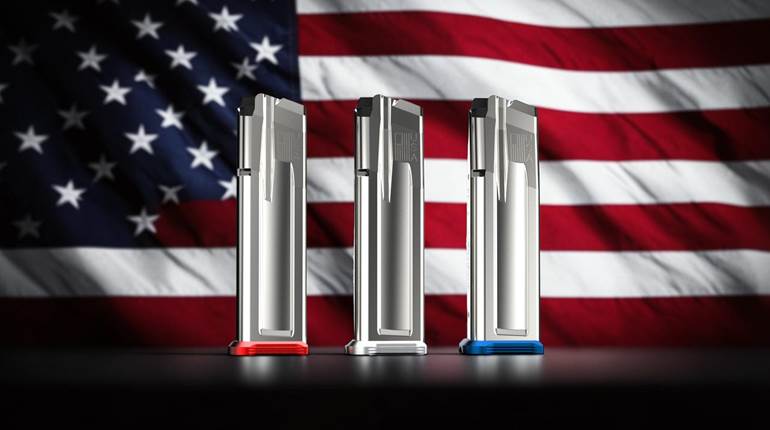
Although there are detachable drum magazines and detachable rotary magazines (i.e., Ruger’s 10/22), the most common form used in new rifles and handguns is the detachable box magazine, which is typically loaded before insertion into the firearm. Some do allow topping off from inside the action port, though.
“Chargers” or “charger clips” come in several varieties, including en-bloc clips that actually hold the cartridges and go into the gun and are part of the feeding mechanism. Notable examples include the eight-round clip for the M1 Garand (ejected out the top of the action after firing the last round) and those for military Mannlicher bolt-actions, the latter of which drop out the bottom of the magazine as the last round is stripped into the chamber.
Stripper clips are used to “strip” cartridges into the magazine of a firearm, such as in Mauser broomhandle pistols and Mauser bolt-action military rifles. These are not essential to feeding from the magazine, but they are a rapid method of charging it. And some stripper clips were intended to be used to fill detachable-box magazines while not in the gun, such as early 10-round stripper clips for the AR-15/M16.
There has been little consistency in what was called a charger and what was called a stripper clip over time. For example, when the British adapted the Short, Magazine Lee-Enfield, Mk III in 1907, older Lee-Enfield and Lee-Metford rifles were upgraded with charger bridges to convert them to “Charger-Loading,” meaning their 10-round, detachable-box magazines could be fed by stripper clips through the top of the action. Confused yet? Rifles such as the U.S. M14 have guides on their receivers to allow their detachable box magazines to be loaded by a stripper clip.
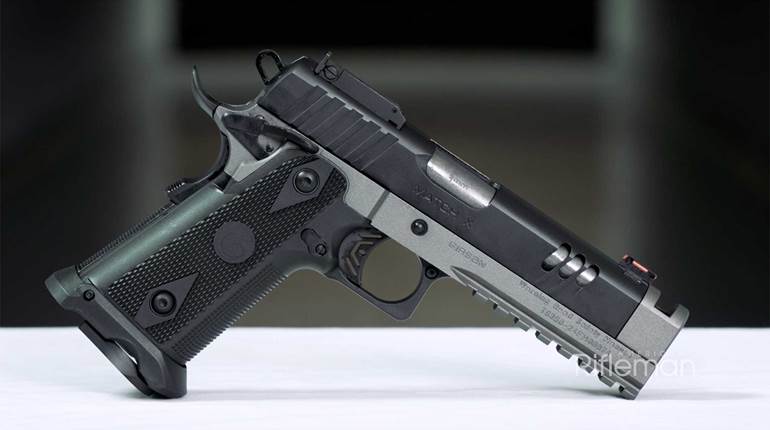
The bottom line is that both terms, clip and magazine, are used almost interchangeably today to describe a detachable device for feeding the action of a firearm. Before purists chime in, let me add that back in 1909 and 1910--as the United States was looking at adopting its first self-loading pistol for widespread issue--in U.S. Army Ordnance Dept. documents it referred to the detachable box magazine for what would become the U.S. M1911 pistol as, well, a clip.
Most Popular