Let's begin by clarifying terms as they relate to the defensive shooter. A "speed load" is accomplished when the pistol is empty and must be quickly reloaded in order to stay in the fight. A "tactical reload," also called "tac load," is appropriate when the shooter wants to top his gun off with a full supply of ammunition. This is true regardless of whether the defensive shooter is using a revolver or an auto.
With one exception, the tac load should only be used when the fight is definitely over. If the fight is an ongoing thing, the shooter should be shooting as long as he has ammunition in his handgun. At the point that the gun is empty, a speed load is the proper response to continue to be able to deal with the threat.
It has become en vogue in some action-shooting matches to require a tac load in the middle of a scenario. I suspect that this is done in order to require the contestant to demonstrate the he knows how to properly perform this drill. While tac loading may be fine in the middle of a shooting match, it can be a terrible mistake in the middle of a gunfight. It takes too much time, the potential to fumble ammunition is greater and, as mentioned, if you still have ammunition in the gun you need to be shooting.
The one exception to the use of the tac load in a gunfight would be if you are behind protective cover and, for whatever reason, you must move from that cover. And, I have to say that if you have obtained good cover it would have to be an overpowering reason to make moving a good idea. Still, it is an excellent idea to make sure the defensive handgun is fully loaded before moving in order to better deal with whatever threats are faced as you move into the open.
With a double-action revolver, the tac load is accomplished by opening the cylinder and slightly depressing the ejector rod. As the shells are partially lifted out of the cylinder, the empties are plucked out and dropped. Fresh ammo is then loaded from a belt pouch or speed strip.
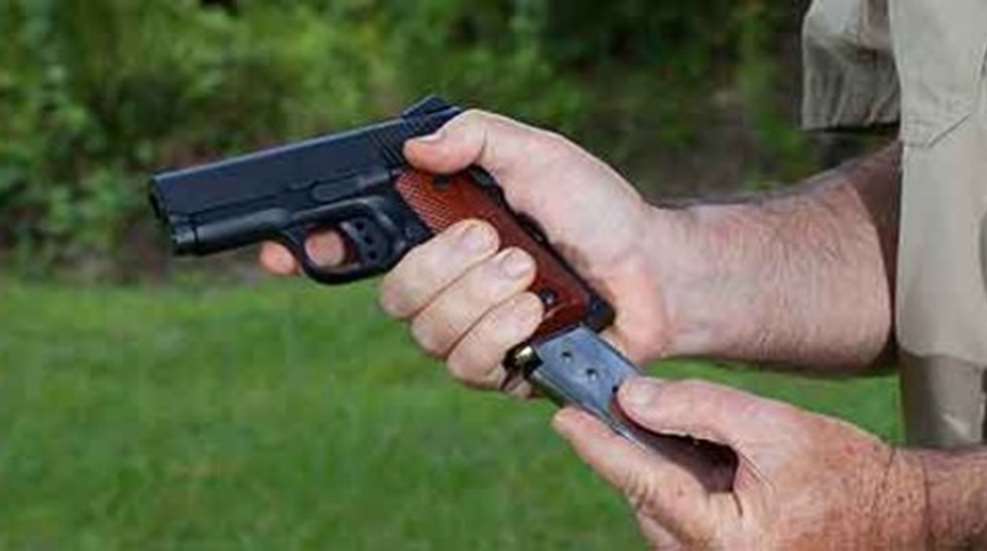
In the case of the semi-automatic, a fresh magazine is drawn with the support hand, holding the magazine between the thumb and index finger. The magazine in the pistol is not released until the support hand is there to catch it, usually between the little finger and ring finger. The fresh magazine is then driven home and the depleted magazine is dropped into a convenient pocket.
The biggest problem that can arise when doing a tac load in the semi-auto is that the shooter will fumble and drop a magazine. That's why I like to hold the full magazine between my thumb and index finger because it gives greater security. It you have to drop one of the magazines, let it be the one that is only partially loaded.
The tac load is an important skill every defensive shooter to learn. And it is just as important to know when to use it.