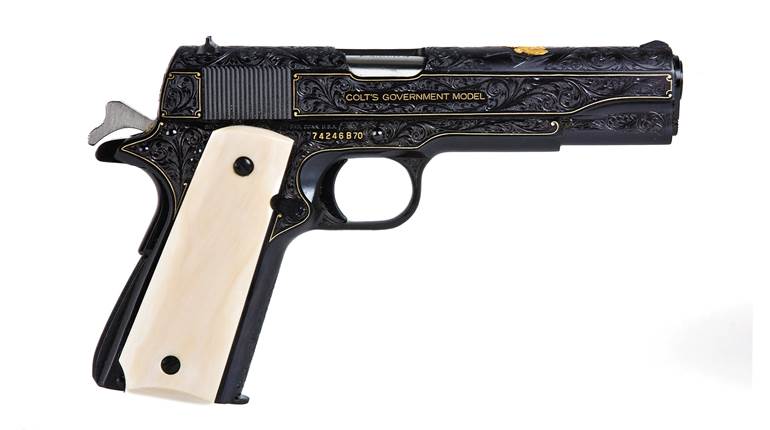
To my admittedly prejudiced hand and eye, the classic handguns are great examples of the saying that “form follows function.” Shaped for completely practical reasons, they are as efficient as they are beautiful. Like many tools, they exist for immediate but specific needs and are more often carried than actually used. As such, it is not surprising that some shooters decorate their tools. Some employ the services of artists who engrave the handgun’s surface, others like to use various forms of etching. I personally like to take advantage of a classic handgun characteristic that is fast disappearing. For me, fancy handles, scales, stocks or grips are the thing. In a world of very nicely shaped butt sections of moulded polymer, my eye—and hand—turns to the pistol or revolver with custom grips.
I’m always looking for new and exotic woods in pieces suitable for a known or as-of-yet unknown craftsman to turn into gems. Plain black walnut is excellent, as is Claro, French and English walnut. I have also used African Blackwood, Holly, Bocote, Myrtle, Cocobolo, Purpleheart and others. Recently, it has been some of the flashy North African wood—Amboyna and Thuya. It has all been a great deal of fun and not terribly expensive. On a few occasions, I have been able to put together the bucks for (legal) ivory and pearl, as well as stag, sheep and elk grips.
But recently, I have received back a pair of grips that are so beautiful that I have to share them with you. They are on a USFA SAA revolver in .45 Colt with the short 3 ¾-inch barrel. The gun is full blue and grips are in the one-piece style. The material is musk ox horn, which is exceptionally rare, especially in pieces big enough to make SAA revolver grips. In color, the material is a light cream with slightly darker streaks of butterscotch and off-white. To some degree, you can see the remains of the growth rings in the animal’s horn, which leads to the real beauty of the grips. Apparently, the horn grows in such a way as to produce wild swirls and streaks that are completely random. To the everlasting credit of the craftsman, he matched the curve of the Peacemaker grip to the grain curve of the material. He then cut and fitted them to absolute perfection. The artisan who did the work was Aaron Pursley of the Little Sharps Rifle Company of Big Sandy, Mont. Craftsmanship is alive in America, and one old musk ox did a pretty good job of growing these things.
Most Popular