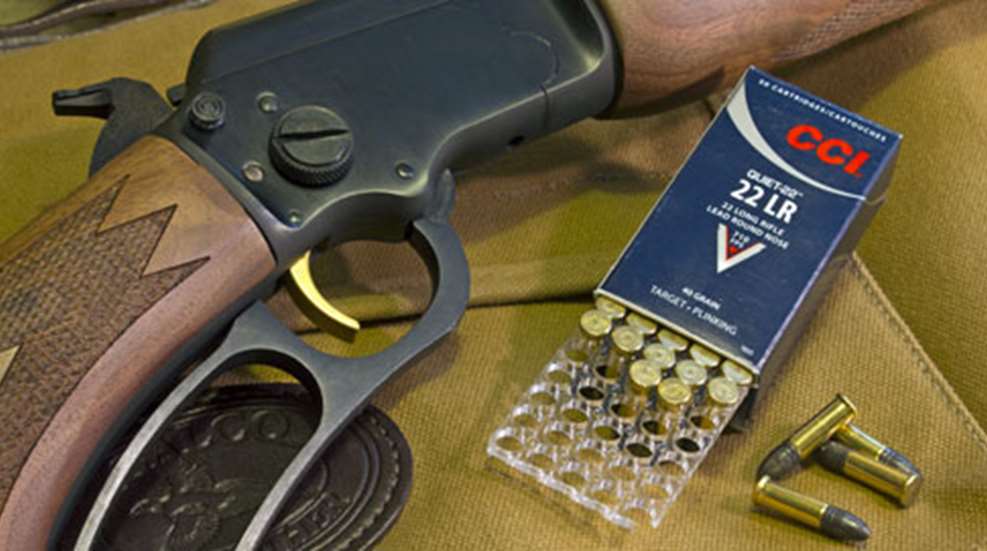
You would think that after 125 years, the .22 Long Rifle cartridge would've faded into obscurity. It would also be logical to assume that after a century and a quarter there would little room for innovation with this cartridge. Not true. The .22 Long Rifle remains the most popular cartridge because nothing is more affordable or fun to shoot. Manufacturers also continue to tweak it to offer more performance for various pursuits. CCI's new Quiet .22 load is a perfect example.
CCI's Quiet .22 load is designed to deliver about 68 decibels (Db) at the shooter's ear. This is about half the noise generated by high-velocity .22 LR ammunition and only slightly more than normal conversation. Sounds can be painful at around 95 Db and sustained exposure to noise in the 125 Db range, or even one time exposure to levels of 140 Db or higher, can cause permanent damage to hearing. When I was growing up hearing protection was rarely used when shooting and the incessant ringing in my ears is a constant reminder of that mistake.
While subsonic .22 LR ammunition—ammo with a muzzle velocity of less than about 1,100 fps—has been available for a long time, it generally comes in the form of expensive match-grade ammo or target rounds that are only slightly below the speed of sound. This means you either pay more for each shot or the noise reduction is minimal so as not to sacrifice velocity.
Velocity is an important component of external ballistics because it allows the bullet to maintain a flat trajectory. In short, it's what lets you sight your .22 rifle in at 25 yards and still hold on at 50 yards. In reality, a lot of the shooting done with .22 rimfires is attempted inside 50 yards and trajectory is not usually an issue. The .22 LR cartridge is also the most popular starter gun for new shooters and, for them, distance to target is not an important factor in their initial training. Rather, it’s about learning the application of sight alignment and trigger control.
A flinch is often the product of the noise produced when a rifle is fired. And, until that flinch is mastered, bullets will never land where they are intended. A friend's 10-year-old son is a perfect example. He is so sensitive to the bang that when shooting a .22 rifle it’s necessary to double up his ear protection.
CCI's Quiet .22 load is a solution. With a muzzle report that’s hardly louder than a clap, you don't even need hearing protection. And, it's accurate too. Out of my New Ultra Light Arms single-shot, bolt-action with a 20-inch barrel, the average for five consecutive, five-shot groups at 50 yards was right at 3/4 of an inch. My 12-year-old son was able to maintain the same level of precision with his sister's 16-inch barrel Marlin XT-22YSR with open sights at 25 yards. This is all the precision you need to train a new shooter or to maintain your own skills. And, you can do it without hearing protection in your backyard or anywhere else where loud noises might strain relationships with neighbors.
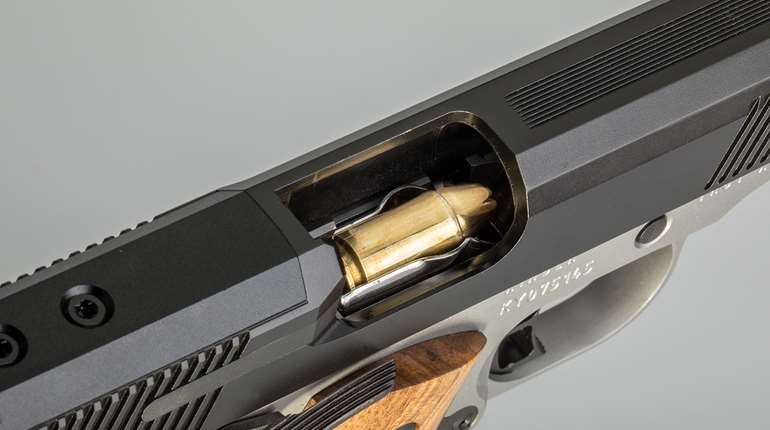
The down side is it's doubtful you'll find a semi-automatic handgun or rifle that will reliably function with CCI's Quiet .22 load. I tested the ammo in a Ruger 10/22, a Smith & Wesson M&P 15-22, a Chiappa M1-22 and a Kimber conversion kit for a 1911. The ammo would not reliably cycle the actions of any of these firearms. However, you can manually cycle the action and these super quiet .22 loads function flawlessly in bolt- and lever-action and single-shot firearms.
Is it affordable? You can find 50-round boxes online for between $2.49 and $2.69 at Midway USA and Cheaper Than Dirt. That averages to about a nickel a shot; about two pennies a shot less than CCI's standard subsonic .22 LR load, and about half what you'll pay for a box of match ammo.
Can you hunt with it? Well, on squirrels and similar size game, CCI's Quiet .22 load should work fine out to 25 yards or so, if you can make head shots. This load uses a round-nose lead bullet that will not expand, so head shots would be the only reliable option. The good thing is; this ammo shoots well enough that if you miss the head, it'll be your fault. Of course, this stuff is so quiet you'll likely get another shot.
Most Popular