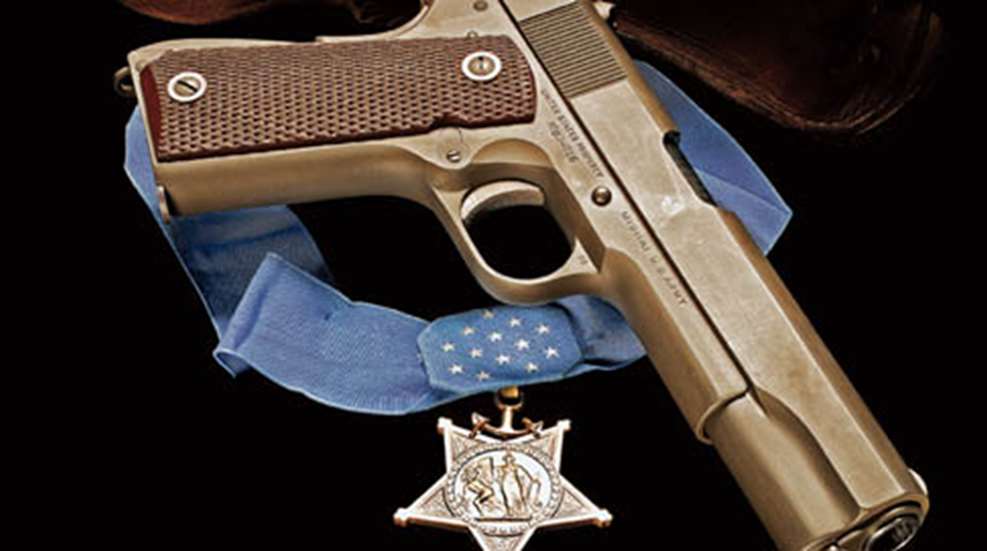
Joe Foss was a friend of mine. Of course, hundreds or thousands of other people can honestly say the same thing. I have never known anyone else with such a large, devoted circle.
In 2000 I learned that Joe was selling some of his firearms. Apparently nobody knew how many there were, least of all Joe himself. His wife, Didi, has always said that Joe could pass up anything but a garage sale or a gun shop, and obviously it was true. There were more shotguns than anything, but the inventory was taking up considerable space in the garage. Clearly it was time for a house clearing.
Having known Joe for years, I called and said I was interested in seeing what was available. I was mildly surprised when he said he still had the last M1911 pistol that he carried on active duty. Even though he had owned it in the Air Force rather than the Marine Corps, I didn’t mind at all. (Joe’s M1911 from World War II is currently on display in the M1911 Centennial Exhibit at the National Firearms Museum in Fairfax, Va.) Shortly thereafter I drove to Scottsdale to purchase Joe’s pistol.
Apparently Joe hoped that I would relieve him of more than the .45, as he knew I was a hunter. In fact, I was preparing for a trip to Zimbabwe the following month. But the African expedition ate into my discretionary funds, and the price of the Colt was fairly steep. Consequently, I said that I was only able to take the pistol.
Joe disappeared into his crowded study—only he seemed to understand his filing system—and I heard him rummaging around. After a few minutes he emerged with the M1911 in a G.I. flap holster. My heart sank a little as I envisioned decades of holster wear. Joe handed me the prize, which I saw was a stock M1911A1 in excellent condition. I turned away, dropped the magazine, locked the slide back (Rules One, Two and Three: After all, Joe Foss was watching!) and visually checked the chamber. I then pointed the muzzle at the carpet and pressed the trigger. Not bad: a crisp five-pound let-off.
I asked Joe when he obtained the pistol, and he said it was issued to him on active duty during the Korean War. He was a colonel with Air Defense Command in 1951-52, made brigadier general in 1954, and still had the Colt when he retired from the Air National Guard in 1975. As a general officer he was able to take his sidearm with him, but he probably had not shot it since. I wrote him a check and he gave me a signed certificate of authenticity, establishing the gun’s provenance. I also had him sign a sheet of paper with the serial number and date, which I countersigned, further removing any future doubt.
Upon returning home I checked the serial number, italicized “No_ 834016”, and found that Joe’s pistol had been produced by Colt in early 1942. The rear of the slide beneath the firing pin retainer bears “834” above the hole and three numerals below, matching the frame number. The slide contains the standard patent dates on the left side while the receiver bears “UNITED STATES PROPERTY” and “M1911A1 U.S. ARMY” on the right, plus the assembler’s number on the trigger guard. On the left side of the guard the Parkerizing is fairly thick, barely revealing a “K” above an inverted triangle (the Colt proof) with what appears to be a “P”.
Inspector’s marks on the frame are “WB” beneath the slide stop and proofmark “P” near the magazine release. The “WB” indicates Col. Waldemar Broberg, Army Inspector of Ordnance at Hartford, reportedly from July 1941 to June 1942. The slide has a “P” proofmark forward of the rear sight, as does the barrel above the link pin.
The Parkerizing on the Colt is easily 98 percent, with the barrel deep blued, the bore extremely clean. Since there is no arsenal stamp indicating rework, the finish apparently is original. I can only conclude that Joe’s pistol had never been issued before he received it. There’s faint holster wear on the front of the slide and receiver, and the left side of the slide has a narrow quarter-inch scrape in the finish. The firing pin retains vestiges of Parkerizing.
Stocks are brown plastic without markings. The G.I. magazine, originally blued, is bare metal over the top 1½ inches or so. The holster is faded brown leather marked “Boyt” and “-42-” on the rear.
People ask if I shot Joe’s pistol. Well, youbetcha’. I cleaned it and fired a magazine’s worth of factory ball ammunition. Then I cleaned it again, oiled it, and put it in a silicone-base storage sock with the documentation nearby.
When I handle Joe’s pistol, I visualize isolated moments, almost like a stop-frame video. Joe Foss was the most genuine celebrity I ever met; he did not know the meaning of pretense. As his son Dean says, “With Joe there was never an unspoken thought!”
The thing about Joe was that he truly enjoyed people. He treated everyone exactly the same, from presidents to janitors. I learned that first-hand after the 1985 NRA Annual Meetings when Didi designated me OICJ: “Officer In Charge of Joe.” We were to meet her car out front of the arena, and it was my task to steer Joe through the inevitable crowd of friends and well-wishers. We broke clear about 40 yards from the exit, and I was just congratulating myself when a custodian pushing a broom hailed us. “Governor Foss!” Immediately Joe turned 40 degrees to port, making for the gentleman. I said, “Joe, Didi’s going to be double-parked.” I will never forget what Joe said: “If somebody wants to meet me, I’m gonna’ meet him.”
Joe strode up to the janitor and shook hands. They passed a few moments comparing geographies (the gentleman was from Minnesota) and Joe disengaged in time to meet Didi curbside. That was Joe Foss
Maybe I’m imagining things, but when I pick up Joe’s old Colt pistol, that bone-deep, essential South Dakota farming goodness seems to emanate from it.
Most Popular