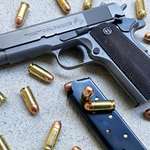
I have been involved in several marathon shoots that gunzine editors take such delight in ordering. One was with a rifle (Colt H-BAR), another was a disaster with a gun that was quickly withdrawn from production and one more was with a Sig P220 .45. This last one was easily the most memorable. The project consisted of a crew of volunteers running 10,000 rounds of high-quality Black Hills ball ammunition through the gun in one day-long session. We could have done it quicker, but I insisted on being fair to the gun, as well as finding out some interesting stuff along the way.
We took the pistol right out of the carton at the range and wiped the shipping oil off before checking to be sure that it was properly lubricated for extended shooting. Then we mounted the gun in a Ransom Rest, fired a few settling shots and before firing a 10-shot group “for record.” After this, we took the pistol out of the Rest and fired two cases of ammo through it (1,000 rounds) by hand using relays of shooters and several guys loading magazines. At the one-grand point, we stopped, let the gun cool, cleaned it and fired another 10-round group from the Ransom Rest. This procedure went on until we had completed ten full cycles. The accuracy started to deteriorate at around 7,000 rounds and was pretty bad for the last group after 10,000 rounds. But I later discovered that the poor grouping was not the gun's fault. We got most of the primer residue and powder fouling out of the barrel at each cleaning. However, you can't shoot that much and that fast without plating the bore grooves with copper from all those bullets. In an at-home cleaning session, I was able to remove all of the copper fouling, at which time it was back to the range for another session with the same ammo. The last group was just about the same size as the baseline group we fired right after breakfast of the first day. In other words, we didn't hurt that barrel; we just burnished it smooth. It was an amazing performance by that high quality pistol.
I also learned other things at that shoot. I found out what really happens with the first-shot flyer syndrome. This is the tendency of almost all automatic pistols to deliver the first shot from a magazine to a spot away from the rest of the shots in the magazine. This particular pistol wanted to shoot the first shot out of the group at 7 o'clock. So the first shot on paper was low and left by about an inch. At 1,000 rounds, the first one was about three-quarters of an inch out of the major group. It was a little closer for each successive group until about 5,000 round mark, when the first one was in the group—on its lower left edge. The first one stayed at that relative position through the end of the shoot. I had always believed that the first shot flyer syndrome went away as the gun wore in. This shoot pretty well proved it.
Most Popular