Since 1990, U.S. Optics has been making scopes engineered to withstand the most rigorous operating environments. U.S. Optics refuses to sacrifice strength and ruggedness for light weight, small size or low price. The company’s scopes typically have main tube walls from 0.080 inch to 0.100 inch thick, lens retaining rings permanently locked in place with epoxy, hardened steel clicker rings, tungsten carbide detent balls, and dual windage and elevation rebound springs. Coil springs are used, and the scopes are waterproof to 33 feet, .50 BMG-shockproof, dustproof and nitrogen-filled to prevent fogging, and all glass surfaces have a proprietary multi-coating.
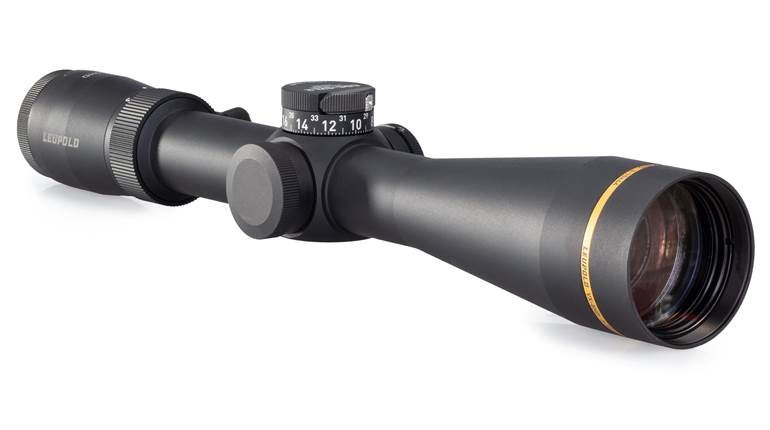
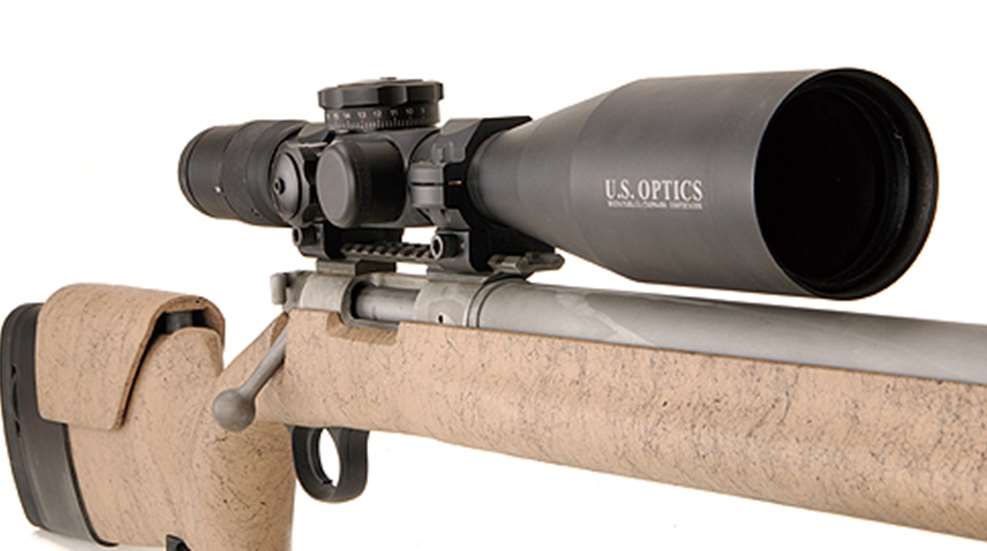
For tactical or long-range target work, the firm’s premier optic is the SN-3 5-25x58 mm T-Pal scope. It offers a turret parallax adjustment, a 58 mm objective and a reticle in the first focal plane. Our test scope incorporated an optional 35 mm tube, EREK elevation knob, and illuminated GAP Mil-scale reticle.
The 5-25x58 mm T-Pal features a left-side parallax focus knob and a rapid-focusing eyepiece, which offers adjustments of -3.5 to +3 diopters. Other features might not seem as familiar. For example, the knob at the right front of the saddle is a rheostat offering 11 levels of reticle illumination.
The scope’s U.S. No. 1 1/4-m.o.a. windage knob offers a zero point and markings from 1R to 5R in the right direction and 1L to 5L in the left direction. There are 48 1/4-m.o.a. clicks, or 12 total m.o.a., of windage per revolution of the knob. Perhaps the most salient feature of our test scope was its oversize EREK (Erector Repositioning Elevation Knob) knob atop the saddle. To use this system the large, outer elevation knob is bottomed out and then an inner reticle elevation screw is adjusted to achieve proper elevation zero at the minimum desired range, such as 100 yards. By doing this, the entire range of elevation adjustment is available to compensate for drop at greater distances. The elevation knob changes impact by 90 1/4-m.o.a. clicks (22½ minutes) per revolution.
We mounted our test scope on a custom F-Class rifle in 6.5 mm-.284 Norma, using a Nightforce Picatinny rail and 35 mm U.S. Optics rings. The adjustment of the EREK elevation knob was simple and quick. The 1/4-minute windage and elevation clicks were accurate, easily felt and repeatable; the scope passed the shooting the square test with flying colors. The image through the objective was as bright, clear, sharp and distortion-free as anything we’ve seen through a scope, and the GAP Mil-scale reticle, though not as thin as a true target crosshair, was fine enough for accurate shooting. The scope was subsequently mounted on a .338 Xtreme Tactical rifle, an arm designed to engage targets at a mile or more. Silhouette targets, set at 2,000 yards, were easily and clearly seen through the scope, and easily quartered. As we expected, the scope also passed our other torture tests, including extended water immersion and freezing.
We found nothing we could suggest to improve the performance of our test scope, although we might have liked a bit more than 2.7 inches of eye relief at 25x magnification. Although the price may seem exorbitant, it is actually comparable to that of other premium-quality tactical/target scopes.
Most Popular