From the July 18, 1894 issue of Shooting & Fishing, the predecessor to American Rifleman
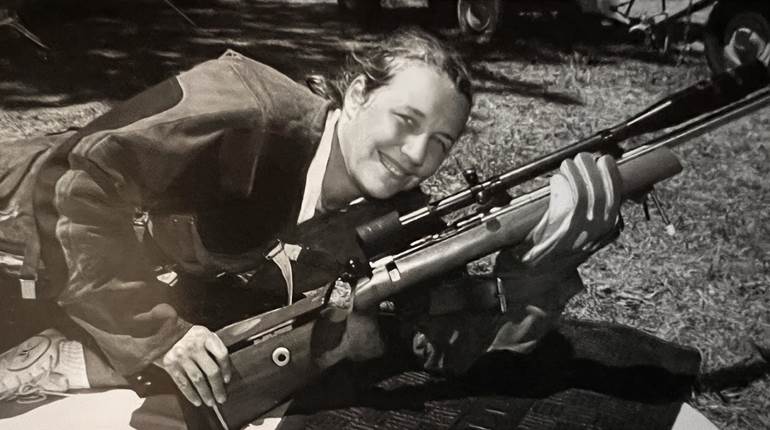
It was the pleasure of your correspondent to be present at a partial trial of one of the Krag-Jorgensen military rifles at the range of the Denver Rifle Club last Saturday. The rifle, No. 9, was sent to Adjt.-Gen. Tarsney by the Government. Lieut. Byrne, of Fort Custer, Col. Hogle, of the N.G.C., and Capt. J.N. Lower were present. The ammunition used was the .30 caliber cartridges made by the Winchester company. The first shooting was done at 200 yards from a bench rest. There was scarcely any wind noticeable. The rear sight on this rifle is similar to the usual sporting leaf sight, but has notches on the base, and the slide has a spring which was intended to hold it firmly in the notched base. There is no provision made for windage, and the sight is marked “300” as the lowest elevation in yards.
The first shot fired struck the target at 11 o’clock corner, counting 1; a second shot went in the same place; the third a miss over the top of the target. The spring on the sight sprang forward from the recoil at each shot, changing elevation each time to 400 yard mark. The rifle was then aimed on right edge of target, the shot counting 2 at 11 o’clock; three more shots went in same place. Mr. Lower then fixed the rifle, aiming about five feet below and five feet to the right of the bullseye, and scored several fair shots.
The barrel was examined, and showed little fouling, but was very hot.
Leaving the sight at 300 yard mark, the rifle was fired at 500 yards, the bullets striking two feet high and about eight feet to left.
With sight at 300 yard mark the rifle was fired at 300 yards from back position, but the bullets all went over target when aimed at the bullseye. Fired at 1000 yards with sight at 800 yard mark, the bullets struck about thirty feet to left, some going high, others low. By this time the trial was given up in disgust. The barrel was clean and bright, but excessively hot. The lands showed no ragged edges, as in the Winchester single shot rifle tried some two weeks ago with same ammunition, an account of which was given in Shooting and Fishing of July 5. Some of the shells stuck badly. Five bullets were found in butts back of 200 yard target. All showed the imprint of the four lands in the jacket, and also the deep crease of the shell where crimped around the jacket; two were found on top of the ground with points flattened slightly; one showed jacket cut around where crimped in shell and doubled in center; one dug out of four inches of earth had gone through jacket, was mushroomed slightly and bent double, its jacket being found behind it, turned almost inside out; the last one was found in about four inches of earth, its point gone, and it was slightly mushroomed and had a small shred of the steel jacket clinging to it.
Aside from the penetration, range, absence of fouling and rapid firing of this arm, there seems to be many faults. The first one is that the sights cannot be lowered below the 300 yard mark, which in above trial showed about 600 yards actual elevation; there is no lateral movement to either sight; the front sight is so high that, unless held level, the shots will go wild; at each shot the sight springs from 300 to 400 yard mark, and must be pulled back to its place. The fault of shooting several feet to left of object aimed at can, of course, be changed with considerable work.
Suppose the soldier under fire has placed five cartridges in the magazine and forgets to close the cutoff, intending to use the arm as a single loader. He places a cartridge in the carrier, but neglects to push it entirely into the barrel. Pushing the bolt forward, a cartridge is lifted from the magazine and wedged under the one in (or partly in) the barrel, necessitating some time to extricate the two, even if an explosion does not occur.
Should a hunter buy a rifle and go out on a trip with it, and find that he must aim several feet to one side and under his game in order to kill it, he would undoubtedly bring the rifle back to the dealer and demand the return of his money, or a rifle with which he could hit something.
-Denver, July 10
Most Popular