It was customary for more than a century to read about new firearm introductions first in the pages of American Rifleman. Now, you will likely find them here on AmericanRifleman.org, Facebook or some other digital platform first. When we broke the news on Facebook about the diminutive new Mossberg MC1sc polymer-frame 9 mm pistol, less than an hour later, one of our followers, Jeremy M., commented “Go to bed Mossberg, you’re drunk … .” I can assure you that the engineers who developed Mossberg’s first new handgun in a century were not inebriated at the time. It will be the April cover story as written by Executive Editor Joe Kurtenbach, or you can read about it, and see a video, now at americanrifleman.org/mossberg/mc1sc.
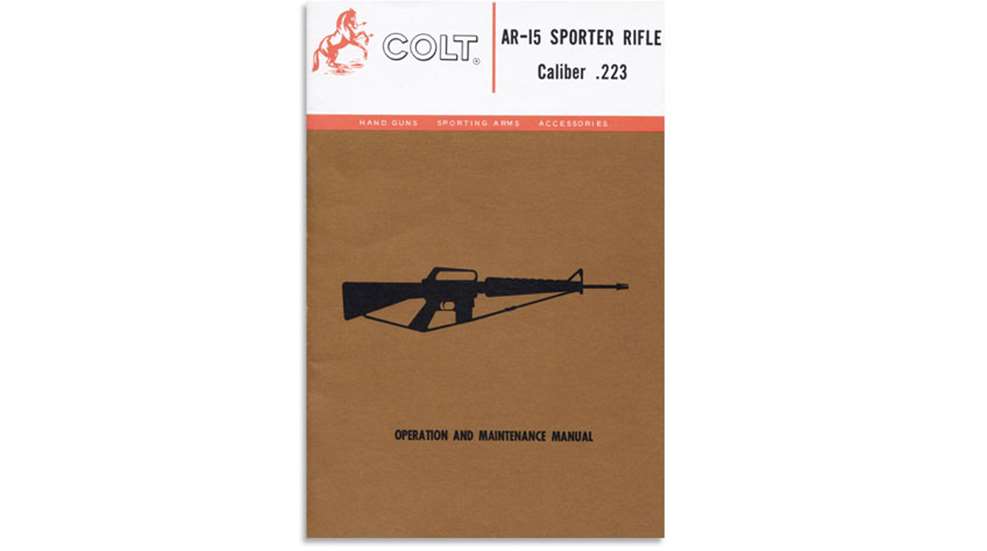
So, what did the blogosphere and Twitter trolls think of the AR-15 when introduced by Colt’s? Nothing. Crickets. Absolute silence, because the commercial version of the AR-15 was introduced in 1963. There was no Internet. Al Gore was still in high school.
But there was The American Rifleman. And, as always, we reported on new firearms of the day, with the AR-15 being covered by then Editor Walter J. Howe and Associate Technical Editor Col. E.H. Harrison. In the gunwriting world of the day, these were the big guns. Although a preliminary test of the AR-15 as made by ArmaLite appeared in the June 1959 issue, this was the first review of the rifle as made by Colt’s. “The management of Fairchild Engine & Airplane Corp. decided to divest themselves of the AR-15 rifle. License to produce the AR-15 was acquired by Colt’s Patent Fire Arms Manufacturing Co., Inc.”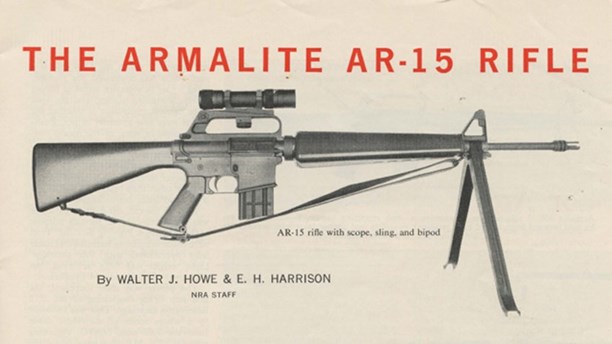
While the article, which you can read at americanrifleman.org/firstcoltar15, covered the concept and design of the selective-fire gun (meaning both semi-automatic and full-automatic capability)—especially its .223 Rem. cartridge—there was some foreshadowing of where the military version of AR-15, shortly dubbed the M16 in 1963, was headed. “In December 1961, The Rifleman staff team visited Colt’s ... in Hartford, Conn., where AR-15 rifle production is being carried on in the same plant where Colt’s handguns are made … . There appeared to be no special production problems in the present operation.
“Production at that time was at the rate of 1,000 rifles per month … Colt’s states that tooling for production of 20,000 rifles per month could be completed within three months … . It is the frequent experience that quantity production rates are not reached at the time expected or without difficulties, nevertheless the above does give an indication of what is possible at Colt’s.”
That makes basic AR platforms, as offered commercially, more than a half a century old. In this month’s issue Field Editor Jeremiah Knupp tells the story of the evolution of the AR with a 20" barrel as a rifle, which seems to have been forgotten by many who have made the basic AR platform the most popular center-fire rifle in America.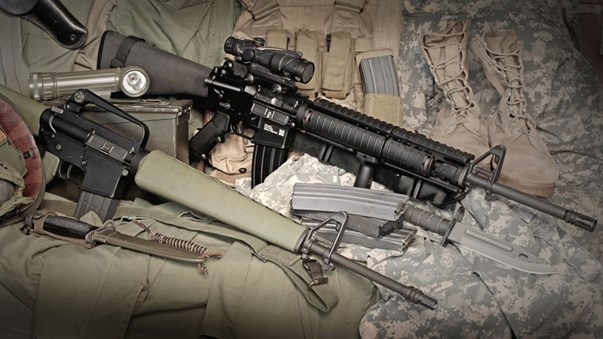
By 1963, Colt’s began offering the semi-automatic-only AR-15 SP1, which has become quite a collectible gun more than a half-century after its introduction, and we have an “American Rifleman Television” segment on it at americanrifleman.org/ihtogsp1.
And if you like the lines of the retro AR, as personified by the SP1, rather than the M16A4-looking FN rifle featured on the cover of the March issue of American Rifleman, then you have some choices. Knupp also covers Brownell’s first foray into rifles, the BRN-601. Then there are the truly “Retro Reissue” M16A1 rifles—semi-automatic-only, of course—offered by Colt’s that look exactly like the guns that rolled off of the West Hartford plant floor back in the 1960s. You can find out about them at colt.com.
Most Popular