In 1897 a 28-year-old lieutenant of the artillery in the Japanese Imperial Army—one Kijirõ Nambu—had been assigned to work with noted Japanese firearms designer Nariakira Arisaka on what was to become the Type 30 rifle. Soon the young Nambu would be promoted to major and tasked with developing a semi-automatic pistol for the Japanese military. A first prototype locked-breech, recoil-operated pistol chambered in an 8 mm cartridge came about in 1902, often referred to as the Type A or Grandpa Nambu.
Few of the Type A pistol were produced. For one thing, Japanese officers were expected to purchase their own sidearms at the time, and the pistol was expensive to make. Most of the original Type A pistols were sold commercially to China and Siam. The Nambu pistol has a passing resemblance to the P08 Luger, but internally it shares more design features with the Mauser C96. Along about 1906 or ’07 a modified Type A pistol with a larger trigger guard capable of accommodating a gloved hand and featuring magazines with aluminum bottoms instead of wood, and lanyard loops retained in rings replacing the old welded loops was introduced. Sometimes referred to as the Papa Nambu, this modified pistol enjoyed some praise from Army Minister Terauchi Masatake, but, again, the cost of production and prevailing notion of officers supplying their own pistols kept it from being formally adopted by the army.
The Type A Nambu was a 31 3/4-oz. pistol with a 4 5/8” barrel. Ballistics of the 8 mm Nambu cartridge were a 102-gr. FMJ, 8 mm (.32-caliber) bullet from a bottlenecked case at 950 fps, producing 202 ft.-lbs. of muzzle energy. Its stopping power is about that of a .380 ACP.
By 1909 a smaller—approximately three-quarter-size—Nambu pistol chambered in a 7 mm cartridge called the Type B debuted. Referred to as the Baby Nambu, it was thought that its smaller size and lighter weight would be better received by the army, but although the Tokyo Artillery Arsenal put the Type B into production quickly, it, too, never caught on very well, due to being approximately twice the cost of an imported pistol. According to the Japanese Army’s Kaikosha military outfitting business, the list price of the Type B Nambu was 180 yen, while a newly commissioned Second Lieutenant’s monthly salary was 70 yen. About 450 of the first Type B pistols featured a wooden magazine bottom and a single-diameter firing pin. Later pistols were produced with an aluminum magazine bottom and a multiple-diameter firing pin. Virtually all of the Type B pistols were purchased by Japanese army officers. Production of the Type B ceased in 1923, though pistols were assembled from parts as late as 1929.
Ballistics of the 7 mm Nambu were a 56-gr., 7.08 (.28-caliber) FMJ at 790 fps, yielding 80 ft.-lbs. of muzzle energy—roughly the equivalent of the .32 ACP.
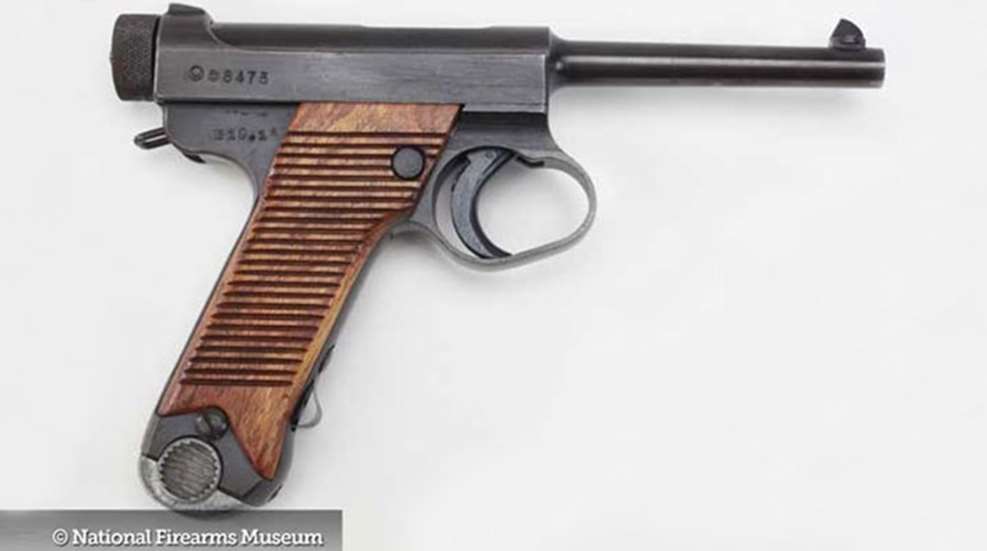
Efforts to reduce the production cost of Nambu pistols resulted in the Type 14 Nambu, introduced in 1925. Three years later it was adopted for issue to non-commissioned officers, though officers were still expected to purchase their own pistols. The Type 14 retained the 8 mm cartridge, and early pre-World War II examples exhibited fine workmanship. As the war drained resources, the quality of Type 14 pistols waned. Later examples featured an oblong trigger guard for easier access with gloved fingers, but the modification appears more like an afterthought than a deliberate design change. Early Type 14 pistols had a slotted cocking knob, while later examples had a knurled cocking knob. Type 14 pistols were marked with the month and year of manufacture, according to year of Emperor Hirohito. It also lacked a grip safety, a feature of the Type A and B pistols. The Type 14 was produced from 1925 until the end of World War II, with some 200,000 copies made.
It is said that Bill Ruger was so impressed with the profile and what would be later termed “ergonomics” of the Nambu pistol that he adopted those characteristics in his initial 1949 offering of the Ruger Standard Auto Pistol.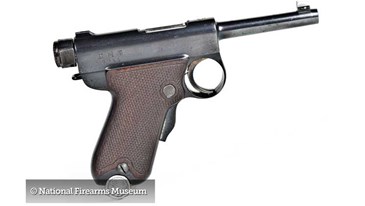
Another variant is the Type 94 Nambu, a lighter, more compact 8 mm pistol favored by pilots and tanker crew members. It featured a 3 3/4” barrel and was fed from a 6-round detachable magazine. Production lasted but 10 years—1935 through 1945—and only 71,000 were made. To modern collectors, late wartime production examples were pretty crude in workmanship due to the rigors of war production. A pristine Type 94 brings about a third the money than will an equal-condition Type 14 pistol. Rare, well-kept examples of the early Nambus command well into four figures, perhaps into five for a 100-percent Grandpa Nambu, especially if it has factory accessories like a detachable shoulder stock with matching serial numbers and matched magazines.
Kijirõ Nambu lived until 1949 and was responsible for a variety of Japanese firearms designs. He is sometimes referred to as Japan’s John Browning.
Most Popular