It’s almost axiomatic that nearly every rifle hunter starts his or her hunting career with the .22 Long Rifle. And even if they have taken the largest game animals with some big and bellowing magnum, there remains a desire to plink small game and varmints with a rimfire. On a pragmatic note, rimfires are generally quieter than a center-fire; recoil is non-existent; and rimfire ammunition is usually less expensive than its big brothers. On the downside, rimfires have a much more limited effective range due to their lower velocities.
Winchester took a look at this market and developed a project that would bring rimfire bullets up into the lower end of the center-fire velocity envelope. Buoyed by the popularity and success of .17-caliber cartridges-both center-fire and rimfire-the engineers at Winchester quickly determined that would be the caliber of choice. Bullet weights in .17 caliber are about half that of .22-caliber cartridges, so it would be much easier and feasible to get 3,000 fps out of a .17 rimfire than a .22.
Now the problem was how to design a case that would withstand the pressure needed to crack the three-grand velocity barrier. Designing a new case from scratch would necessitate a large investment in cash, but Winchester had a card up its sleeve. Olin-the parent company of Winchester Ammunition-has been supplying a rimfire power source to the construction industry for powder-actuated nail and stud guns for many years. These guns are used to attach metal to concrete, or in some cases, metal to metal. The power source is a .27-caliber rimfire case. So rather than invest in the tooling and manufacturing resources for a new and stronger case, Winchester elected to see what this case could produce, naming the new cartridge the .17 Winchester Super Magnum (WSM).
This introduced a whole new set of challenges in terms of firearm design. It would not be possible to simply ream a .17-caliber barrel with a new chamber because the brass in the head of the case was substantially thicker than other rimfire cartridges. Too, the larger head diameter required the bolt to be redesigned to have the firing pin perfectly located, as well as providing a stronger spring to accelerate the pin enough to reliably ignite the priming compound in the rim of the case. The firing pin was given a round profile rather than the rectangular one normally seen on rimfires in order to concentrate the force on the thicker rim. And, finally, the rifle needed a new magazine design for the larger cartridge.
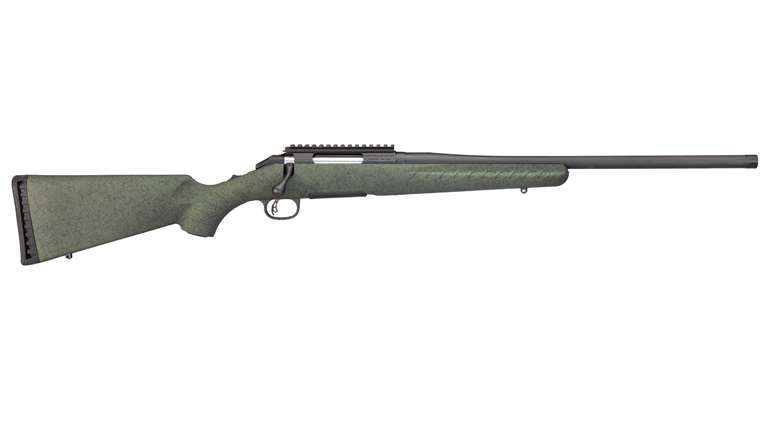
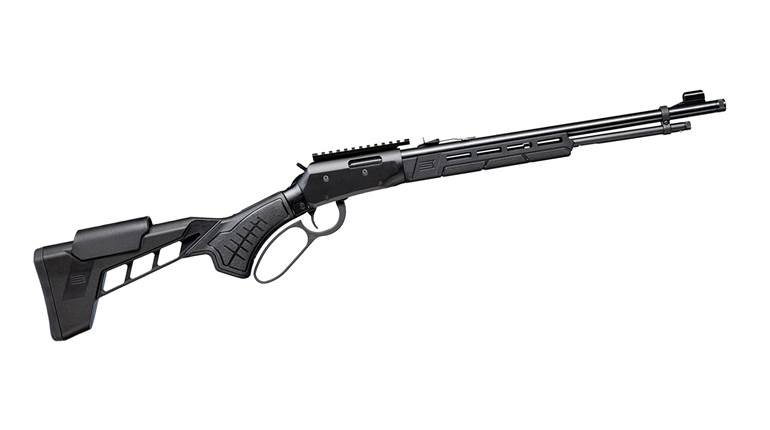
While other companies are working to bring out a rifle, Savage-a company with a well-deserved reputation for agility in bringing new guns to market quickly-introduced the B.Mag along with the cartridge’s intro at SHOT Show. There were shooting samples available at Media Day-the day before the SHOT Show opened, but winds howling at 30 to 40 mph made shooting the tiny 20- and 25-grain bullets futile. I had to wait until fall before I could get a crack at this new rimfire.
The claims of 3,000 fps for the 20-grain bullets and 2,600 fps for the 25-grainers are accurate. My chronograph showed an average of 3,042 fps with the 20-grain polymer-tipped bullet and 2,636 fps for the 25-grain polymer-tipped bullets. A standard deviation of 22 and 26 respectively indicated that these should be very accurate loads. With a ballistic coefficient of 0.185 for the 20-grain bullet and 0.230 for the 25-grain bullet, these lighter bullets will retain their velocity better than many .22-caliber bullets, but in the end they are very light bullets and therefore will be more susceptible to wind deflection. I went through five different range sessions with the Savage B.Mag before I had it calm enough to get some good groups.
One thing I discovered is that accuracy begins to suffer after 50 rounds or so. A quick swabbing with a patch soaked in bore solvent followed by two or three dry patches took care of that issue, but it is something to keep in mind if you take this rifle/cartridge combo on an all-day varmint shoot.
In a day where so many are necking up and necking down, blowing out shoulders and cases, and then making outlandish claims of velocity and terminal performance when their precious brainchild isn’t really doing anything new, the .17 WSM really does produce some real-world improvements. The .17 WSM has 61 percent more energy with a 20-grain bullet at the muzzle than a .17 HMR with a 17-grain bullet and 19 percent more energy than the .22 WMR with a 30-grain bullet. Muzzle velocities of the three are 3,042 fps with a 20-grain bullet in the .17 WSM, 2,525 fps with a 17-grain bullet in the .17 HMR, and 2,250 fps with the 30-grain bullet in the .22 WMR. Ballistic coefficients for these bullets are 0.185 for the 20-grain bullet in the .17 WSM, 0.125 for the .17-grain bullet in the .17 HMR and 0.095 for the 30-grain bullet in the .22 WMR.
If all those numbers are making your head spin, here’s the meat of it: If you sight in a 20-grain load in the .17 WSM to zero at 150 yards, you’ll be just 0.78 inches high at 100 yards and 2.38 inches low at 200 yards. Translation: Hold on the head of a standing prairie dog 225 yards away, and you’ll center-punch his torso-not too bad for a rimfire. By comparison, the .22 Hornet with a 45-grain bullet will be almost an inch lower at 200 yards. Holding on the head of that same 225-yard prairie dog will give him a hot foot.
Bottom line is this: Winchester’s new .17 WSM provides better performance than a .22 Hornet in a rimfire package that’s less than half the price of the .22 Hornet. Its trajectory is 50-percent flatter than the .17 HMR. I have had a fair amount of experience with both the .17 HMR and the .22 Hornet, and I am a big fan of both. Count me in as a proponent of this new cartridge.
The only fly in the ointment might possibly be distribution. Ammo is already in short supply, and the gun manufacturers are running full tilt to produce guns for a market with an insatiable thirst. If enough rifles are made to keep the market interested and the ammo guys can keep up with the demand, I predict the .17 WSM will be a winner. Just remember to take a cleaning rod, some patches and core solvent with you on an all-day shoot.
Most Popular