 Q: Is there an industry standard for the regulation of double-barreled shotguns? Out of the box, my side-by-side shoots 2" low and 2" to the left. And, has the American Rifleman staff changed the process for evaluating pattern effectiveness in its “Dope Bag” section?
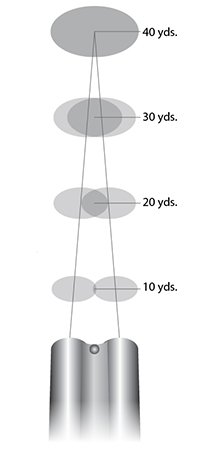
A: Thank you for your note regarding shotgun patterns. There is an industry standard for double-gun impacts, and it is that the patterns shot from both barrels should overprint each other at 40 yds. (r.) American Rifleman has not changed how it patterns in decades We shoot 10 patterns at 40 yds. (25 yds. for .410), and count all the hits within a 30" circle and a 21.2" inner ring. The rings are bisected vertically and horizontally, resulting in eight quadrants. We will also determine the central thickening—the center of the pattern—and measure how far away it was from the point of aim. We then average all the results and include them in the “Shooting Results” table for each review. We have changed the design of how those results are presented in recent years but not the information itself.
It’s worth noting that there are actually two patterning disciplines. The first covers gun fit or point of impact. The second governs how a particular shotshell/barrel/choke combination affects the downrange dispersion of shot, but space does not permit elaborating on that here.
So far as determining the point of impact of your shotgun, the industry standard is as follows: Erect a target at approximately eye level or slightly higher. Measure exactly 16 yds. from the target, mount the gun and fire three consecutive aimed shots at the target. Then measure the distance between the marked center/aiming point and the center of the shot impact. For each inch of deviation of the pattern from the point of aim, the stock needs to be adjusted 1/16".
For example, if the pattern center is 2" low and 2" left, the comb of the stock should be raised 1/8" and the stock cast off 1/8" for a right-handed shooter. It is then recommended that the three-shot series be repeated by first mounting the gun, as in an actual hunting scenario, and three shots again fired. If one is an obvious miss, just shoot another round. If there is a question, keep repeating the series of targets and shots until resolved. Shooting both barrels will indicate the necessary amount of stock adjustment required and whether there is an impact problem. If the impact problem appears to be barrel-related, then shoot from a rest. However, with a production gun, I suspect a 6" deviation at 25 yds. is within the company’s range of acceptability.
Using this system should give you a better understanding of where your shotgun shoots, and whether remedial action, in terms of an eccentric choke or stock adjustment, is necessary.
—John M. Taylor
Most Popular