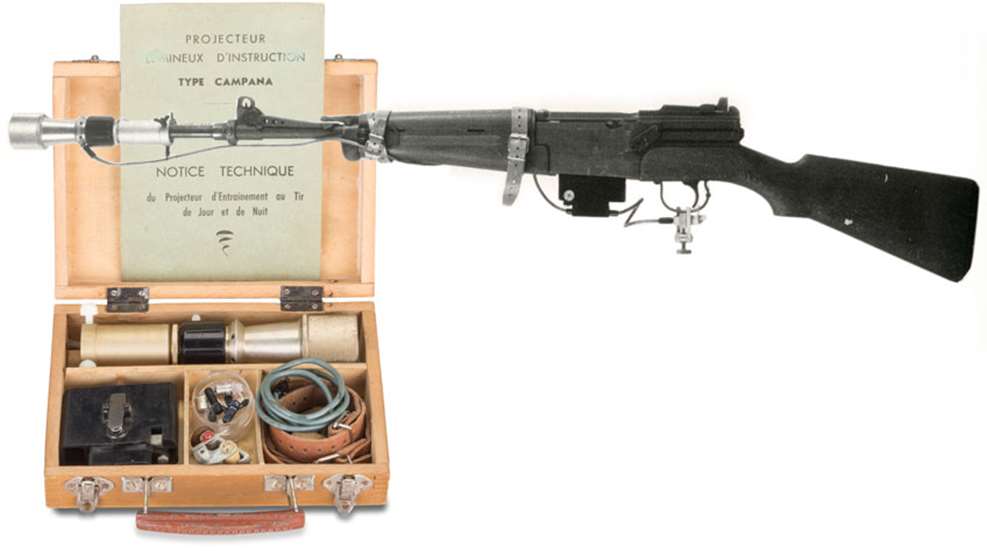
 Q: I own a French MAS-49/56. Recently while looking up information on my rifle I came across this picture of an unusual device attached to the barrel, fore-end and trigger guard of the 49/56. The piece at the end looks as if it is some sort of flashlight, but I am at a loss trying to understand it. Perhaps you might shed some light on the matter.
A: The device you have discovered is called the Campana Day-Night Training System (sometimes referred to simply as the Campana Device). In fact, the piece at the end of the barrel is a projector that focuses a narrow beam of light on a target when the trigger is pulled on the rifle. In full, the Campana System is comprised of a projector (which incorporates a conical diffuser with a lamp at the base), a battery housing (which contains two 1.5v batteries and fits into the magazine well of the rifle), a trigger-actuated solenoid (that is mounted to the trigger guard via a knurled nut), a pair of flexible insulated wires (to transmit energy to the lamp) and a couple of leather straps (to hold the wires flush against the rifle).
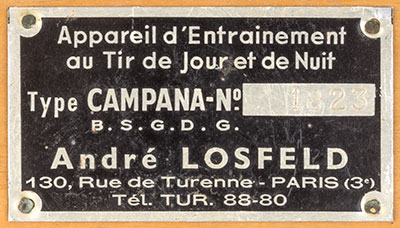
The device was invented by then-French army officer Monsieur Campana, and produced by André Losfeld Company of Paris. It was adopted by the French army in 1962.
The advantages of the Campana Device are that it allowed cadets to train with the rifle without the presence of ammunition. This provided a measure of safety for those unfamiliar with the MAS-49/56 platform and greatly reduced ammunition cost during part of the training process with the actual rifle. Further, the light projected on the target can be seen in both daylight and darkness, proving useful in a variety of training conditions.
In fact, the Campana Device can be applied to a variety of French small arms in addition to the MAS-49/56: the .22 Long Rifle-chambered Instruction Carbine MAS-45; the 9 mm Luger Machine Pistol MAT-49; the 7.5x54 mm bolt-action MAS-36 and 36-51 repeaters; and the 7.5x54 mm AA-52 light machine gun.
Most Popular