Rifleman Q&A: Did Savage Arms Make Lee-Enfields?

by
posted on April 14, 2020
** When you buy products through the links on our site, we may earn a commission that supports NRA's mission to protect, preserve and defend the Second Amendment. **
ssenfield.jpg

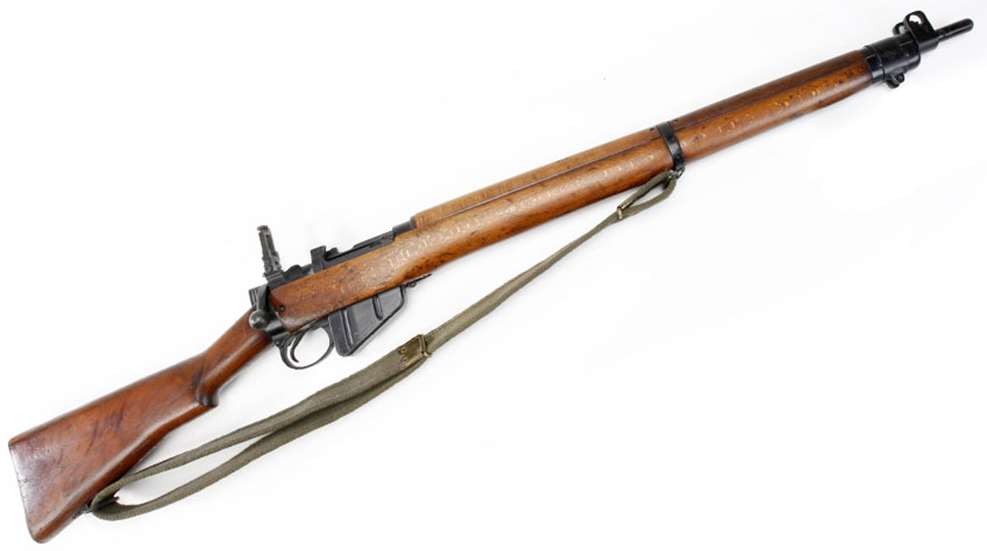
Q: I recently saw a British No. 4 Mk I Enfield rifle manufactured by the Savage company that was marked “U.S. Property.” I didn’t realize that these rifles were manufactured for the United States during World War II, nor have I ever heard of them being issued to American troops. Can you enlighten me?

A: In 1940, the British government faced a shortage of military firearms, exacerbated by the debacle at Dunkirk. So it made arrangements with a number of American firms to manufacture the badly needed arms, and, to that end, contracted with Savage Arms Corp. to manufacture 200,000 Enfield No. 4 Mk I rifles at the J. Stevens Arms Co. factory in Chicopee Falls, Mass.
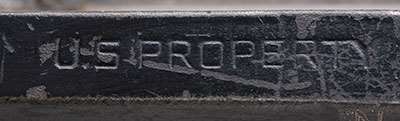
U.S. Property stamp on receiver

Since America was ostensibly a neutral country at the time, the contracts required that manufacture of the arms be on a “cash and carry” basis. However, the British government did not have the financial resources to continue paying cash for the rifles obtained from the United States.

In order to continue assisting our important ally, President Franklin Roosevelt was instrumental in having the Lend-Lease Act passed in March 1941. Under the terms of the act, the United States government took over existing British contracts for arms manufactured by American companies. In order to comply with the Lend-Lease legislation, arms provided to any allied nation had to be marked to denote that they were technically the property of the United States.

The first few thousand Enfield rifles made by Savage under the original British contract were not marked “U.S. Property,” but after passage of the Lend-Lease Act, the marking was added. These rifles were not intended for issue to American troops, and the “U.S. Property” markings were applied strictly to conform with the technicalities of the Lend-Lease Act.

Latest

Sub Calibers Self Defense 1

Small Calibers for Self-Defense: Addressing Common Myths & Criticisms

For decades, small cartridges like the .22 Long Rifle were derided as incapable rounds for defensive use and were even considered dangerous for the user by some. Today, those critiques deserve a second look.

New for 2026: HUXWRX Flow 9k PCC & Flow 9 M Suppressors

Continuing the legacy it first established as Operator Suppressor Systems, HUXWRX is still introducing new and mission-specific flow-through suppressors, with its latest products being the FLOW 9 M and FLOW 9k PCC.

Armed Citizen Stops Oregon Attack; NRA Reaffirms Importance of Law-Abiding Armed Citizenry

The National Rifle Association of America today issued a statement regarding yesterday’s act of violence in Oregon.

Gun of the Week: Tokarev TT-12 Pro

While there are several AR-style, semi-automatic shotguns on the market, the Tokarev TT-12 Pro has a few features you won’t find elsewhere. And it’s affordable, to boot.

Beretta Holding Announces Preliminary Results of Cash Tender Offer for Shares of Sturm, Ruger & Co., Inc.

Beretta Holding announced today the preliminary results of its cash tender offer to purchase up to 2,400,184 of the outstanding shares of Sturm, Ruger & Co., Inc. common stock.

Ankle Holsters: Are They Still a Good Option for Concealed Carry?

The use of ankle holsters is an old-school, deep-concealment method that was popular in the age of the snub-nose revolver. In today’s world of micro-compacts, does it still hold up as a good carry position?
Interests


Get the best of American Rifleman delivered to your inbox.