by
Support NRA American Rifleman
DONATE
** When you buy products through the links on our site, we may earn a commission that supports NRA's mission to protect, preserve and defend the Second Amendment. **
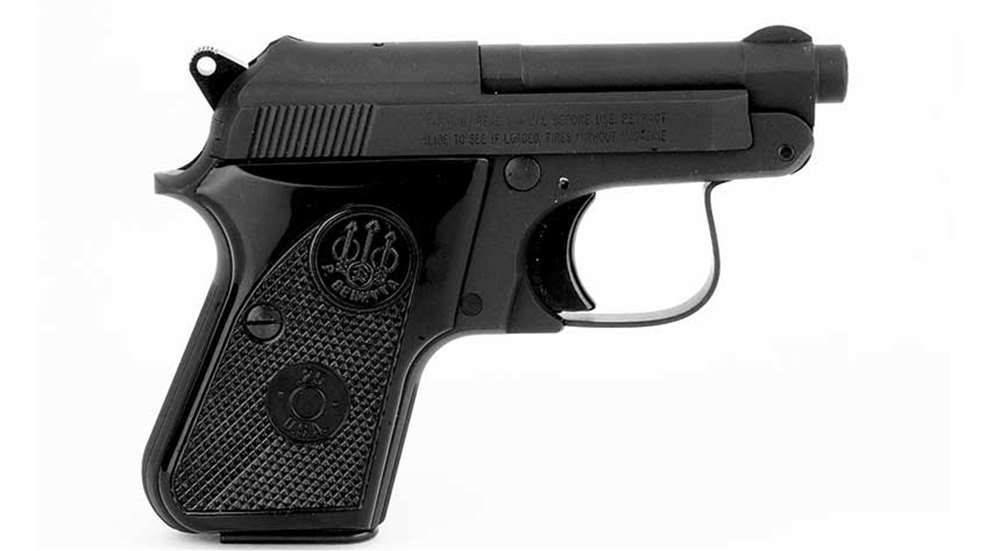
Italy’s Fabrica d’Armi Pietro Beretta has been making .25 ACP pistols since 1910, but the firm’s existence dates back a bit further—to 1526, according to Beretta’s latest research. Some six Beretta .25 ACP pistols appeared before World War II, but none equaled the popularity of the post-war Model 950 and its later variations.
Although the Model 950 of the year 1950 shares a great deal with the 950BS, there are differences. The earlier 950 employed dual recoil springs and a separate barrel latch spring as opposed to the novel combination spring used in all later versions.
Close on the heels of the 950 came the .25 ACP 950 B “Jetfire,” the .22 Short 950 B M2 “Minx” and the .22 Short M4 “Minx” (with a 33⁄4” barrel instead of the normal 23⁄8” length). The 1968 Gun Control Act halted U.S. importation of 950s; but, by 1978, Beretta’s plant in Accokeek, Md., was in operation, and the first product of Beretta U.S.A. was the .25 ACP 950BS.
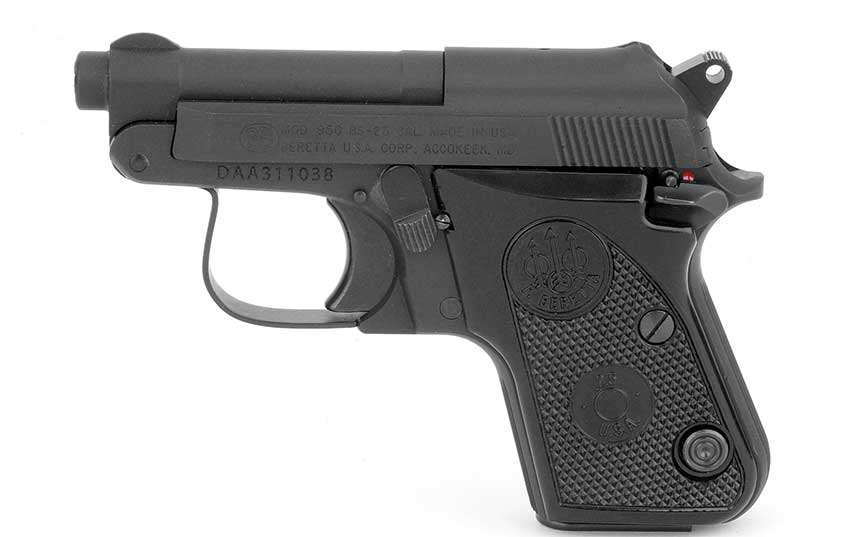
The Italian-made versions of the pistols depend on a half-cock position of the hammer for safe carrying; the U.S.-made 950 BS also has a conventional thumb safety lever on the frame. It can be engaged with the hammer in either full- or half-cock positions.
A distinguishing feature of this series of pistols is the pivoting barrel system. It was borrowed from three earlier firearm designs: the French Le Français, the Spanish Jo Lo Ar and the Austrian 1909 Steyr.
The use of the system means that manual slide retraction is not necessary to clear or load the chamber of the pistol as one can simply push the barrel latch forward to make the barrel pop up and expose the chamber. That allows for convenient access to the chamber for loading or unloading and is ideal for those who lack the strength to retract the slide of a conventional semi-automatic pistol.
Another feature of the design is its lack of an extractor. The relatively low power of the chamberings in this pistol allows the cartridge case to simply blow rearward out of the chamber when a round is fired. The cartridge’s head is supported by the breech face of the slide, and the case travels rearward until its rim impacts the fixed ejector mounted on the frame.
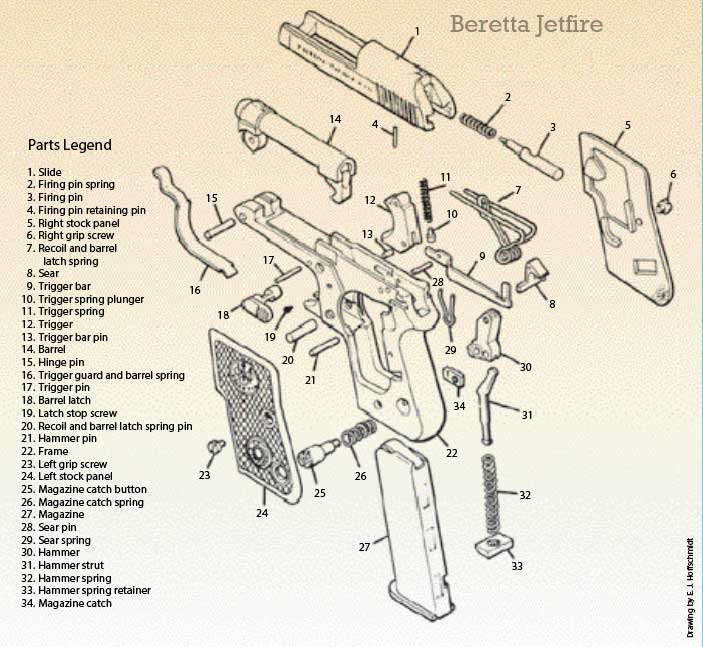
Disassembly Instructions
The basic take-down procedure for the Beretta Model 950BS Jetfire pistol is simple and easy. Extensive disassembly is not recommended.
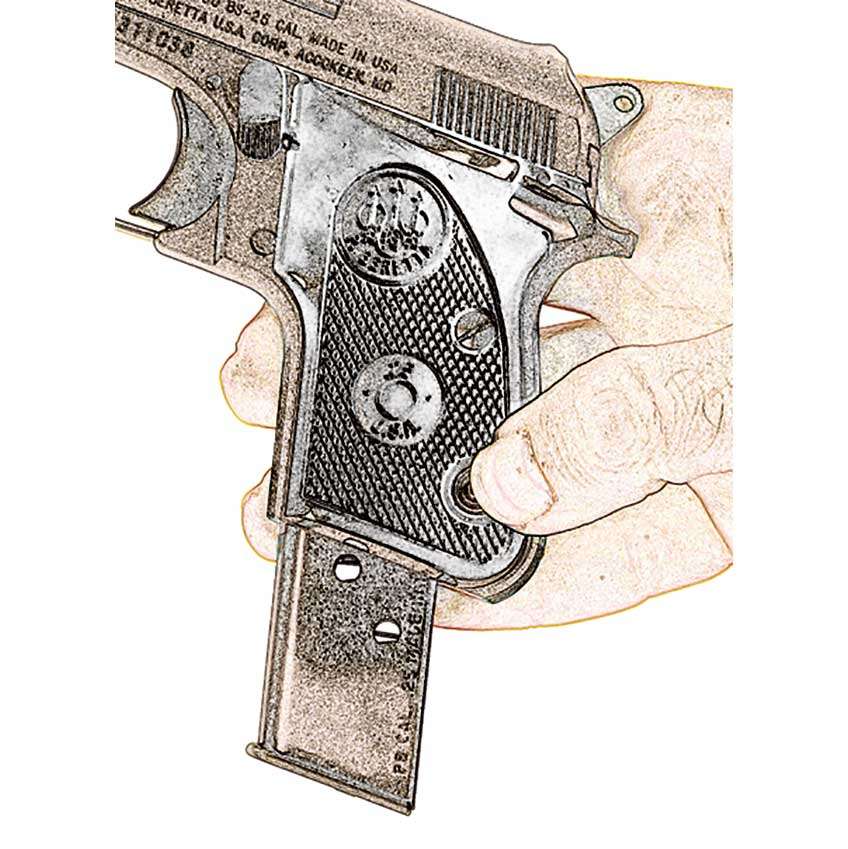
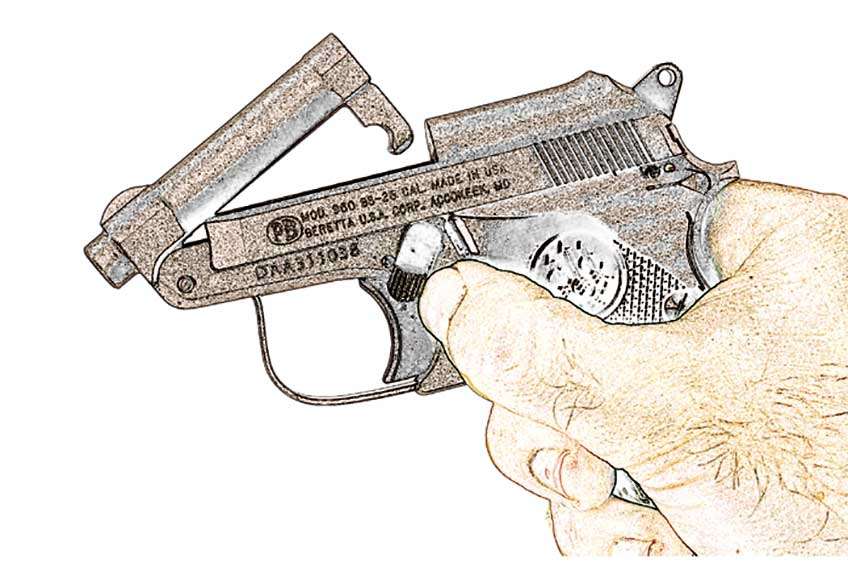
First, remove the magazine (27) by pressing on the magazine catch button (25) located at the rear base of the left stock panel (24) (Fig. 1). Next, press the barrel latch (18), located on the left side of the frame above the trigger guard, forward in a clockwise direction (Fig. 2). Activating the latch releases the barrel (14) and allows it to tip up, giving direct access to the chamber.
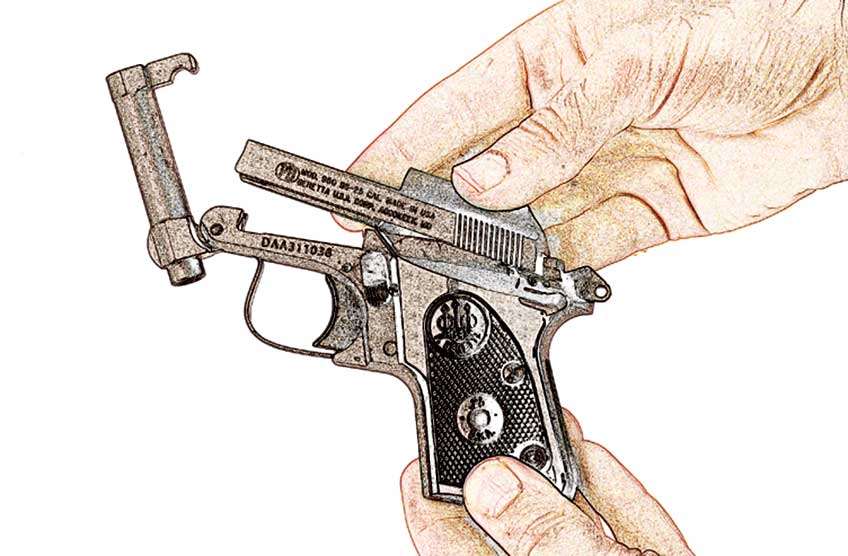
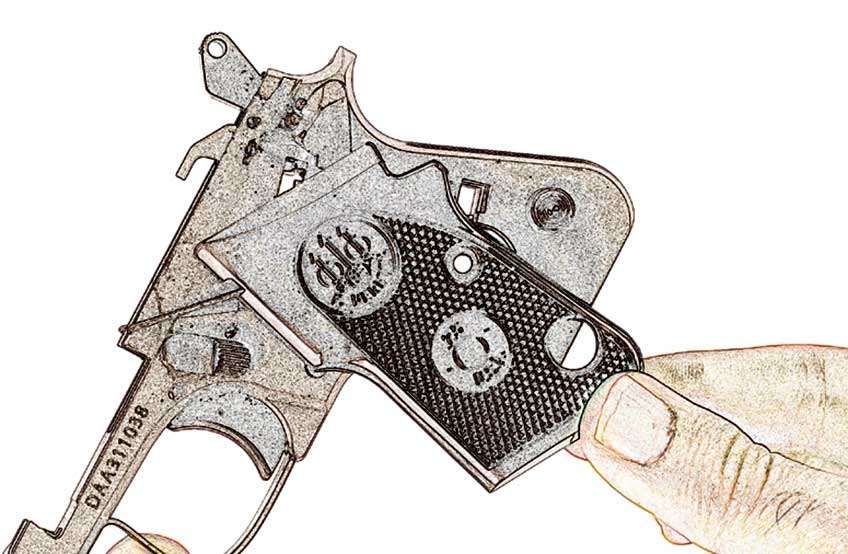
Once the chamber is cleared, swing the barrel up to a vertical position. To remove the slide (1), first cock the hammer (30). Lift up slightly on the front of the slide until it is free of the frame (22) (Fig. 3). Once the slide is clear, slide it rearward off the back of the frame. It is advisable to now remove the stock panels (5 and 24) (Fig. 4) from the pistol to allow visual access to the internal sections.
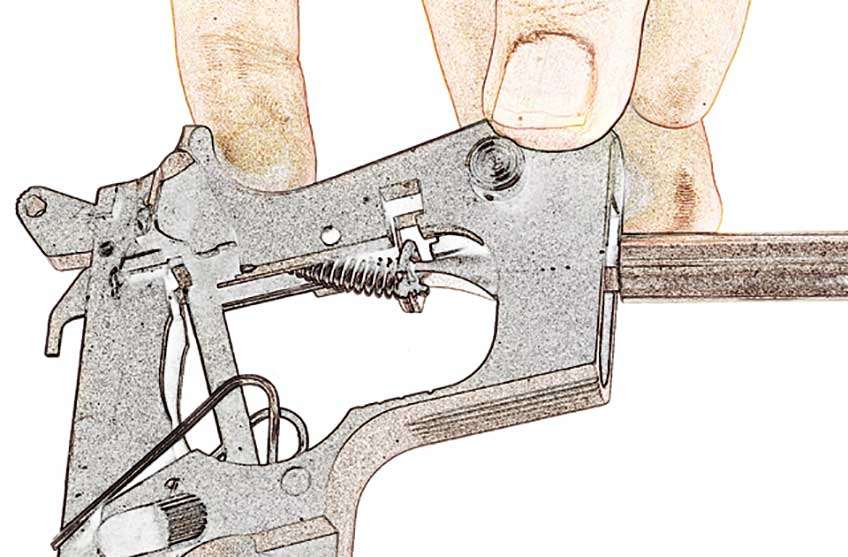
The hammer spring assembly can now be removed from the pistol. Lower the hammer and remove the hammer spring assembly by inserting a narrow screwdriver into the magazine well. Push up and outward on the hammer spring retainer (33) until it is free of its recess in the frame (Fig. 5).
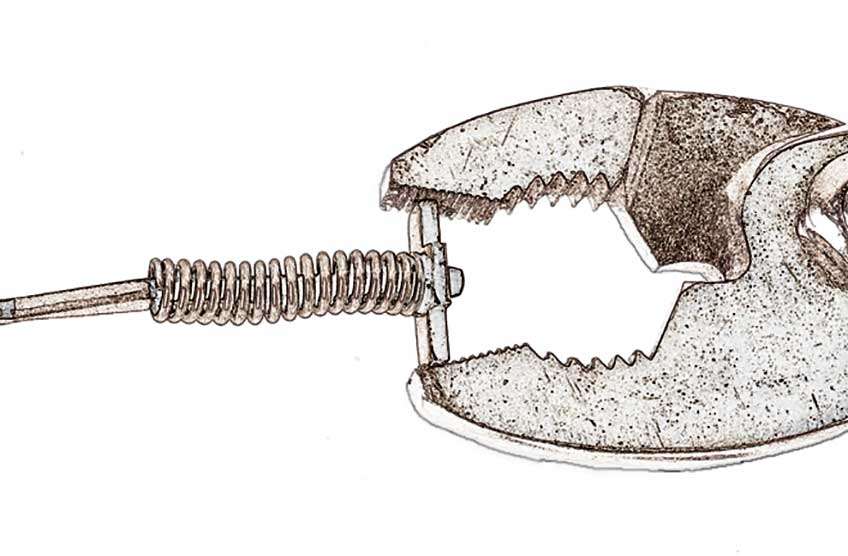
The hammer spring (32) and hammer strut (31) are assembled as a unit for easy handling. To disassemble this unit, hold the hammer strut in a padded vise. Grasp the hammer spring retainer with pliers and push toward the spring until the tail of the strut is clear of its seat in the strut (Fig. 6).
Rotate the retainer 90 degrees and ease the retainer off the tail of the strut. Be sure to use care in removing the retainer because it is under spring tension.
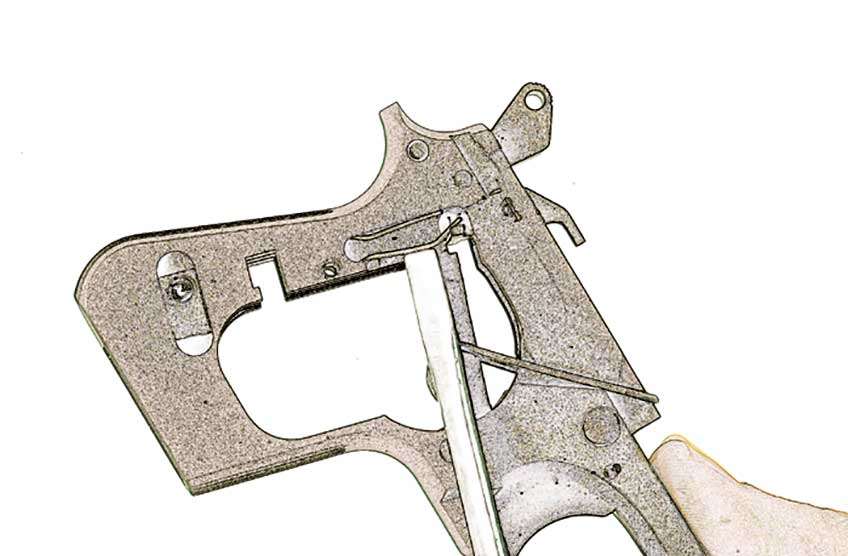
The sear spring (29) may now be removed from the right side of the pistol’s frame. Using the edge of a flat screwdriver, press the front leg of the sear spring toward the rear of the frame (Fig. 7). Once it has been pushed back enough to clear the opening in the frame, it may be lifted out. Be mindful that the spring can fly out if care is not taken.
This completes the procedure for basic disassembly of the Model 950BS. Reassembly is in the reverse order. Further disassembly is not recommended.
Although the Model 950 of the year 1950 shares a great deal with the 950BS, there are differences. The earlier 950 employed dual recoil springs and a separate barrel latch spring as opposed to the novel combination spring used in all later versions.
Close on the heels of the 950 came the .25 ACP 950 B “Jetfire,” the .22 Short 950 B M2 “Minx” and the .22 Short M4 “Minx” (with a 33⁄4” barrel instead of the normal 23⁄8” length). The 1968 Gun Control Act halted U.S. importation of 950s; but, by 1978, Beretta’s plant in Accokeek, Md., was in operation, and the first product of Beretta U.S.A. was the .25 ACP 950BS.
The Italian-made versions of the pistols depend on a half-cock position of the hammer for safe carrying; the U.S.-made 950 BS also has a conventional thumb safety lever on the frame. It can be engaged with the hammer in either full- or half-cock positions.
A distinguishing feature of this series of pistols is the pivoting barrel system. It was borrowed from three earlier firearm designs: the French Le Français, the Spanish Jo Lo Ar and the Austrian 1909 Steyr.
The use of the system means that manual slide retraction is not necessary to clear or load the chamber of the pistol as one can simply push the barrel latch forward to make the barrel pop up and expose the chamber. That allows for convenient access to the chamber for loading or unloading and is ideal for those who lack the strength to retract the slide of a conventional semi-automatic pistol.
Another feature of the design is its lack of an extractor. The relatively low power of the chamberings in this pistol allows the cartridge case to simply blow rearward out of the chamber when a round is fired. The cartridge’s head is supported by the breech face of the slide, and the case travels rearward until its rim impacts the fixed ejector mounted on the frame.
Disassembly Instructions
The basic take-down procedure for the Beretta Model 950BS Jetfire pistol is simple and easy. Extensive disassembly is not recommended.
First, remove the magazine (27) by pressing on the magazine catch button (25) located at the rear base of the left stock panel (24) (Fig. 1). Next, press the barrel latch (18), located on the left side of the frame above the trigger guard, forward in a clockwise direction (Fig. 2). Activating the latch releases the barrel (14) and allows it to tip up, giving direct access to the chamber.
Once the chamber is cleared, swing the barrel up to a vertical position. To remove the slide (1), first cock the hammer (30). Lift up slightly on the front of the slide until it is free of the frame (22) (Fig. 3). Once the slide is clear, slide it rearward off the back of the frame. It is advisable to now remove the stock panels (5 and 24) (Fig. 4) from the pistol to allow visual access to the internal sections.
The hammer spring assembly can now be removed from the pistol. Lower the hammer and remove the hammer spring assembly by inserting a narrow screwdriver into the magazine well. Push up and outward on the hammer spring retainer (33) until it is free of its recess in the frame (Fig. 5).
The hammer spring (32) and hammer strut (31) are assembled as a unit for easy handling. To disassemble this unit, hold the hammer strut in a padded vise. Grasp the hammer spring retainer with pliers and push toward the spring until the tail of the strut is clear of its seat in the strut (Fig. 6).
Rotate the retainer 90 degrees and ease the retainer off the tail of the strut. Be sure to use care in removing the retainer because it is under spring tension.
The sear spring (29) may now be removed from the right side of the pistol’s frame. Using the edge of a flat screwdriver, press the front leg of the sear spring toward the rear of the frame (Fig. 7). Once it has been pushed back enough to clear the opening in the frame, it may be lifted out. Be mindful that the spring can fly out if care is not taken.
This completes the procedure for basic disassembly of the Model 950BS. Reassembly is in the reverse order. Further disassembly is not recommended.
Most Popular