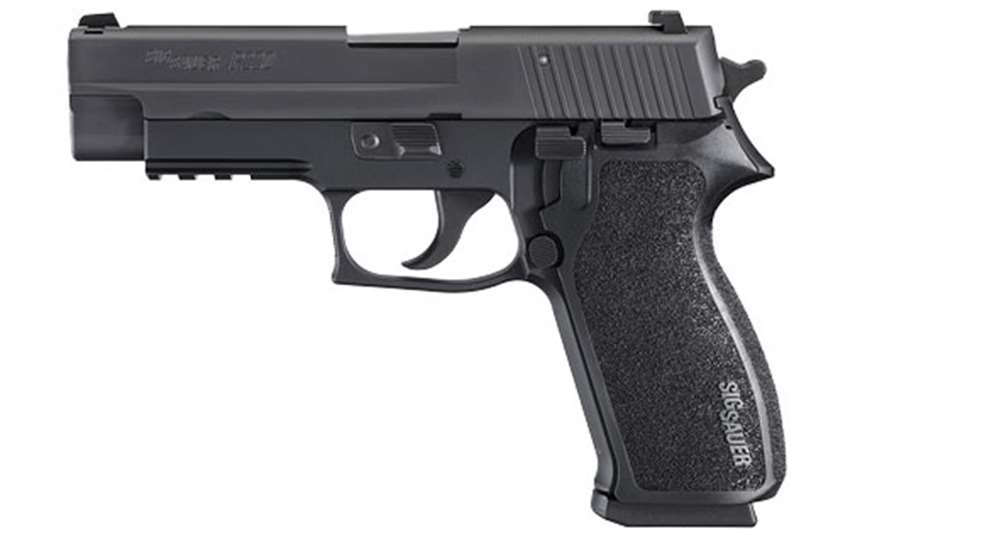
Jeff Cooper was the man who changed the handgunner's approach to shooting the pistol or revolver in a very important way. For decades, pistoleros accurately concluded that the pistol could be fired with one hand and inaccurately assumed that it should be. Cooper developed what has come to be called the Modern Technique of the Pistol, in which the dominant hand grasps the gun and the non-dominant one braces the dominant. Except for certain emergency shooting drills, almost all defensive or combat shooting is performed with one style or another of two-handed shooting. In the case of the semi-automatic pistol, the gun's detachable magazine afforded a marked advantage when the gun was used with two hands. It was possible to reload very quickly.
It is common to see a trained semi-automatic shooter drop an empty or nearly empty magazine with the thumb of the dominant hand, as the other hand secures a loaded replacement. As the dropped first magazine falls free, the support hand orients the spare at the magazine well of the gun, then slams it home. If the handgunner has initiated the change properly, it happens when there is a round in the chamber. The result is a fully loaded pistol ready to go. This is hardly rocket science—it happens on training ranges all over the country every day. We have come to accept this as the norm. You learn to do speed reloads in the first days of combat pistol training, along with the tactical load that is a bit slower.
But what would you do if you could not drop that magazine with the shooting hand? These days, every pistol that is truly competitive in the combat shooting scene has some kind of readily accessible mechanical button, paddle, lever or other gizmo that retains the magazine in the pistol. It was not always so. Not so many years ago, a number of models had the so-called “European” type, where the catch was (usually) on the heel of the butt. There's no way the magazine can be removed, except by using the support hand to reach over and work the latch. Therefore, the support hand cannot be getting the spare magazine ready to go into the magazine well. It is much slower and you have to wonder why anyone would design a gun that works this way.
Part of the reason is simply tradition—sort of a “we've always done it that way” mentality. Also, many European makers never completely accepted the idea of the need for a spare magazine. The service pistol was issued with a single magazine and thus equipped, the shooter was expected to resolve his defensive crisis. Without a loaded spare, the concept of a speed reload is a moot point and there is no point in tactical positioning of the magazine catch. The best example of a good gun that was limited by this thinking was the early SIG Sauer P220s. A fine pistol, the P220 had considerable difficulty winning acceptance in Yankee combat shooting circles, because of a European mag catch. It was enough of a problem that the importers got the German maker to do a speed development of a speed magazine catch. The firm currently offers an extensive array of modern service autos—all of them have a magazine catch on the left side at the lower rear corner of the trigger guard. 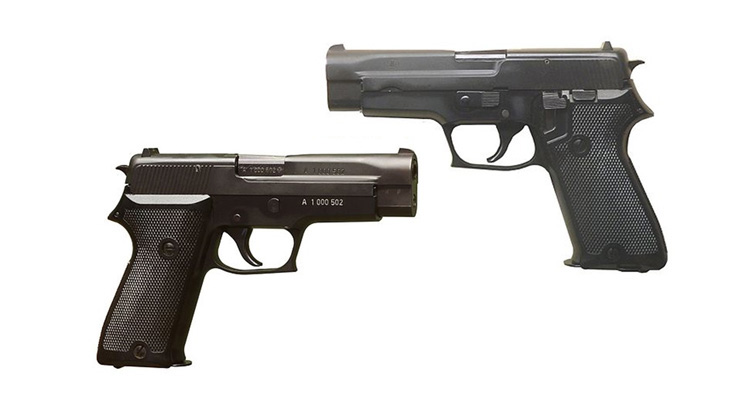
Image of early SIG P220, on display at the Morges castle museum.
The latest variation on this concept is a magazine catch that is ambidextrous. Usually, this means that there is a grooved or checkered button on both right and left sides of the frame. Pushing the button in—from either side—releases the magazine to fall free. Most commonly, shooters use the gun hand thumb to drop the magazine, but it can be with the tip of the trigger finger. This fingertip technique was long used by 1911-shooting southpaws. A pistol with an ambidextrous magazine catch is surprisingly flexible in the tactical sense, because right- and left-handed shooters can work it with either thumb or trigger finger. It is a concept that is slowly making its way on to just about everything.
Most Popular