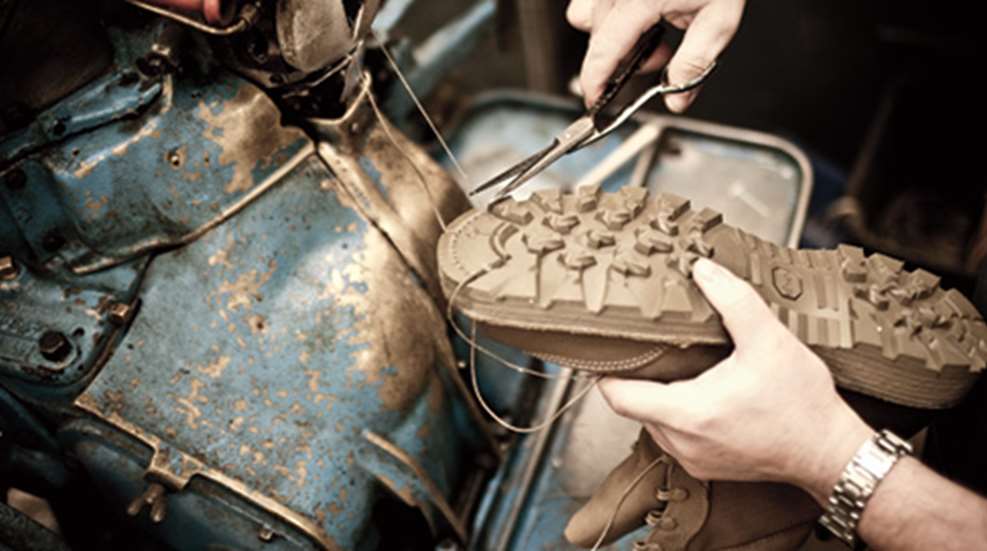
In a shaken economy replete with product labels beginning with “Made in” and inevitably ending with the names of countries other than the United States—some of which are not even friendly to America—it is reassuring to learn that virtually every soldier and Marine deployed to Iraq and Afghanistan is issued a pair of Danner boots built in Portland, Ore.
That fact would no doubt have pleased company founder Charles Danner who in 1932 began handcrafting economical work boots in the midst of the Great Depression in Wisconsin. Four years later he moved the operation to Portland to pursue a more lucrative trade making loggers’ boots. The company grew and prospered, remaining in the Danner family until 1983 when it was sold to a new owner who continued its commitment to high-quality, hand-crafted boots. In 1994 Danner merged with the then-nearly 100-year-old LaCrosse Footware Company of Wisconsin, which remains its parent company today.
For troops in Iraq and Afghanistan, the knowledge that their Danner boots are made at home is comforting on a patriotic level to be sure, but it is in their day-to-day duties—including front-line combat—in inhospitable terrain and relentless heat that their Danners afford them the literal comfort for which they have become renowned. According to the company, “Danner pioneered specific boot designs intended for the rugged, mountainous terrain of Afghanistan.” The company’s Combat Hiker and RAT designs, made under contract for the U.S. Army and USMC, respectively, were derived from the Talus and Raptor outdoor/hunting line of boots made for sportsmen. Another Danner boot, the Desert TFX, is approved for optional wear and has become popular with soldiers and airmen. It too is built from a platform similar to the company’s Pronghorn hunting model and Striker II law enforcement boot.
To date the company’s Portland facility has made more than half a million pairs of boots under contract to the U.S. military. Since its first contract award in 2006, Danner has made significant commitments to the local economy, increasing its workforce and adding a second shift for the first time in its 78-year history. In fact, to support the increasing demand for both military and commercial products, Danner plans to relocate its factory in coming months to a new location in Portland to increase production capacity and efficiency.
In 2008 and 2009 Danner brought its support of U.S. troops full circle by helping to raise more than $20,000 to benefit military support organizations, most notably the Marine Corps Family Foundation. More recently it was preparing to pack hundreds of Christmas stockings to send to military service members stationed overseas in support of Operation Santa.
In an era rife with trite sentiment, the following company slogan serves as a refreshing reminder of that, like Danner Boots, capitalism and patriotism have not gone entirely out of style: “Danner Boots is Proud to Serve Those Who Serve.”
Most Popular