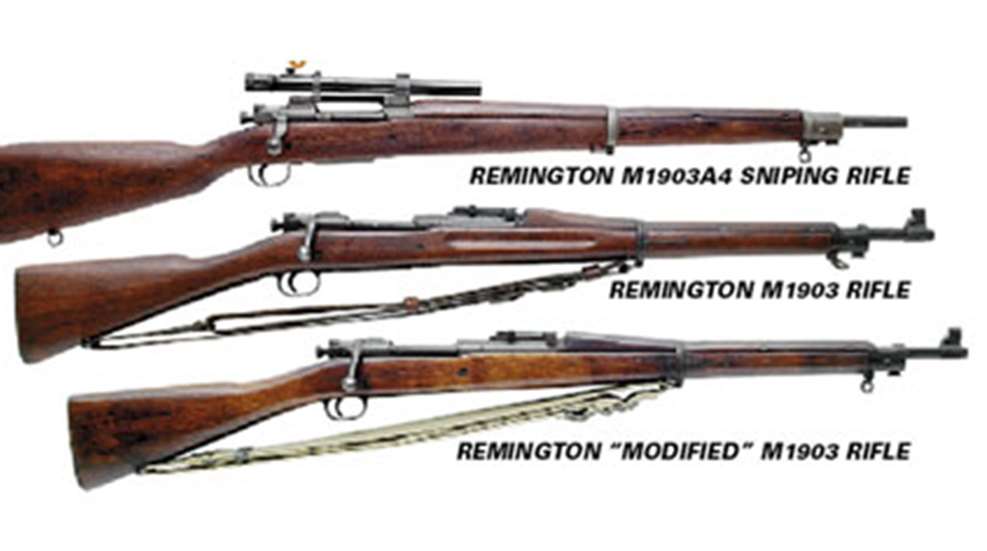
Q: I was at a gun show and saw a Remington-made Model 1903 Springfield rifle. It looked just like a World War I ’03, but I have been told Remington only made 1903A3 rifles during Word War II. Was this some kind of rebuild?
A: By 1941, the U.S. government had taken steps to increase production of the semi-automatic M1 Garand rifle, but it was apparent that other sources of rifles were needed. It was decided to resume production of the bolt-action M1903 since the tooling to produce the rifle was still available.
Springfield Armory, however, was heavily burdened with Garand production, and the Rock Island Arsenal had long since ceased manufacture of the ‘03, and was involved with other war-production projects.
Fortunately, the production tooling for the M1903 rifles was still stored at Rock Island. After some negotiations with the Ordnance Dept., the Remington Arms Co. accepted a contract to produce the M1903 rifle for the government.
Remington transported the Rock Island tooling to its plant, and by November 1941, production of the M1903 Springfield was underway. Remington marked its rifles with the company name on the receiver and the initials “RA” and the date of production on the barrel. The early Remington ‘03s were essentially identical to Rock Island Springfield rifles made during World War I, and they were made with the same quality materials and craftsmanship.
Remington engineers, working with Ordnance officials, proposed several time-cutting changes, including substituting simple, stamped-metal components for some formerly milled or forged components, modifying the stock to save production time and eliminating some non-essential parts completely, resulting in the “U.S. Rifle, Caliber .30, M1903 (Modified).”
Additional changes to decrease manufacturing time, as well as the addition of an adjustable aperture rear sight mounted on the receiver, resulted in the adoption of the “U.S. Rifle, Caliber .30, Model of 1903A3” on May 21, 1942. Remington made M1903A3s from December 1942 until production ceased in February 1944, as well as 1903A4 sniper rifles.
Most Popular