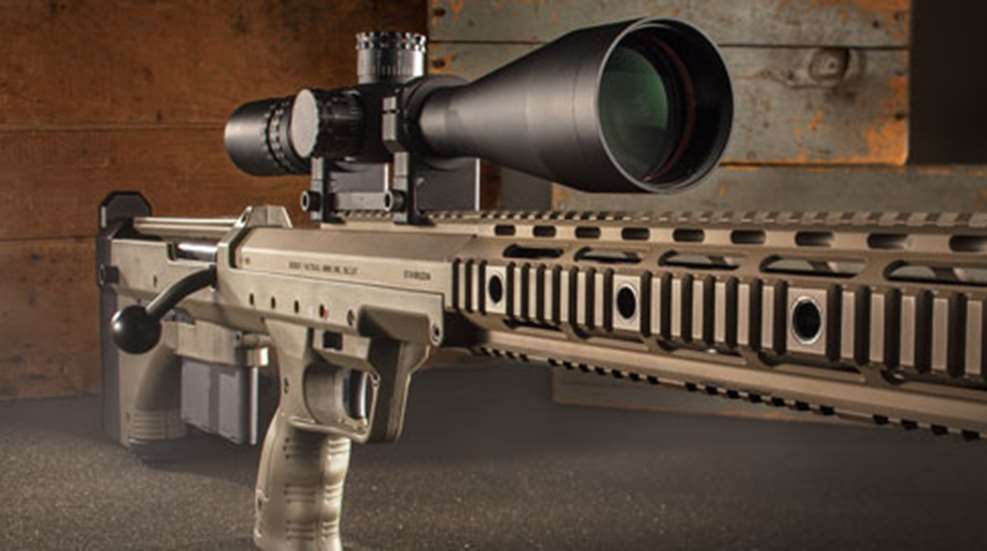
The Desert Tactical Arms Stealth Recon Scout (SRS-A1) is a precision rifle that is unique in both appearance and function. The SRS is a multi-caliber bullpup design, which provides the shooter the performance of a full-size precision rifle in a compact package about the size of a carbine.
Unless your idea of a rifle is the Steyr AUG or British SA-80, the appearance of the SRS is nontraditional, to say the least. The receiver, barrel and trigger mechanism are hidden from view, fully-encased in the synthetic stock and Picatinny-railed fore-end. As a bullpup, the receiver and magazine lie to the rear of the trigger mechanism, a concept that allows the overall length of the rifle to be kept to a minimum—in this case 35 inches—even with a 22-inch barrel installed. Beneath the clamshell injection-molded stock, the heart of the SRS is a receiver constructed of 7075-T6 aluminum that uses a traditional turnbolt action featuring two rows of three locking lugs. The bolt locks into the barrel, thus rendering the receiver a low-stress part. Because the bolt slides rearward into the chassis under the shooter’s cheek, there is no drop to the stock, so scopes must be mounted relatively high above the axis of the bore. Cartridges are fed from a simple but rugged detachable six-round (five in .338 Lapua Mag.) box magazine that locks up via an ambidextrous release. The magazine’s bottleneck design prevents bullet tips from impacting the front of the magazine under recoil, thereby protecting the projectiles from deformation.
Other than the nontraditional design, the SRS feeds, functions and shoots like any other magazine-fed, push-feed bolt-action rifle. The trigger is user-adjustable and, on our test rifle, broke at a crisp 2 pounds, 8 ounces. The safety button is on the chassis in a position and design similar to that of the Uzi submachine gun and is actuated by forward movement. It is ambidextrous and can easily be released by the trigger finger of the firing hand without changing the shooter’s grip. The rifle can be cycled, loaded and unloaded with the safety engaged. Our evaluation rifle fed and extracted reliability, though we did experience several failures to fire with Norma ammunition. That did not occur with the other brands tested and each of the rounds fired when the rifle was re-cocked.
The SRS can be quickly changed to different calibers, accepting seven available offerings ranging from .260 Rem. up to the .338 Lapua Mag. with minimal effort. The button-rifled Lothar-Walther barrels are locked into place using four hex screws just above the rifle’s grip. To remove the barrel, a hex key is used to “unlock” the mechanism on the left side of the receiver before the four screws on the right side are loosened. The barrel is removed from the receiver by sliding it forward and out of the railed fore-end. Barrels are installed by reversing the process and, due to the design, it is basically impossible to install a barrel incorrectly. The receiver bolts are tightened using a pre-set torque wrench and the barrel lock is reset.
If a caliber change necessitates a different bolt due to case head diameter, the stock’s buttplate is removed by depressing a button under the toe and sliding the pad upward. With the butt removed, the bolt slides rearward out of the stock and the new bolt slides into place. With no practice, the entire caliber transition process takes under two minutes to perform. Our testing indicated no loss of zero or shift in point-of-impact after changing barrels.
Barrels feature a two-port muzzle brake that, along with the rifle’s weight and stock design, keeps recoil to a pleasant minimum. Desert Tactical Arms’ muzzle brakes are threaded to accept the company’s sound suppressors, and a hand-removable knurled thread protector covers the threads. All metal parts including the barrel are coated with a baked-on abrasion and corrosion-resistant finish. The polymer stocks are available in a variety of earth tones to suit the user's needs and can be replaced easily by removing the cover screws. Because the stock is merely a shroud for the chassis system and the barrel is completely free-floating, no bedding issues are encountered. The Picatinny rail fore-end allows for mounting of necessary accessories, such as a bipod, and the rifle’s exterior has 14 different flush cup sling swivel sockets so slings can be configured in a wide variety of ways to suit individual preferences. An integral rear monopod threads downward from the buttstock but is stored out of the way when not in use.
Full accuracy testing was performed with the .308 Win. barrel. Three-round groups met the company’s accuracy claims—1/2 m.o.a. accuracy, though the company specifies using Desert Tactical Munitions (DTM) loads—but five-round groups did not; the .300 Win. Mag. barrel exhibited comparable performance. What the table does not convey is the rifle’s consistency, nearly all bullet types, weights and loads had nearly identical points-of-impact.
A long-range precision rifle that exhibits fine performance and maintains the overall length of a M4 carbine is truly unique. Add in the versatility of barrels of various lengths and the ability to change calibers in mere minutes and you really have something special.
Manufacturer: Desert Tactical Arms; (801) 975-7272; deserttacticalarms.com
Caliber: seven options available; .308 Win. and .300 Win. Mag. tested
Action type: bolt-action, center-fire, repeating rifle
Receiver: 7075-T6 Aluminum
Barrel: 22" button-rifled LW19 chrome-moly match-grade; 26" available
Rifling: four-groove, RH 1:11" twist
Magazine: six- or five-round capacity detachable box
Sights: none, Picatinny rail
Trigger: adjustbale 2-lb., 8-oz. pull
Stock: injection molded synthetic chassis-style; length of pull, 16" (adjustable); drop at heel, 0"; drop at comb, 0"
Overall Length: 35"
Weight: 11 lbs., 8 ozs.
Accessories: manual
Suggested Retail Price: $4,500; $9,000 (as-tested)
Most Popular