8/7/2012
Despite of its lack of current popularity, point shooting is a viable defensive shooting technique and one that can be learned by most shooters. I prefer to call it point shooting instead of instinctive shooting because there is nothing instinctive about any form of shooting. Nor does hip shooting really define the technique because one only shoots from the region of the hip, or close to the body, at very close range. It is point shooting because one shoots the handgun at the target using the sights in a limited manner.
Another misconception about point shooting is that point shooters never use their sights. Bill Jordan, Col. Rex Applegate and Jelly Bryce, to name a few, all used their pistol sights when the target was far enough away as to be out of their effective range of just pointing the handgun. And, to answer those critics of point shooting, all three of these men lived long, productive lives. They were living proof that point shooting could be effective.
Point shooting relies heavily on good hand-eye coordination. The eye focuses on the exact spot on the target where the bullet should be placed, and through practice, the gun hand delivers the shot to that same place. The key phrase in that last sentence is through practice, because it will take a good deal of practice to become proficient at this skill. What follows are some ideas on how to get started at point shooting.
The shooter should select one handgun and then stay with it. I don't think it really matters if the shooter chooses a revolver or prefers an auto-loading pistol. Switching around among various handguns only leads to confusion and misses, as handguns have different weights and balances that can interfere with the ability to deliver the shot with accuracy. In addition, the grip-to-bore angle is different from gun to gun and may cause the shooter to hit high or low if he or she is not familiar with that particular gun.
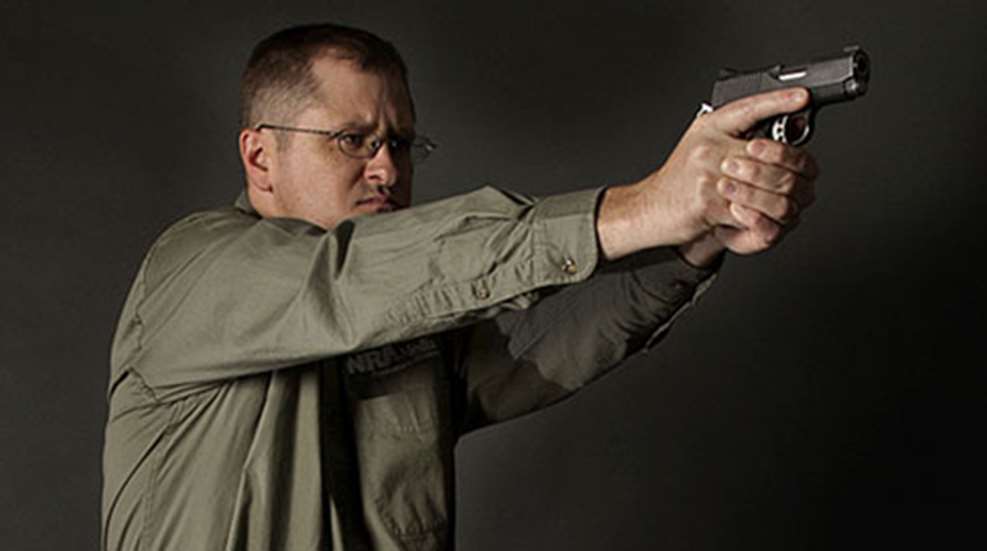
The shooting stance should be an aggressive, athletic stance with the body's weight on the balls of the feet. Beyond that, results matter more than technique. Bill Jordan used a very erect stance while Jelly Bryce used a very deep crouch much like the one used by early FBI agents (in fact, Bryce taught them that style of shooting). Col. Applegate was sort of in the middle, using a forward crouch, but not nearly so deep as Bryce. The shooting arm is forward and held quite rigid. Effective point shooters pivot and turn as they address various targets, using their whole body to aim the handgun.
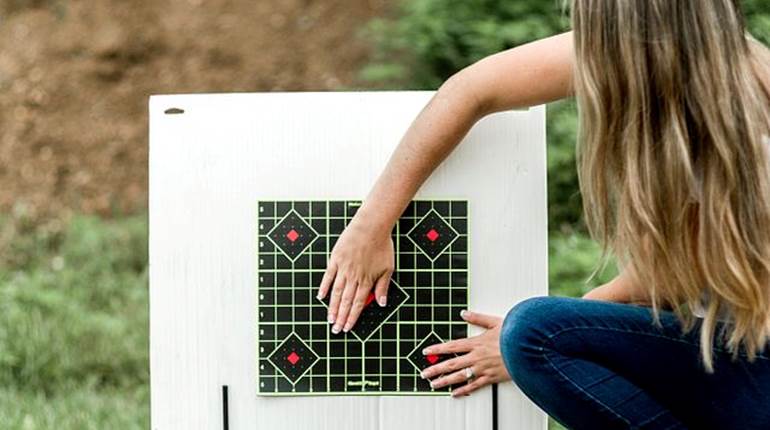
Point shooting practice should begin at very close range, say about 3 yards. While a silhouette target helps, it is not entirely necessary. What the shooter really needs is an 8-inch circular target, with the standard paper picnic plate being just about right. As the gun is presented toward the target, the shooting eye focuses on the center of that 8-inch circle and the shot is triggered.
Once the presentation begins, it is best not to stop until the shot is triggered. Trying to hesitate and improve the accuracy of the delivery generally has just the opposite results. Once the shooter is keeping all hits in the circle, it is time to start working on delivering pairs to the target. Again, the key is to work for accuracy; speed will come with time and practice.
Only when the shooter is able to keep all hits within the 8-inch circle, is it time to back up and create more distance. And only the shooter's ability will dictate how far away from a target can point shooting be used. A shooter's effective point shooting range is the distance where he or she can keep all shots within the circle. With practice, distance and speed of delivery will both increase just a bit.
While I don't know about the effective point shooting ranges of Applegate or Bryce, I do know that Bill Jordan could deliver hits, and deliver them quickly, out to 15 yards. In my own case, I found that my ability to deliver fight-stopping hits with point shooting was diminished at 10 yards. Dealing with an attacker who was 10-yards away, I was far better off using my sights.
The value of point shooting for the defensive shooter is that one can draw and get a fight-stopping hit very quickly. Jordan was able to draw and center punch a man-sized target in some 37/100ths of a second. Compare this to the average Modern Technique shooter who will draw and hit in one second. It also gives the shooter an effective defense against the close-range surprise attack that is so often encountered on the street.
The downside of point shooting is that it takes a lot of practice. One can expect to shoot several hundred rounds every week, for a lot of weeks, before beginning to see any results worth talking about. Point shooting also takes continual practice. Stop going to the shooting range on a regular basis and your shooting ability will quickly diminish.
Even though the Modern Technique of the Pistol has given us an effective defensive shooting method that can be mastered with far fewer rounds of ammunition and practice, point shooting is a gunfighting skill that should not be forgotten or ignored. For those who are willing to work at mastering it, point shooting may be the difference between life and death.
Most Popular