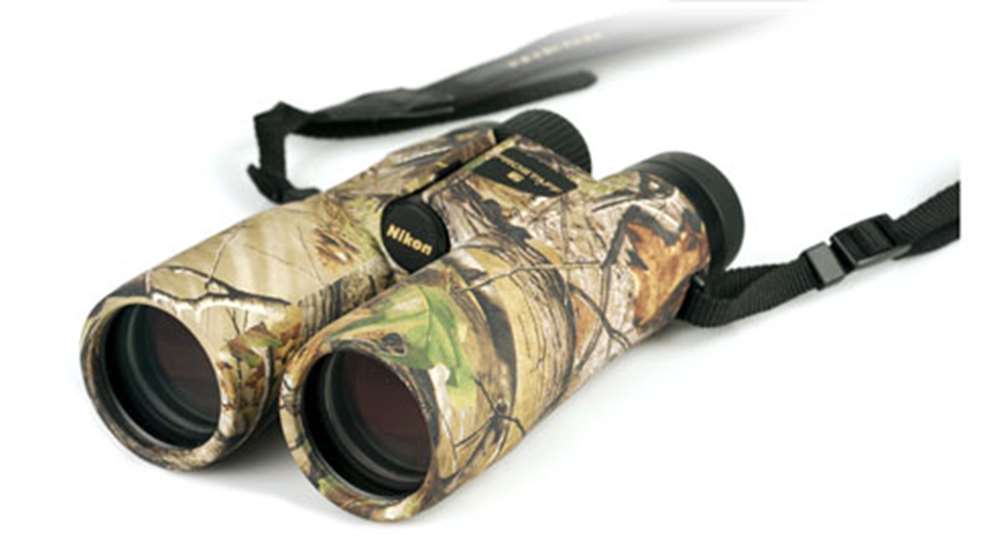
At just under 7 inches the Nikon roof-prism ProStaff 7 is a long binocular, but at 23 ounces, it is lightweight for its size. The unit is available in 8X or 10X magnifications, with 42 mm objective lenses. We tested the 10X unit.
While some Nikon products hail from Japan, the ProStaff is made in China, allowing for a lower suggested retail price. A glance down the ProStaff’s barrel-end with a flashlight revealed no telltale glue streaks or black tape meant to hide seams or cheaply baffle light. It’s evident the binocular’s aluminum barrels have been machined precisely. All of its glass-to-air lenses are fully multi-coated and its roof prisms are top-end BaK-4 glass and phase-corrected. Only a few years ago these features would have been impossible at the unit’s price.
The main difference in this unit and Nikon’s costlier lines is that its prisms are coated with aluminum alloy for 87 to 93 percent (average) light transmission. Nikon’s mid-priced units use silver alloy (95 to 98 percent), while top-end units such as the $2,200 EDG are dielectrically coated (99 percent). This means that the ProStaff’s low-light performance is slightly inferior.
Also, a new focusing mechanism adds overall length but also saves weight and cost. In testing it, we found its central focus wheel movement to be firm but not stiff; it’s also fast, requiring only 1.25 turns to focus from 13.1 feet to infinity.
The ProStaff 7 is categorized in Nikon’s ATB (All Terrain Binocular) line because it’s touted to be waterproof, fogproof and durable. We confirmed those claims by submerging it in warm water and impact testing the unit with no adverse effects. We did notice slight aberration at the outer edges of the lenses, but the only time that is noticed is when testing optics—not when using them.
We particularly liked that the eyecups rotated out in three positive stages quickly and quietly to accommodate either eyeglasses or naked eyes. Although the binocular’s advertised eye relief is 15.4 millimeters, our measurements indicated it had slightly less at 14.95 mm—either of which is adequate for even the thickest of eyeglasses. Its field of view of 314 feet at 1,000 yards is ample but standard for a 10X 42 mm binocular.
With Nikon’s ProStaff line a sportsman can buy an optic that should serve him for years to come, all without breaking the bank. The ProStaff 7 10X 42 mm is an example.
Importer: Nikon Sport Optics; (631) 547-4200; www.nikonhunting.com
Model: 7538; 7539 (camo)
Finish: black rubber armor; Realtree APG camo rubber armor
Field of View (Ft. @ 1,000 Yds.): 314 ft.
Eye Relief: 15.4 mm
Exit Pupil: 4.2 mm
Length: 67⁄8"
Weight: 23.5 ozs.
Features: fully multi-coated, click eyecups, tripod adaptable, aluminum coated phase corrected prisms, nitrogen purged
Accessories: lens caps, case, carry strap
Suggested Retail Price: $199; $250 (camouflage)
Most Popular