The idea is so deceptively simple that I’m surprised someone had not tried it before 2003, which is the year that Gaston Glock did try and success. In a world gone mad over high-capacity magazines on the one hand and big bore pistols on the other, Glock made a monumental effort to give shooters both. Most shooters are uncomfortable with a high-capacity, big-bore pistol and the double-wide magazine that is required. They are much happier with two columns of the shorter 9 mm or 40 S&W rounds. These are the people that I call Capacitonians, those who fill the air with metal and hope for the best. Their opposite number is the Caliberite, the worshiper of cavernous barrels and the massive projectiles that issue forth therefrom. Both would profit mightily from the application of the principles of marksmanship, but that’s another story.
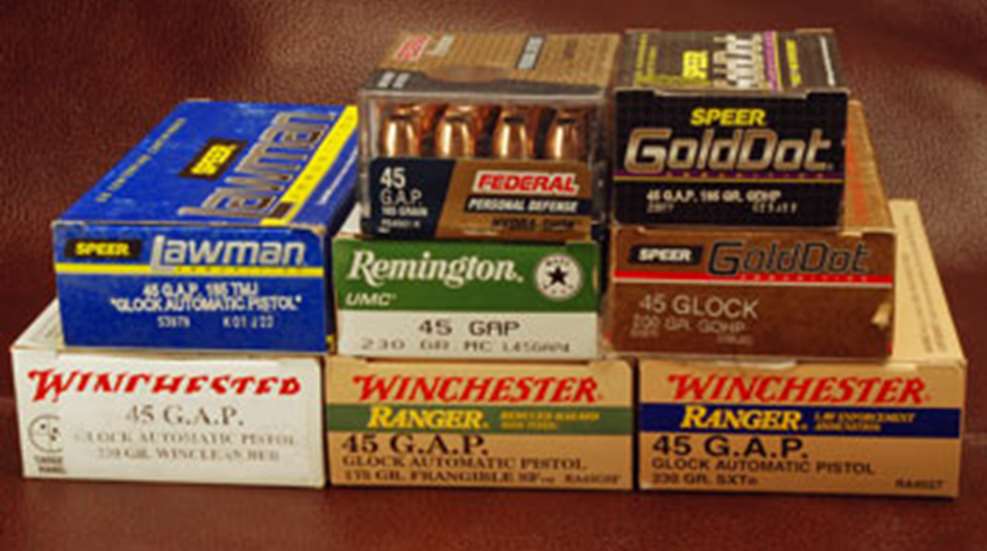
Glock and his designers simply shortened the .45 ACP case to 9 mm/.40 S&W length and inserted a typical .45 ACP bullet over a charge of powder. It used the same type of 9 mm magazine as typical guns of that caliber, of course it held a few less cartridges. Mechanically, the new pistol had to have a stronger, heavier slide and other mechanical modifications. But these were possible and Glock got them done. They offered small, medium and large versions of what was essentially the world’s first 9 mm-sized .45. The new cartridge was called the .45 GAP (Glock Auto Pistol) and ammunition makers started loading it quickly.
They say the measure of a cartridge is how many ammo makers produce the ammo and how many gunmakers build a gun for the caliber. Most ammo makers offer a .45 GAP round, but no other gunmakers currently offer a pistol in that caliber. There were a few XDs from Springfield and some really neat experimentals from Para, but if you want a pistol for your .45 GAP ammo, you have go to the source—Glock.
In short, the idea has not caught on particularly well. I believe Glock still sells respectable quantities of the guns, but there is no other option for the caliber. Most of that seems to be because “simply shortened the .45 ACP case” does not completely describe what happened. The designers had to fiddle with nearly every dimension of that case to make it work right and they obviously reduced case capacity. That simply means that a .45 GAP pistol will essentially reproduce .45 ACP ballistics—a 230-grain slug at 850 fps—but it does so at a sharply increased pressure level. And too much pressure is very hard on pistols—very hard.
Most Popular