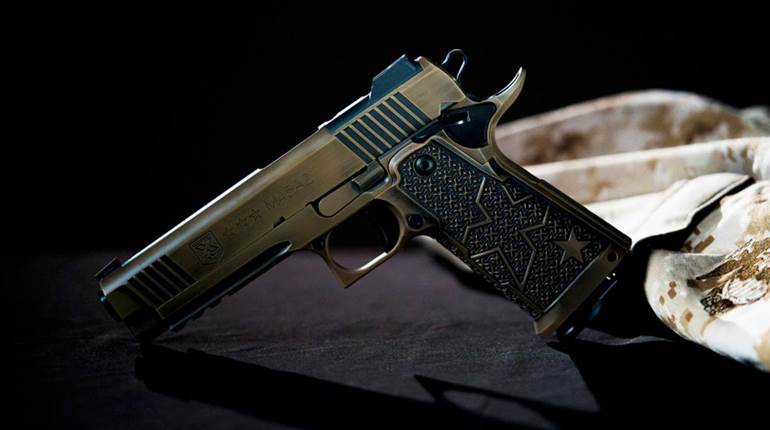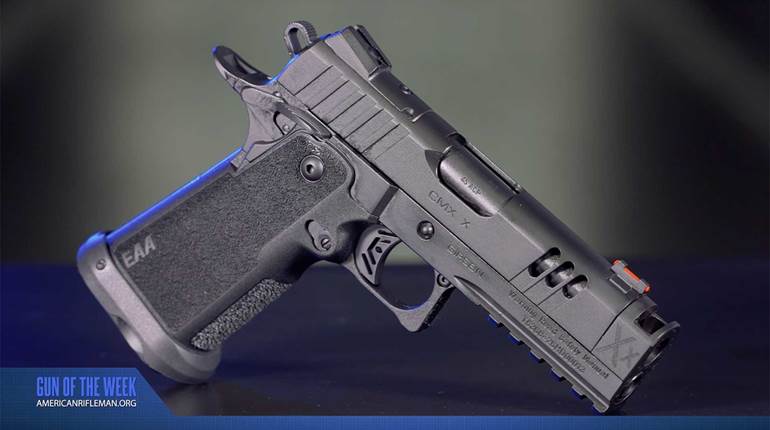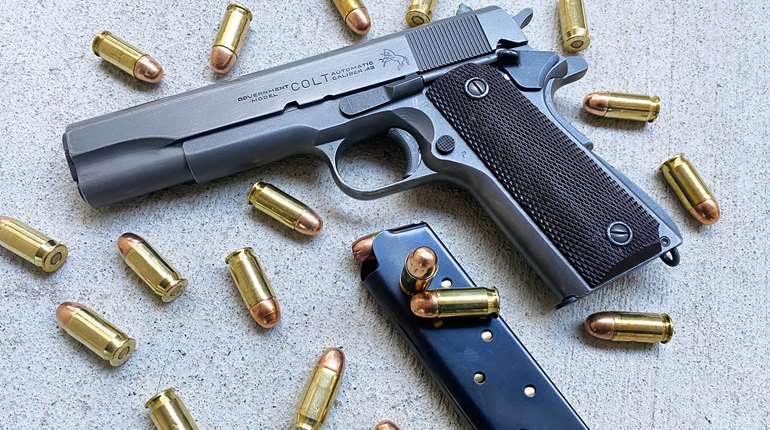
It is really amazing how many cartridges have long service lives. During this centennial year of the great .45 ACP cartridge (and the gun that shoots it), we remember a full century of service for this legendary problem-solver. Students of the .45 know that the basic idea is more than 100 years old, since Colt made early relatives of the 1911 as far back as 1905. The desirable ballistics of a big, slow-moving .45 slug for military service goes back as far as 1875 with the .45 Schofield round and 1873 for the .45 Colt. That turn of the century era was fertile time for ammunition designers. We saw the .38 Spl. introduced in 1898, the 9 mm Luger in 1904 and the .44 Spl. in 1907. The .38 Spl. became the top police cartridge of the 20th century in America. It also was the basis for .the famous .357 Mag., which ushered in the Magnum handgun era.
The 9 mm has been by called many different names, but it went on to world-wide success as a military service cartridge, not only in countless handguns, but also in numerous submachine guns. In the 1970s, concern over low cartridge capacity in police revolvers drove the cops to semi-automatics and the 9 mm became the standard police round by default. Presently, it has become the most popular police and civilian defense cartridge, because of its great adaptability to small autos. Looking at the considerable range of fine 9 mms on today's market, it's easy to forget that the round got its start with the beautifully made Luger pistol more than a century ago.
Elmer Keith's favorite .44 Spl. enjoyed limited success as a field cartridge, primarily as a handload in thousands of home ammo factories across the country. But it was the foundation for the enormously successful .44 Mag. of the 1950s. We are now seeing a resurgence of interest in the medium bore pistol—.40, 10mm, .41—but only the .40 S&W shows much sign of having a future. It seems like the most long-winded cartridge ideas date to that turn-of-the-century era.
Except for one that one started much earlier—the .22 rimfire. The earliest was the Short and that one dates back to 1857. It was followed by the .22 Long, which was first used in 1871 and then by the .22 Long Rifle, which first made its familiar craack in 1887. It is nothing less than amazing that the oldest metallic cartridge is the rimfire .22, which is alive and doing well, with no signs of slowing down.
Most Popular