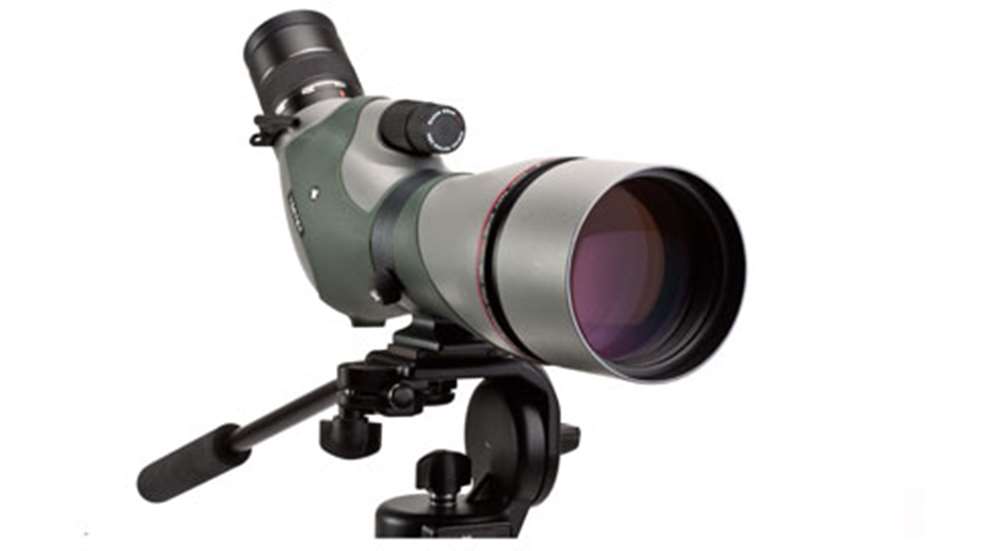
In addition to its riflescopes and binoculars, Vortex Optics offers a complete line of spotting scopes, ranging from the economical Nomad series to the top-tier Razor HDs, with options for nearly all applications and budgets. Within the feature-filled, but costlier, Razor HD line are angled and straight versions of the same 20-60X 85 mm scope configuration. The former is evaluated here.
The Razor HD porro-prism spotting scope uses extra-low-dispersion, high-density (HD) glass for optimal resolution and color fidelity, and the company’s XR lens coatings—the lenses are fully multi-coated on all air-to-glass surfaces—increase light transmission. The unit’s triplet apochromatic lens system minimizes chromatic aberration, or the color fringe of objects’ edges, across the entire field of view. ArmorTek, a treatment that protects against corrosive salts (from finger prints), scratches, stains, oil and dirt, is chemically bonded to the exterior lenses. The Razor HD is purged with argon gas to prevent internal fogging and corrosion, and it is sealed with O-rings to ensure it is waterproof.
The 20-60X eyepiece is removable, and the company offers wide-angle and tactical 30X versions for purchase separately. To enhance grip, the magnification band features a rubber, 7/8-inch-wide strip with molded-in checkering, and a twist-up eyecup accommodates eyeglass wearers and non-wearers alike. Alongside the eyepiece, on the right side, is the helpful “sightfinder”—essentially a hollow tube that coordinates to the scope’s field of view, enabling users to find objects more quickly. With the eyepiece off, the sightfinder is easily removed.
Attaching the eyepiece requires only aligning the orange/red line with the same-color dot on the scope body, then rotating the eyepiece clockwise until it locks into place. To remove, depress the spring-loaded lock located on the rear of the body below the eyepiece and turn the eyepiece counterclockwise.
Focusing is via dual dials. The rearmost dial is for coarse adjustment, and the front knob enables detail sharpening. Movement of the ribbed, rubber dials is smooth, but resistance is adequate to prevent unintentional changes.
Due in part to its gray, die-cast, magnesium-alloy body, which has functional and aesthetically pleasing green rubber inlays, the Razor HD is a bit heavy—4 pounds, 1.3 ounces. That said, the material was selected because of its strength-to-weight ratio, being lighter than aluminum and stronger than polycarbonate.
To evaluate the Japanese-made Razor HD, we tested it side-by-side with a top-tier, European-made 80 mm spotting scope fitted with a 20-60X eyepiece in widely varying light conditions—with heavy emphasis placed on low light—as well as at varying ranges, from 50 yards to two-plus miles. Overall, the Razor HD compared favorably, especially considering it costs significantly less. In most lighting conditions, and on identical magnification settings, it offered similar sharpness, clarity, contrast, and brightness; however, in extreme low light—nearing darkness—the competitor provided approximately five to seven minutes of extra viewing time.
Other noteworthy differences included the Razor HD’s 9.2-ounce heavier weight and dual focus adjustment dials. Concerning the former, neither optic—the competitor weighed 3 pounds, 8.1 ounces—is ideal for backcountry use; however, for range work and most hunting, they would excel. Although performing the same task, the single focus band on the competitor’s model was more intuitive.
The optic was placed in the freezer for six-plus hours and, after returning to room temperature, it exhibited no internal fogging. The scope was then placed in water for 15 minutes, and once again suffered no ill effects. It comes with Vortex’s VIP unconditional lifetime warranty.
With a suggested retail price of $2,000, the Razor HD is a significant expenditure; however, when comparing its features and performance to well-known, European-made spotting scopes, its true value is realized.
Importer: Vortex Optics; (800) 426-0048
Model: 20-60X 85 mm Razor HD
Finish: gray with green rubber inlays
Field of View (@1,000 yds.): 117 ft. (20X), 60 ft. (60X)
Eye Relief: 18-20 mm
Exit Pupil: 4.25-1.42 mm
Length: 15.25"
Weight: 4 lbs., 1.3 ozs.
Features: premium HD glass, XR lens coatings, removable eyepiece, coarse and fine adjustment dials, integral sunshade, viewing from multiple angles
Accessories: objective lens cover, eyepiece cap, view-through carrying case, owner’s manual
Suggested Retail Price: $2,000