The story of firearms in the Revolutionary War is a complex one, but a new exhibit at the DeWitt Wallace Decorative Arts Museum at Virginia's Colonial Williamsburg seeks to showcase the vast array of guns and edged weapons used in the fight for American independence. "To Arm Against an Enemy: Weapons of the Revolutionary War," which opened in April, includes more than 70 artifacts from the Colonial Williamsburg collection, each one highlighting a unique aspect of that story.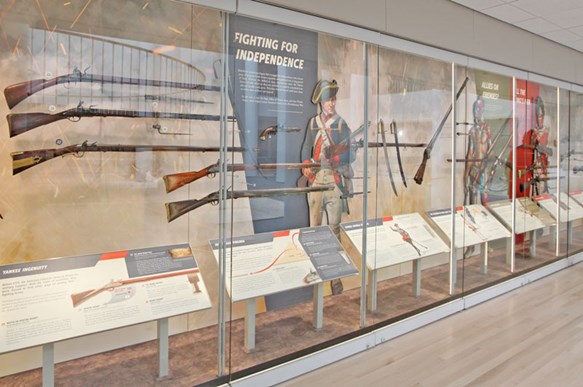
The exhibit "To Arm Against an Enemy: Weapons of the Revolutionary War" opened in April at the DeWitt Wallace Decorative Arts Museum in Colonial Williamsburg.
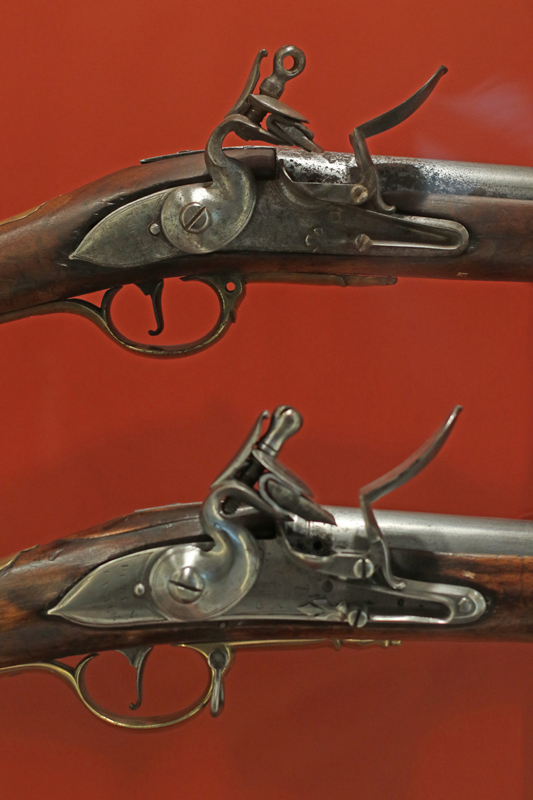
"More than just showcasing the weaponry of the French and Indian and Revolutionary wars, “To Arm Against an Enemy” speaks to the progression of military technology and the tools that were used to secure American independence,” said Erik Goldstein, Colonial Williamsburg’s senior curator of mechanical arts and numismatics, who led the exhibition.
The exhibit highlights not only the weaponry of American patriots and British Redcoats, but also colonial Loyalists who fought for the Crown, and Germanic mercenaries employed by the British. It begins by telling how the French and Indian War in the mid-18th century brought the first major influx of military weapons into the American colonies. It highlights the international nature of the conflict, from the importance of French weaponry to the cause for independence (the King of France supplied more than 100,000 weapons to the colonists), to the arms carried by Germanic mercenaries, to the fledgling efforts to manufacture military arms in America. Focused not solely on the arms of the infantry, those close-packed lines so often associated with Revolutionary War battles, it also showcases the weapons used by mounted combatants and naval forces.
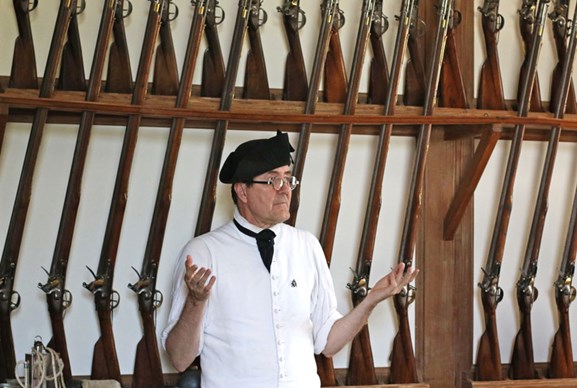
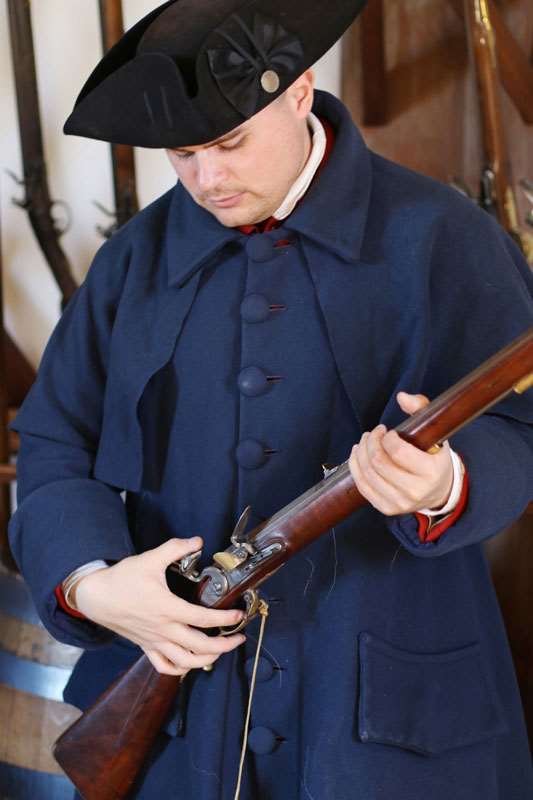
An interpreter talks about firearms in the powder magazine at Colonial Willliamsburg.
"Every piece here has a story," said Goldstein, pointing out a Brown Bess musket that was most likely surrendered at Yorktown before becoming a hunting firearm for a Virginia family.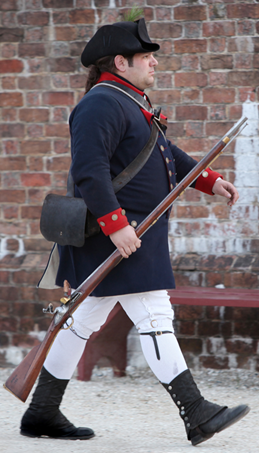
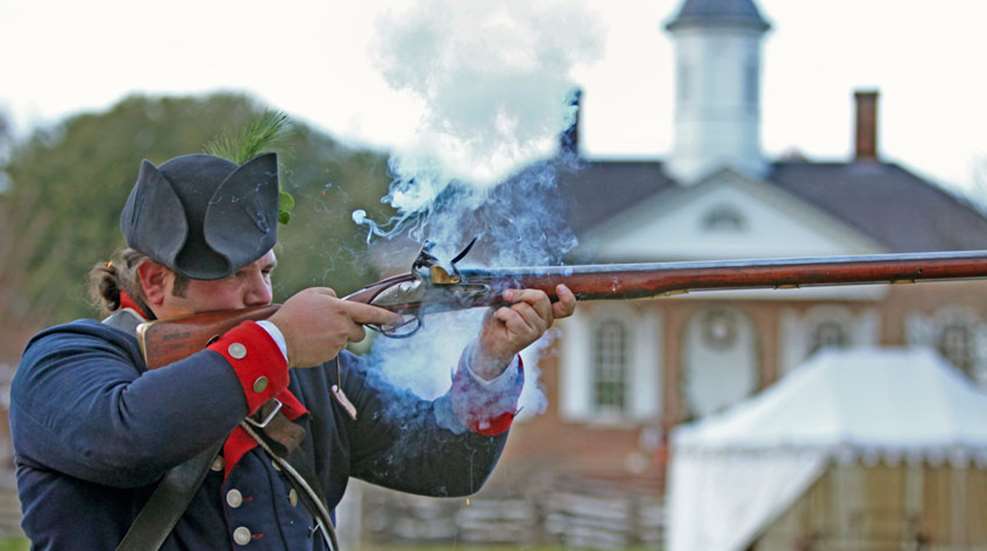
Military program interpreter Kilian Head prepares to demonstrate the firing drill at the powder magazine at Colonial Williamsburg.
The Colonial Williamsburg collection of more than 500 firearms from the 18th century, assembled over eight decades, is one of the most comprehensive collections of Revolutionary War-era weaponry in existence.
"Some of the firearms we're displaying you can count on one hand how many surviving examples are still in existence," Goldstein said. "The technology of firearms didn't change much between 1720 and 1840. These are weapons that remained in use for a long time and got used up."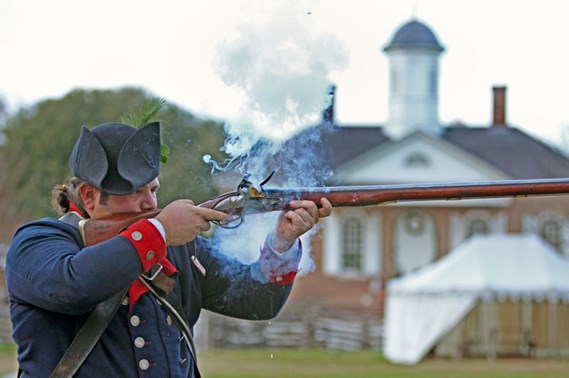
Military program interpreter Kilian Head demonstrates a firing drill at the powder magazine at Colonial Williamsburg.
Included in the exhibit are objects like an ultra-rare 1746 Land and Sea Service Brown Bess musket (one of three known to survive) and an equally scarce musket, pistol and sword produced by the Rappahannock Forge in Virginia—one of the few manufacturers in the colonies who produced weapons for the Continental Army (less than two dozen examples of their work are known).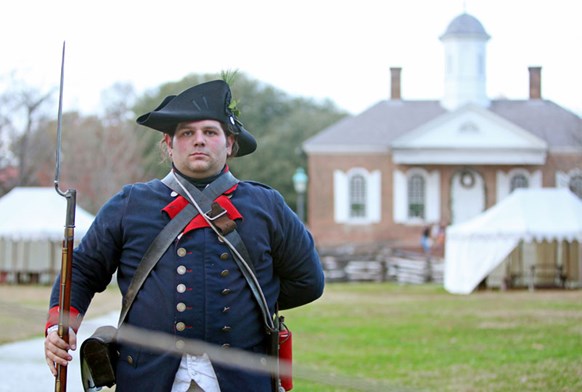
Military program interpreter Kilian Head demonstrates a firing drill at the powder magazine at Colonial Williamsburg.
The exhibit opened on April 20, the anniversary of the Gunpowder Incident, in which Virginia's Royal Governor, Lord Dunmore, removed the gunpowder from the magazine at Williamsburg. The 1775 event, which occurred a day after the battles of Lexington and Concord, enraged the local citizenry and was one of the catalysts of the American Revolution. The timing of the museum opening was deliberate, Goldstein said, as the exhibit displays the very arms that the British attempted to deny the colonists.
"To Arm Against an Enemy" replaces "Lock, Stock and Barrel," the museum's previous firearms display that was the DeWitt Wallace's longest running exhibit. Those who would miss the former exhibit's famous "deconstructed" musket (a Brown Bess disassembled in 3-D), will be pleased to know it has been included in this new exhibit.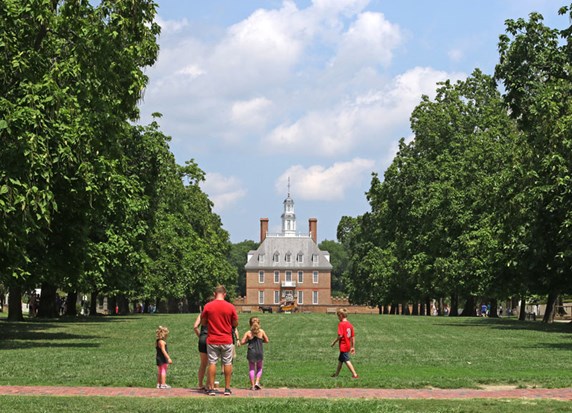
The Governor's Palace offers a guided tour of the life and home of the royal governors during the 1700s when Williamsburg was the capital of the Virginia colony.
Static museum displays are just one aspect of how Colonial Williamsburg interprets the role that firearms played in 18th century American life. They also have daily military arms demonstrations, craftsmen who meticulously create authentic American rifles using 18th century techniques, and a live-fire musket range where visitors get the opportunity to try their hand at firing a Brown Bess. 
The musket range is open every day at Colonial Williamsburg, where visitors can pay to experience firing a colonial-era flintlock firearms.
"From the historic firearms we have on display, to our military programs to our musket range, Colonial Williamsburg offers the complete flintlock musket experience, which is something that you can find nowhere else," Goldstein noted.
In October Colonial Williamsburg will host "Weapons of War: Military Arms in Revolutionary America." The three-day conference, which will bring in historians, collectors and Revolutionary War aficionados from around the country and is open to the public, is one more part of Colonial Williamsburg's effort to foster scholarship and interest in the firearms technology of the 19th century.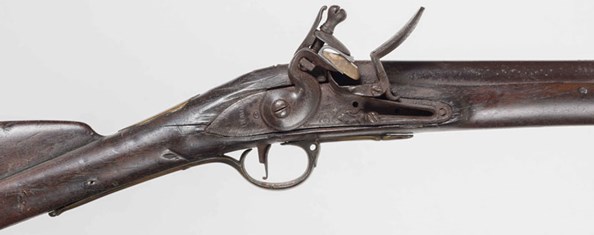
Pattern 1769 Land Service musket is on display in the exhibit "To Arm Against an Enemy: Weapons of the Revolutionary War" which opened in April at the DeWitt Wallace Decorative Arts Museum in Colonial Williamsburg. Photo courtesy of the Art Museums of Colonial Williamsburg.
"Colonial Williamsburg plays a leading role in the history and preservation of Revolutionary War-era firearms," said Goldstein, who noted that the foundation opens its collection to historians and researchers on the period.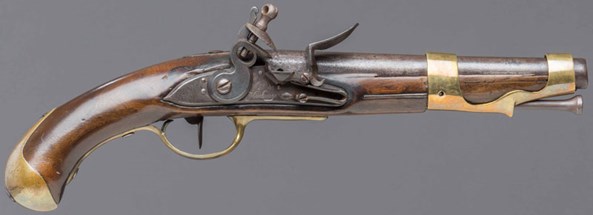
A French M-1766 cavalry pistol on display in the exhibit "To Arm Against an Enemy: Weapons of the Revolutionary War" which opened in April at the DeWitt Wallace Decorative Arts Museum in Colonial Williamsburg. Photo courtesy of the Art Museums of Colonial Williamsburg.
"To Arm Against an Enemy" is the first part of what will be three separate firearms-related displays at the DeWitt Wallace Museum. A display of artillery artifacts and military accouterments, and an exhibit called "Arming Williamsburg," are scheduled to open in 2021.