The quest to make our firearms’ projectiles move downrange at ever higher velocities cuts across multiple shooting pursuits and predates anyone alive today. Beyond our very American penchant for things that go fast, the ballistic motivations for these efforts are easy to see. Purpose-built defensive and hunting bullets, such as expanding designs or deep-penetrating solids, usually perform best at higher-impact velocities. Within the military small-arms realm, high velocity is a key criterion for armor-piercing munitions.
Extreme-long-range rifle shooters quickly learn that top-end muzzle velocities (MV) can also help supersonic projectiles remain stable at greater distances, thereby extending reach. Likewise, the quicker a bullet bridges the gap between muzzle and point-of-impact (POI), the less time gravity, wind, spin drift and other external forces have to work against it. That makes compensating for distance easier. It’s also why long-range competitors always seem to be staring across the bar at the trajectory that’s slightly flatter than the one sitting next to them.
Unfortunately, this aspect of projectile speed is also responsible for the misconception that increased velocity and better accuracy always arrive at the party together. During the past 40 years of serving and working in professions that focus on precision shooting and terminal projectile performance, dealing with the effects of MV changes has become a routine part of my life. In my experience, faster is not always better.
While increasing a projectile’s velocity often makes long-range shooting simpler, it can also ruin the chances for accurate shooting at any distance. This is especially true in pursuits that demand the highest levels of precision. Minute changes in chamber pressure and bullet speed cause fluctuations in the vibrational patterns that accompany projectile movements through the bore. Just like a sudden impingement on a freefloat rifle barrel, these variations can take the barrel “out of tune” from its ideal state for on-target performance with a specific bullet.
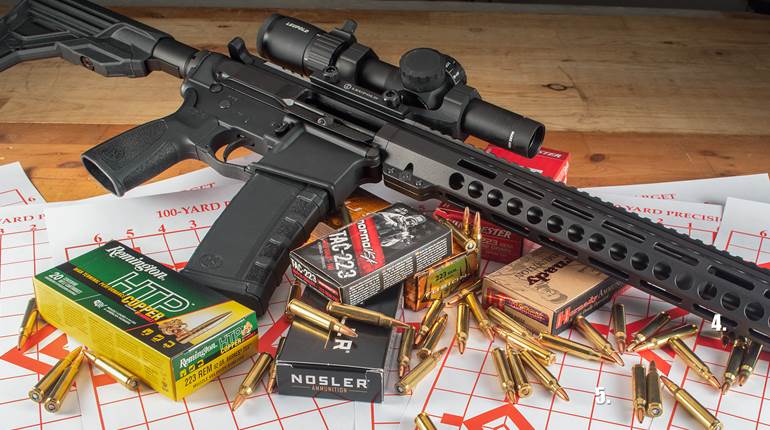
Handloaders who concentrate on precision aren’t (initially) obsessed with velocity for this reason. Once acceptable accuracy is found for a particular barrel, bullet and powder combination, charge weight is adjusted by fractions of a grain (up to the maximum recommended load) to determine if on-target results remain constant, fall off or improve. A higher-velocity recipe that meets or beats the “sweet spot” load’s accuracy is beneficial only when it doesn’t come with too much extra baggage.
Similar results can be seen when switching between a manufacturer’s lots within a specific factory load. Assuming that all other elements are equal, slight changes in accuracy, velocity or POI often accompany lot changes. Likewise, a specific bullet that performs well through a barrel won’t necessarily give the same performance when loaded by different manufacturers.
Things get even trickier in the shotgun department. Many a slug shooter has watched accuracy degrade when higher-velocity Fosters, Brennekes or sabots were tried. Malleable shot can suffer when pellets are damaged and misshapen by super-charged loads, leading to erratic and larger patterns due to increased drag. A more tangible effect, regardless of firearm type, is that the higher pressures generating faster MVs also cause more firearm movement. As shooters of full-power, big-bore loads through ultra-light firearms quickly learn, this forces the trigger puller to work harder to maintain his or her part in the accurate-shooting equation. When we struggle to maintain a solid position, or when felt recoil becomes uncomfortable, following through after each shot and applying the fundamentals of accurate shooting become big challenges.
Those same higher pressures also tend to accelerate bore wear from the increased heat and erosive actions of gases, powder and other particles—especially in the throat area of rifle barrels. Once a barrel is “shot out,” consistency quickly disappears. Furthermore, semi-automatic parts and components that lock a bolt or slide in battery, while chamber pressure is still high, also take more abuse. If all these downstream effects have you wondering when the velocity quest becomes a battle of diminishing returns, you’re not alone. New wonder-loads that achieve ultra-high-for-caliber velocities by pushing rifle-chamber pressures into the 80,000-psi range can generate excitement and skepticism.
At the end of the day, all elements in the system must be capable of handling the side effects of increasing muzzle velocity. Thankfully, evolving manufacturing methods, metallurgical advancements and ammo developments are helping in the quest for faster projectiles. One of these days, we may even see the elusive foursome of velocity, accuracy, “shootability” and durability work together all the way from primer to target.