“Over there, over there,
Send the word, send the word over there
That the Yanks are coming, the Yanks are coming
The drums rum-tumming everywhere.
So prepare, say a prayer,
Send the word, send the word to beware -
We'll be over, we're coming over,
And we won't come back till it's over, over there.”
—“Over There” by George M. Cohan
A century ago today, United States of America was no longer sitting on the sidelines. President Woodrow Wilson, who had struggled to keep the United States out of the military cataclysm of the Great War, asked the U.S. Congress for declaration of war, and he got it on April 6, 1917.
“Whereas, The Imperial German Government has committed repeated acts of war against the people of the United States of America; therefore, be it resolved by the Senate and House of Representatives of the United States of America in Congress assembled, That the state of war between the United States and the Imperial German Government, which has thus been thrust upon the United States, is hereby formally declared; and that the President be, and he is hereby, authorized and directed to employ the entire naval and military forces of the United States and the resources of the Government to carry on war against the Imperial German Government; and to bring the conflict to a successful termination all the resources of the country are hereby pledged by the Congress of the United States.”
The Great War had been raging for three years, and the optimistic nationalist fervor of the belligerent nations in 1914 resulted in bloody stalemate in the trenches on the Western Front, stretching from the English Channel to the Swiss border.
And it was into those trenches an American army would be sent. An army that didn’t exist. The pitifully small American regular army and National Guard—less than 250,000 strong and rated 14th in size in the world in 1914—needed to be expanded, trained and equipped.
The Allies needed men, and sought to use American Doughboys as replacements for the hundreds of thousands, if not millions, lost at places like the Somme or Verdun.
General John J. Pershing, commanding the American Expeditionary Force, wasn't going to let that happen. Not only would he not allow American lives to be thrown away piecemeal by French and British generals, he insisted that the men be trained. And not just in marching and close order drill. The French and British wanted men to wield bayonets throw grenades. General Pershing wanted riflemen.
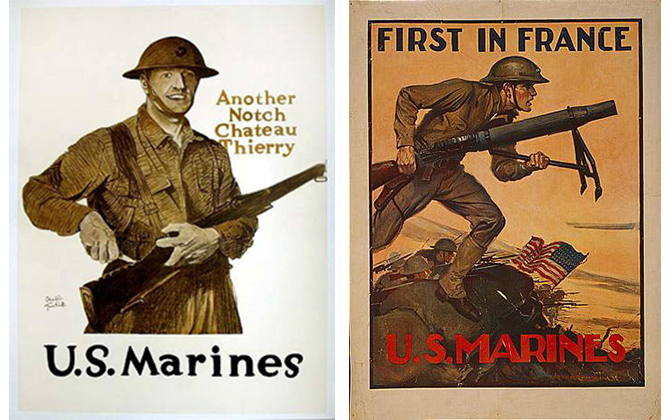
And eventually that is, indeed, what he got. Eventually about a million American soldiers would serve in France—including a brigade of United States Marines. 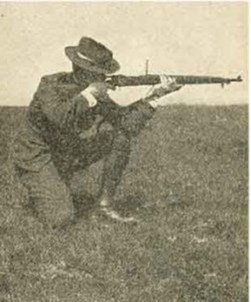
In the trenches late in 1917 (the first elements of the 1st Infantry Division arrived at St. Nazaire on June 26, 1917 but headed to the front in late October 1917) and more so in the open warfare that developed in 1918, American marksmanship mattered. American riflemen did things that the enemy didn't expect. They used precision rifle fire to overcome machine guns and strong points. Ever heard of Pvt. Roland Fisher? Things that simply weren't done.
While the U.S. Army was small, its small arms were state of the art, and on the Mexican Border in 1916, they proved their worth—or revealed shortcomings. The problem was there were simply not enough of them. Eventually, 2.8 million Americans would serve during the Great War.
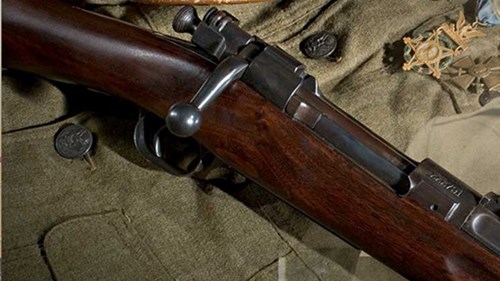
The standard infantry rifle of U.S. military in April 1917 was the U.S Model of 1903 Rifle, better known as the ‘03 Springfield. Chambered in .30-’06, the ’03 Springfield fed from a five-round stripper clip into its internal magazine. It was a two-lug turn-bolt design with the claw extractor on the bolt’s right. Of course, Springfield borrowed heavily from the German Model 98 Mauser. It had an intermediate length barrel, not a long rifle but not a carbine either. And it had excellent sights for long-range shooting.
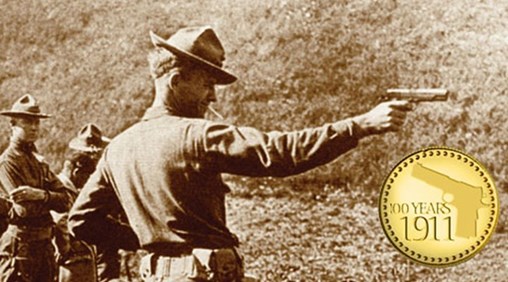
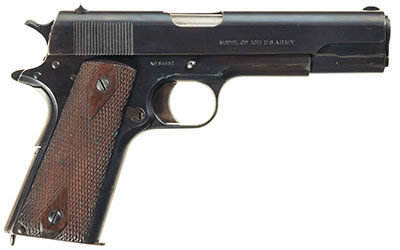
The standard sidearm for the U.S. military was the superlative U.S. “Model of 1911 U.S. Army” pistol (or Model of 1911 U.S. Navy for Marines). The John Moses Browning design finished by Colt chambered the .45 ACP cartridge and was dubbed “The Greatest Pistol in the World” by this magazine when adopted. Indeed, the M1911 was—and remains—one of the greatest fighting handguns of all time. The problem is there were not enough of them, despite Colt production being supplanted by the U.S. Springfield Armory (until 1916) and later Remington-UMC.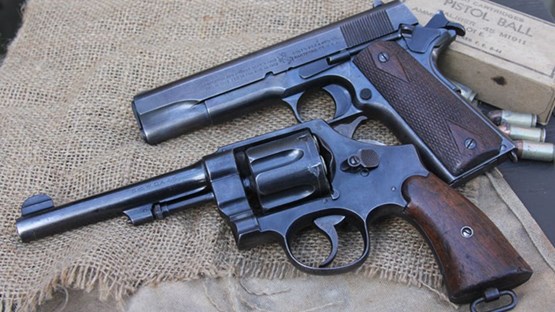
Demand for small arms was so strong that U.S. Army Ordnance Department adopted new designs to supplant the ‘03 Springfield and M1911 pistol. In particular, the British Pattern ‘14 rifle was slightly redesigned to accept the .30-‘06 Sprg. cartridge. This resulted in the U.S. Model of 1917 rifle, which was arguably better rifle for the trenches of France than the revered Springfield. And the majority of Doughboys who fought in the trenches actually carried U.S. M1917 Enfields. 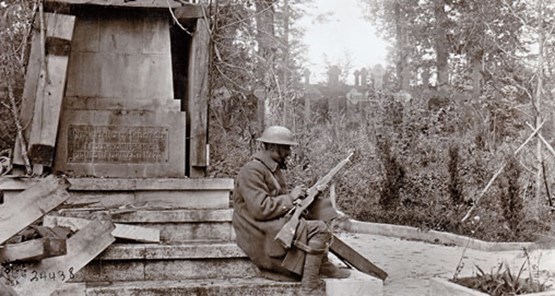
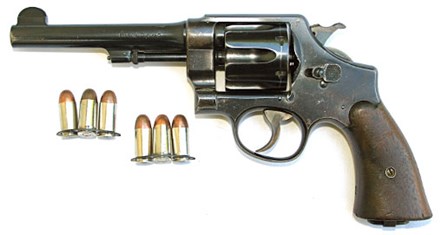
And although Remington-UMC in Bridgeport, Conn., joined Colt in the manufacture of the M1911 pistol, there was no way enough pistols were going to be available in time. This resulted in the adoption of two different U.S Model of 1917 Revolvers. One was based on the Colt New Service and the other was based on the Smith & Wesson Hand Ejector. They chambered the .45 ACP cartridge through the ingenious use of a half-moon clip (invented by Joseph Wesson) that permitted rapid loading and extraction for the rimless .45 ACP cartridge.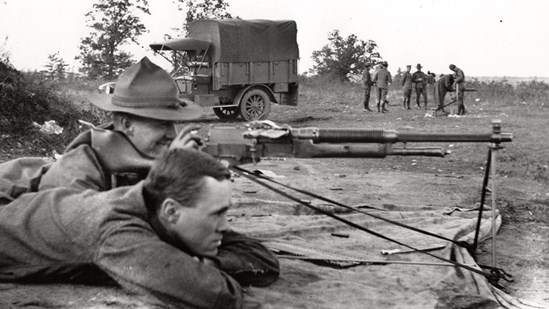
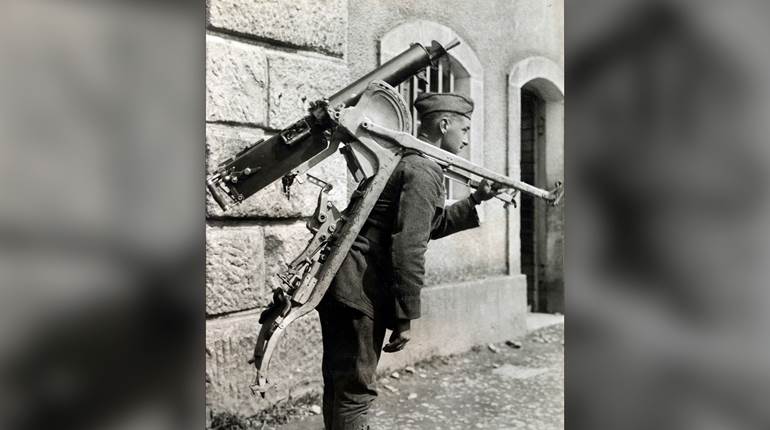
What the Doughboys didn’t have a century ago were machine guns (nor planes, tanks or artillery). The U.S. Model of 1909 Benet-Mercie machine rifle was a flawed Hotchkiss design that fed from metal feed strips, and there weren’t enough of them anyway. And the belt-fed hodgepodge of Maxim and Vickers machine guns in the U.S. inventory was simply a debacle. So the Americans turned to the Allies for both light and heavy machine guns. The majority of Americans ended up equipped with Hotchkiss heavy machine guns in a machine gun companies, while infantry platoons were issued CSRG Chauchat in 8 mm Lebel.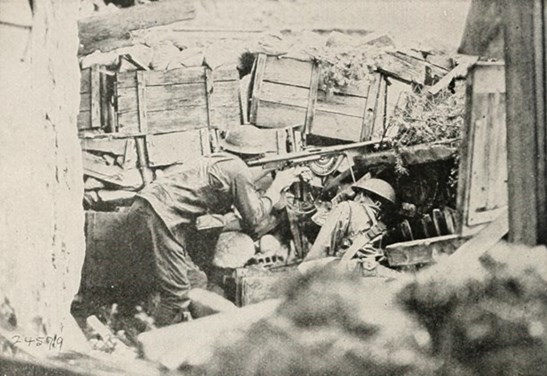
American infantry divisions that eventually ended up in the British sector, such as the 27th and 30th Divisions, lucked out when it came machine guns. They were issued the Model of 1914 Lewis light machine gun, while the machine gun companies used the excellent Vickers.
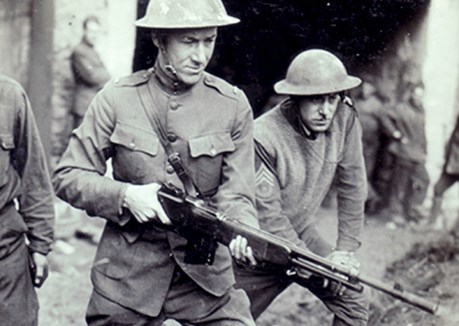
Late in the war, the Browning M1917A1 medium machine gun begin to see issue—and it would serve well into the Korean War—as did the Model of 1918 Browning Automatic Rifle. These two contributions from America’s greatest gun designer would serve first Doughboys, then G.I.s and then Grunts. Browning's M1911 would serve even longer.
During “The War to End All Wars” 116,708 Americans died—53,402 of whom were combat deaths or “missing”—and on this day, 100 years after their war began, we must remember their courage and sacrifice “Over There.”
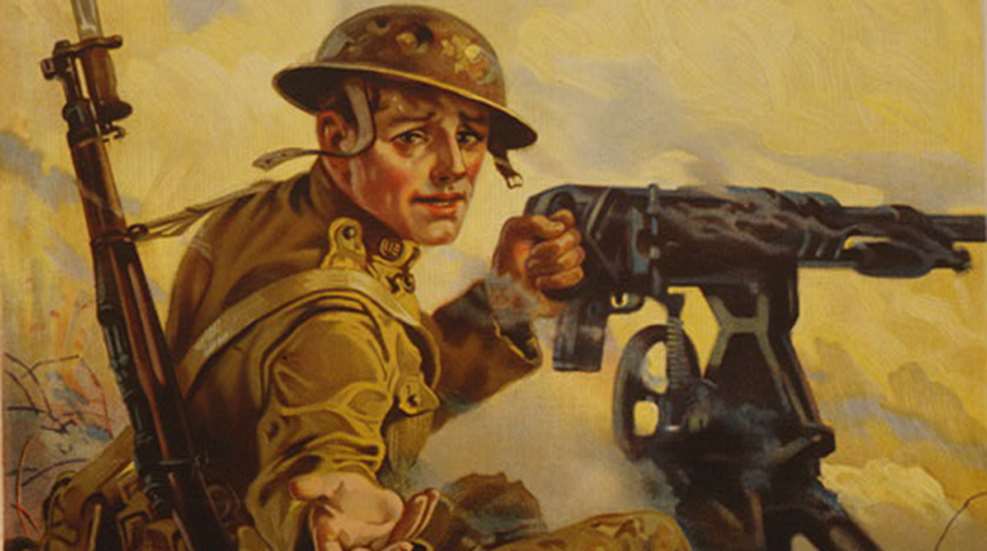
Top image by Vincent Lynel, 1918, Library of Congress
Most Popular