Designed to be easily broken down for convenient transport and storage, yet with the capacity to be rapidly reassembled and brought to bear if needed, takedown models of long guns have been produced since the latter part of the 19th century. While several takedown models exist on today’s market, few contemporary manufacturers are as fond of the idea as Ruger.
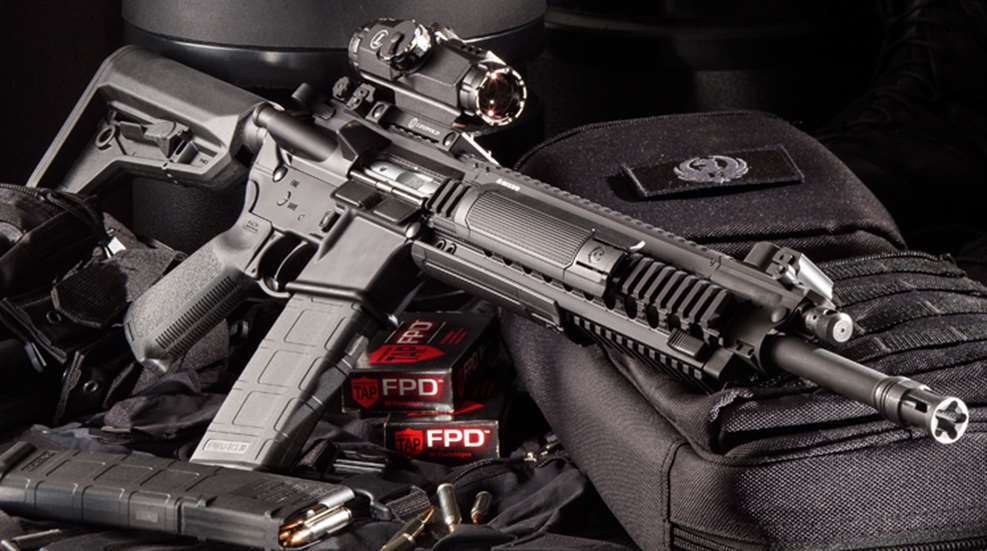
At home in a product line that also includes takedown variants of the company’s 10/22 rifle and 22 Charger pistol, the SR-556 Takedown is Ruger’s application of the takedown concept to the AR-15 platform. An upgraded version of its piston-driven SR-556 (October 2009, p. 62), the Takedown not only adds a quick-detach barrel system, but also contains a few additional improvements to the rest of the gun.
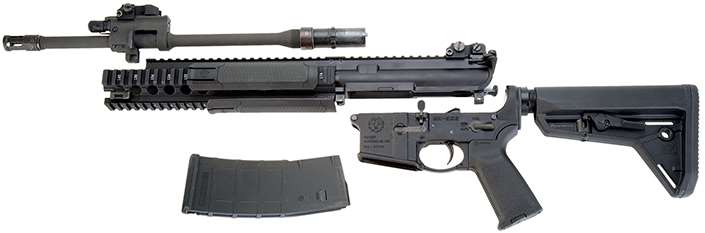
While the lower receiver is standard AR fare, the rifle’s barrel can be removed from the upper with only a twist of the wrist. When assembled, eight lugs located on the outside surface of the barrel extension solidly engage the inner splines of the upper receiver’s barrel nut to hold the two parts together. To remove the barrel, just lock the bolt back, depress the spring-loaded latch located at the front of the handguard and twist the barrel assembly an eighth of a turn counter-clockwise. The barrel, gas block and front sight will now freely slide from the handguard.
To reinstall, with the bolt locked back, just insert the barrel back into the upper (it can only be fully inserted the correct way) then twist the assembly clockwise until it clicks into place. A protrusion at the 9 o’clock position of the barrel extension’s face mates with an indention in the bolt carrier during lockup and ensures that the barrel cannot be either removed or installed while the bolt is forward, thus preventing potential out-of-battery discharges. The rifle’s tight tolerances and repeatable assembly mechanics ensure that the SR-556 Takedown is capable of consistent accuracy. As well, because the front sight is both elevation- and windage-adjustable, each barrel retains its zero even after repeated reassembly.
The Takedown’s operating system—with energy from the piston acting on a transfer rod that in turn acts upon the bolt carrier—is ideally suited for life in a takedown model. The gun’s gas block and piston are part of the barrel assembly, and the transfer rod is a part of the upper, with the interface between these two components providing the perfect location for barrel separation.
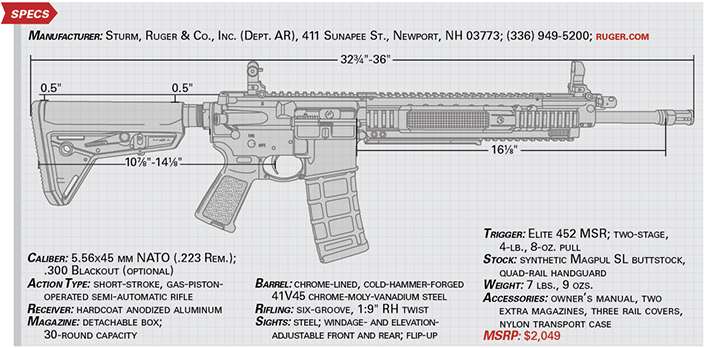
Apart from the addition of the takedown mechanism, Ruger’s newest SR-556 is also an upgrade over the original model in a number of ways. The Takedown ships from the factory with Ruger’s Elite 452 MSR trigger installed. The two-stage unit provides a crisp pull with a 2-lb., 8-oz. first stage and a clean 4-lb., 8-oz. break. Standard SR-556s come with a single-stage “G.I.” trigger with a pull weight range of between 7 and 9 lbs.
The new model also includes a Magpul MOE SL buttstock and MOE pistol grip, as opposed to the G.I. M4-style stock and neoprene Hogue grip of the standard SR-556. It is up to the shooter to decide if the changes constitute an upgrade; however, the new parts do help contribute to the takedown model weighing nearly 5 ozs. less than its predecessor.
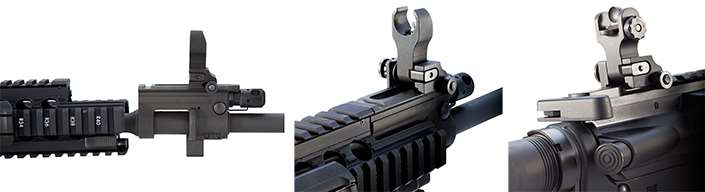
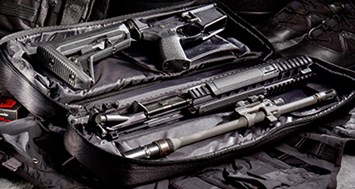 The rest of the Takedown remains largely unchanged. A semi-automatic rifle chambered in 5.56x45 mm NATO, the gun utilizes a four-position gas regulator. Both the upper and lower receivers are forged from 7071-T6 aluminum then hardcoat anodized.The 16.1", cold-hammer-forged, chrome-lined barrel is made of 41V45 chrome-moly-vanadium steel. All components of the operating system are chrome plated for greater wear and corrosion resistance, as well as increased lubricity. Standard features include metal flip-up sights, a dust cover, a forward assist and a flash hider. Our evaluation gun featured a quad-rail handguard, however, Ruger has introduced a new model furnished instead with a KeyMod-compatible handguard. The new model weighs 8 ozs. less than the quad-railed rifle reviewed here. The guns ship disassembled in a nondescript, easily toteable, 24" nylon case, with three, 30-round Magpul PMAGs and three rail covers.
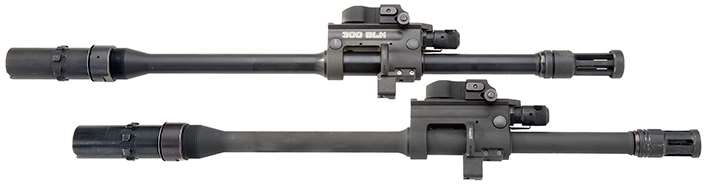
Further increasing the SR-556 Takedown’s versatility is Ruger’s 300 AAC Blackout Barrel Kit ($449), available at shopruger.com, which includes a 16.1" takedown barrel assembly chambered in .300 Blackout and two additional magazines. As both cartridges utilize the same bolts, buffer springs and magazines, a 10-second barrel change effectively makes the SR-556 Takedown a dual-cartridge-capable rifle. To minimize the risk of shooters potentially trying to fire a .300 Blackout cartridge through the 5.56 NATO barrel, all components included in the kit are emblazoned with “.300 BLK” on the side.
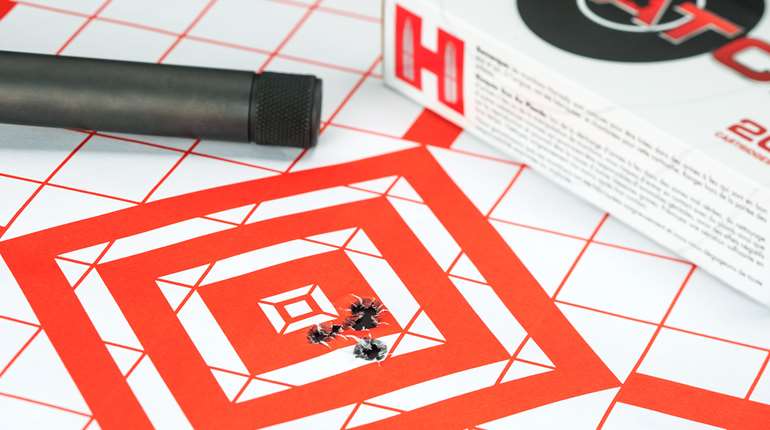
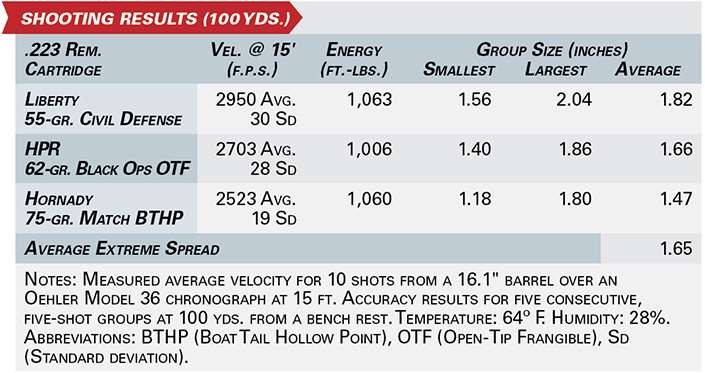
Previous evaluation of the original SR-556 revealed it to be capable of 1.5" to 2" groups at 100 yds., and our testing of the Takedown indicated that the addition of its quick-detach barrel system did not have a deleterious impact on the platform’s accuracy. Repeatedly switching between the 5.56 and .300 Blackout barrels also did not result in a shift in point-of-impact for either barrel. Results are tabulated nearby, and the gun functioned flawlessly throughout our testing.
Reliable, accurate, eminently portable and dual-cartridge-capable, the SR-556 Takedown raises the versatility of the AR platform to a level rarely seen before. Ruger intends to eventually migrate all SR-556 production to the takedown configuration, and the new model certainly seems to be a worthy successor to the original.
Most Popular