Thirty years after its introduction, the hybrid-frame, 2011-style pistol has gone mainstream, moving from the hands of high-level competitive shooters to the holsters of law enforcement and civilians going about their everyday business. With more eyes and hands on 2011 pistols comes more scrutiny. While the concept of a separate frame and grip module allowing a double-column magazine is still high-tech, at its heart, a 2011 pistol is based on the 114-year-old 1911 design. Staccato seeks to change this with the HD series of handguns, which it considers to be 2011s rendered modern, practical and rugged for everyday use.
The Staccato HD’s most notable feature is that the handgun is designed around the Glock-pattern magazine. If 2011 pistols have a weakness, it is their magazines. The commonly used STI/SVI pattern can be pricey—and may need tweaks to run reliably with specific pistols or ammunition. Glock magazines have a solid reputation and run about $20 at any gun shop you walk into, and many quality aftermarket models exist. The HD is compatible with any full-size (17 rounds or more), 9 mm Glock-pattern magazine and comes supplied with Mec-Gar’s new steel-body version. By using metal instead of polymer as its main component, the Mec-Gar magazines can fit an extra round within the same overall space for a total capacity of 18. The HD’s use of a Glock-pattern magazine results in a different grip profile that is slightly slimmer than a standard 2011, yet maintains the grip angle for which the 1911 is known.
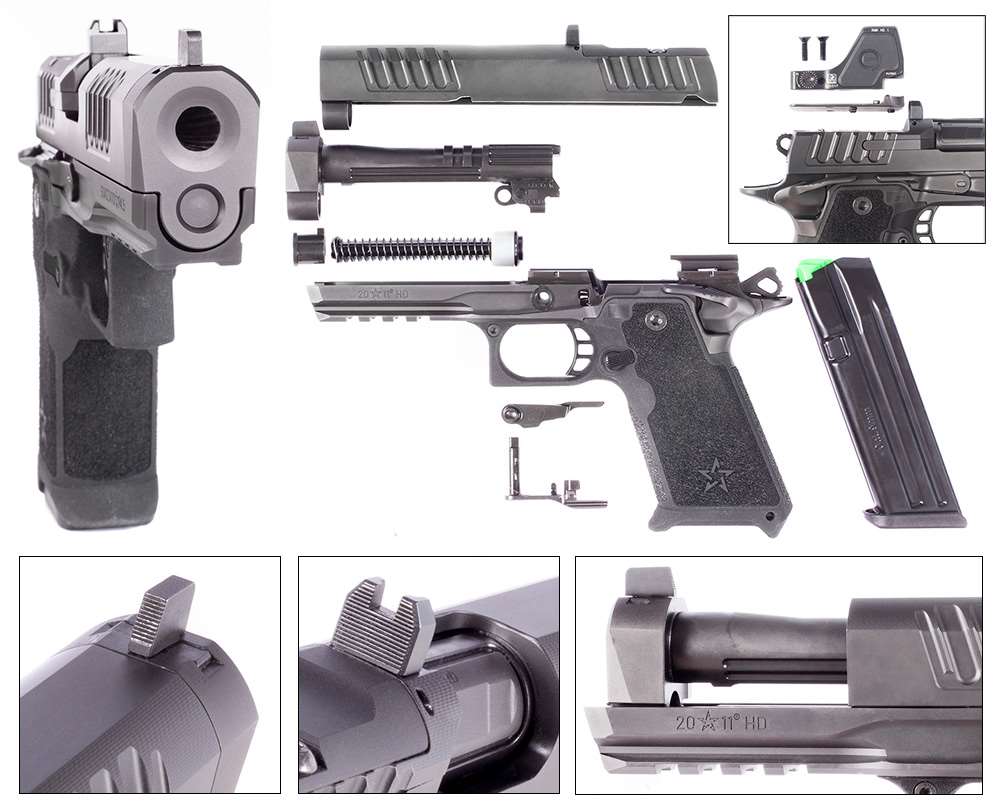
There is more to the Staccato HD than just being a 2011 that takes Glock magazines, however. Taking feedback from military and law enforcement users of other Staccato products, the company designed the HD from the ground up to be more rugged, durable and reliable. It was put through a battery of testing that Staccato said resulted in “our most thoroughly and aggressively tested set of pistols to date.” This redesign includes many changes from a traditional 1911 format. Gone is the traditional grip safety, replaced by a Series 80-style firing-pin block in the slide. The extractor is now external, like Staccato’s Carry line of pistols, and the recoil spring is a captive, flat-wire design.
The Staccato HD has been engineered to accommodate modern shooting techniques and right- and left-handed shooters. Controls are fully ambidextrous, with a manual safety lever and slide stop present on both sides of the pistol, and the magazine release is reversible. The slide stop has been moved rearward from the usual 1911 position, allowing the thumb of the shooting hand to reach it, but keeping the support-hand thumb from accidentally actuating it. A prominent beavertail and an undercut trigger guard allow for a higher grip. Thumb indexing “gas-pedal” platforms have been machined into both sides of the frame, as well as a four-slot accessory rail on the dustcover. The slide has a more pronounced bevel on its upper surface, with texturing on the radii and front serrations that extend over its top surface to provide a firmer grip when using gloves or working around an optic.
What remains of a 1911 in the HD design? Namely that hammer-fired, single-action mechanism with a manual safety that allows for an excellent trigger pull and “cocked and locked” carry, the swinging barrel link that unlocks the action as the slide moves rearward and some remnants of that classic 1911 visual aesthetic.
The iron sights are of sufficient height to co-witness with most optics. Optical sights are mounted with Staccato’s HOST (Host Optic Specific Technology) plate system, which uses two screws, each of which passes through the adapter plate to attach the optic to the slide. Plates are available for a wide variety of optic footprints and retail for $75.
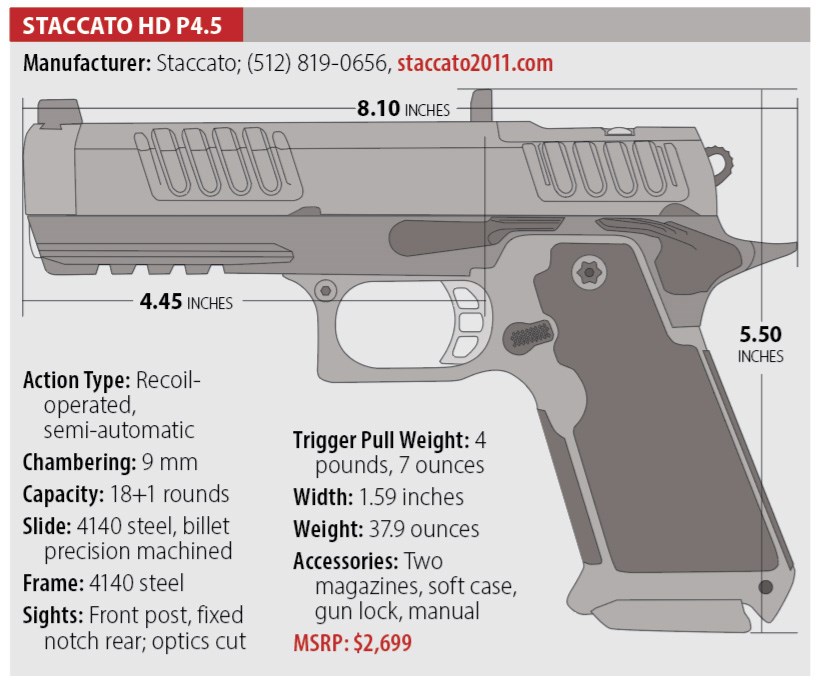
The HD is offered in two versions—the 4-inch-barreled P4 and the 4.5-inch-barreled P4.5 that is the subject of this test. A unique feature of the HD series is that both pistols use the same recoil system and slide, with the P4.5’s barrel having a sight block on the end. This means that the longer-barreled P4.5 benefits from the quicker cycling time and reduced reciprocating mass of the shorter slide with the additional muzzle weight of the sight block to produce a quicker and flatter-shooting pistol.
Staccato is now also manufacturing ammunition, and I used its range and match cartridges to test the HD. Unsurprisingly, the company’s 136-grain, open-tip match ammo provided the best groups. Reliability was 100 percent from round one. Staccato recommends the use of the included Mec-Gar magazines, as well as OEM Glock magazines, and both functioned perfectly in testing.
The HD’s trigger has about .05 inch of take-up, as a proper duty/defense 1911 should, and then breaks crisply at just lighter than 4.5 pounds. Only about .05 inch of movement is required for the trigger to reach its positive reset.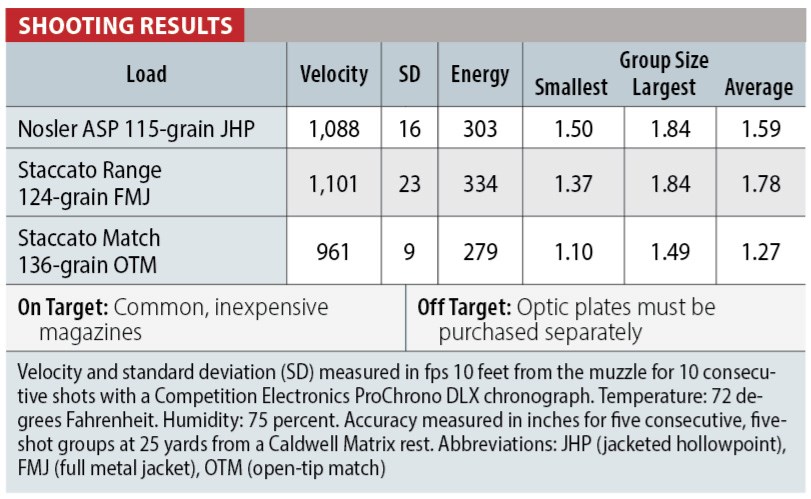
Ease of disassembly and reassembly is where the HD differs from most modern service pistols. The first step in disassembling the HD is just like a standard 1911. After confirming the pistol is unloaded, retract the slide to align the slide stop with the slide-catch notch (that also serves as the takedown notch) and remove the left-side slide stop. Removing the slide from the frame, lift out the captured takedown spring and remove the reverse plug. The barrel can then be removed through the front of the slide.
HD pistols are available in three packages, from the base model to upgraded front sights, mag wells and deeper “X-serrations” that are lightening cuts that expose the barrel. HD pistols start out at an MSRP of $2,499 for the base model P4, and the P4 is also offered in a California-compliant model. The P4.5 I tested came with Staccato’s “Standard Package” and has an MSRP of $2,699.
Staccato is certain enough of its HD pistols to call them “the future of 2011s;” traditional, yet innovative and now durable, turning the once-niche 2011 into an everyday handgun.