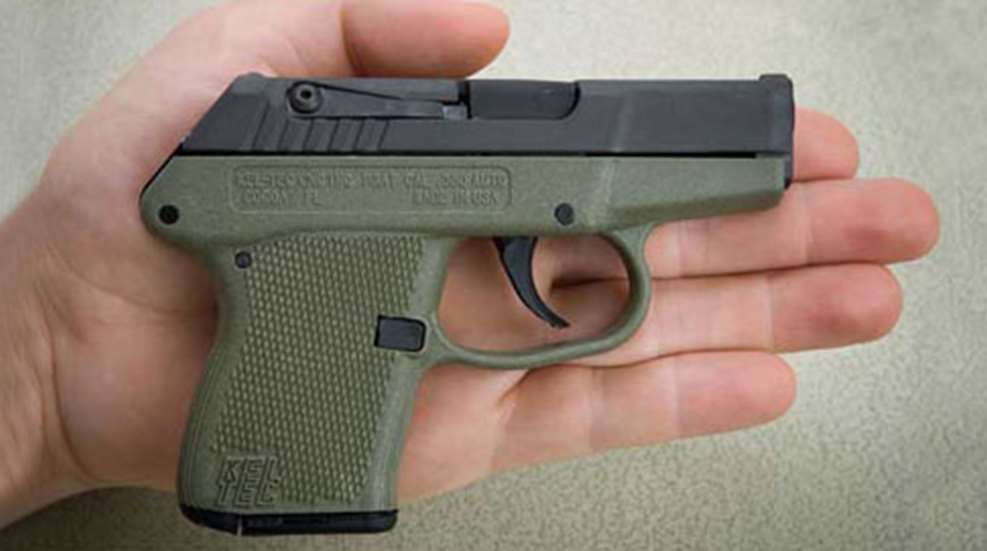
Despite the plethora of subcompact handguns in duty chamberings such as .38 Spl., 9x19 mm, .357 Mag., .40 S&W and .45 ACP, there is still a case to be made for the true pocket pistol—most commonly in .25 ACP or .32 ACP. These tiny guns make up for their lack of stopping power, cartridge capacity and accuracy with one critically important attribute: the ability to be carried discretely with just about any type of clothing.
The 6.5-oz. Kel-Tec P-32 is the lightweight winner among pocket guns, and with a width of approximately ¾ inches is about the thinnest as well. The P-32 has perhaps only one flaw: its anemic .32 ACP chambering. Realizing this, the engineers at Kel-Tec started work on a .380 version of the P-32. The 7.5-oz. P3AT was introduced in 2003 and retains the virtues of its older brother, while offering increased terminal effectiveness.
The .32 ACP and the .380 Auto may be weaklings, but they are by no means equal. In the top loadings, the .380 Auto is capable of generating around 200 ft.-lbs. of energy—some 50 percent more than the hottest nominal .32 ACP ammunition and roughly equivalent to the energy of standard .38 Spl. loads.
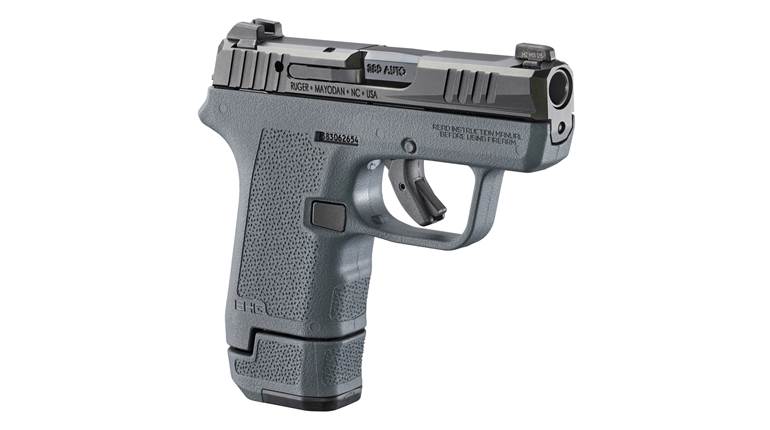
The P3AT is a locked-breech, double-action-only, semi-automatic pistol featuring a polymer grip frame (available in black, gray or green). The gun can be had with a blued, Parkerized or hard-chromed slide. The P3AT is identical in length and width to the P-32, and less than an ounce heavier. Externally, the P3AT can be distinguished by the lack of the P-32’s lengthwise lightening cuts in the slide; internally, the .380 sports a different barrel, a stiffer dual-coil recoil spring, a new ejector and a slightly wider magazine.
The frame consists of an aluminum block—pinned in place inside the polymer grip unit—that forms the frame rails and contains the trigger mechanism. Locking and unlocking are accomplished by way of a familiar pattern: A shoulder on the barrel abuts the rear face of the ejection port and a kidney-shaped cut-out on the large barrel underlug engages the takedown pin, causing the barrel to be cammed downward out of engagement when the slide moves rearward and upward into lockup when the slide returns forward.
Feeding is from a detachable, six-round steel box magazine with a removable floorplate. A small polymer button on the left side of the frame—under the thumb of a right-handed shooter—is depressed to drop the magazine. Extraction is by way of a spring-loaded claw, and ejection is via a block that sits in a recess in the left frame rail.
Pulling the trigger actuates a right-side trigger bar that, as it moves forward, retracts and then releases the spring-tensioned hammer to fire the gun. As the slide moves rearward under recoil, it cams the trigger bar downward, allowing the trigger to reset. The P3AT incorporates two passive safeties: an inertia firing pin and a hammer block that prevents the hammer from contacting the firing pin unless the trigger is pulled.
Sights are integral with the slide and consist of a small rear notch and a 0.50-inch-high post at the muzzle. Although rudimentary, the sights cannot catch on clothing during a draw from concealment. The recessed, spurless hammer and the absence of any projecting safety or slide-lock levers also contribute to its snag-free profile.
We tested the P3AT off sandbags with Cor-Bon JHP, Remington Golden Saber and Winchester FMJ ammunition at 15 yards, which we felt was more appropriate than 25 yards in light of the gun’s miniscule sights and intended purpose. We experienced no failures to feed, but three failures to eject with the Winchester ammunition, which was also the least-powerful load tested. Kel-Tec recommends fairly energetic loads for best functioning in the P3AT, and we concur. Test results are summarized in the accompanying table.
With all loads, accuracy was adequate for close-range defensive purposes. Also, with all loads, groups printed slightly low. Recoil, was quite snappy and eventually created a sore spot on our test firer’s trigger finger where it was slapped by the trigger guard. The narrow polymer frame with its molded-in checkering allows a secure and comfortable grip for persons with small- or medium-size hands; larger-handed people may want to take advantage of the optional seven-round magazine with its extended finger rest.
Weighing less than half that of its competitors, and priced at between $311 and $367 depending on the finish, the P3AT is hard to beat among .380 carry guns. Reliable with ammunition it likes, and concealable under almost any type of clothing, it leaves the armed citizen with no excuses for failing to observe the first rule of gunfighting: have a gun.
Manufacturer: Kel-Tec CNC Industries, Inc., (321) 631-0068; Kel-Tec.com
Caliber: .380 ACP
Action Type: double-action-only, semi-automatic pistol
Frame: CNC machined 7075-T6 aluminum block inside Dupont ST-8018 polymer grip frame
Barrel: 2 3/4"
Rifling: six-groove, 1:16" RH twist
Magazine Capacity: six rounds
Sights: front post and rear notch, integral with slide
Trigger Pull: double-action, 6 lbs., 4 ozs.
Overall Length: 5"
Height: 3 1/2"
Width: 3/4"
Weight: 7.5 ozs. (without magazine); 9.25 ozs. (with magazine)
Accessories: soft case, owner’s manual, lock
Options: +1 magazine extension/finger rest, belt clip
Suggested Retail Price: $311 (blued slide), $352 (Parkerized slide), $367 (hard-chromed slide)
Most Popular