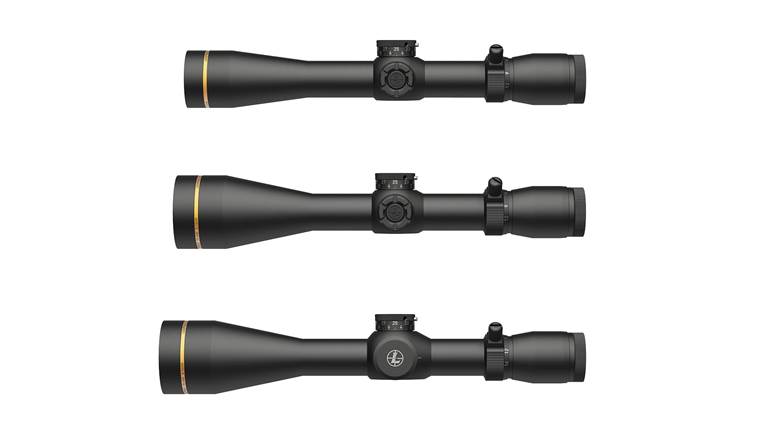
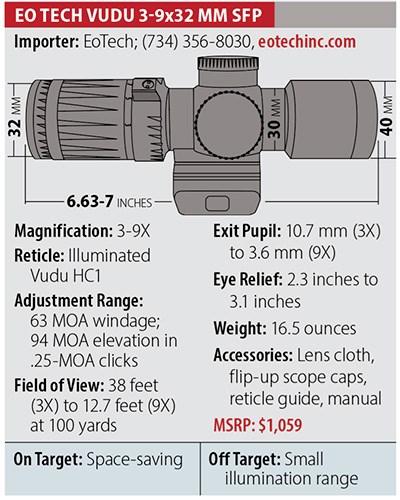
Given time, nearly every piece of technology eventually shrinks in size. We’ve seen this across dozens of shooting-product genres, with optics being no exception. As long guns become more condensed and peripheral gear becomes more prevalent, these compact riflescopes are a welcome addition to the landscape. One of the latest is EOTech’s Vudu 3-9x32 mm SFP, a variable-power scope so small, it rivals many fixed-power prismatic optics in compactness. The package is built with perhaps the archetypal hunting magnification range of 3-9X. Its 32 mm objective lens widens the field-of-view compared with most low-power variable optics (LPVO), and, at roughly 6.8 inches in length, the scope is substantially shorter. Set into the second-focal plane is the company’s HC1 reticle, which provides evenly spaced hashmarks that emanate from a central aiming dot. As these marks do not scale with magnification, their values vary based on where the zoom ring is set. At the lowest setting, the dot will cover 3.6 MOA and the spacing between each hashmark is 6 MOA.
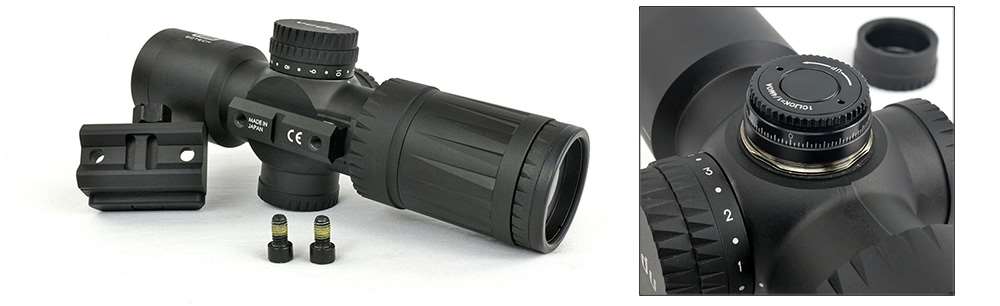
The windage and elevation turrets are meant to be set and left alone; each is capped with a knurled cover to offer protection from accidental engagement. On the left side of the main tube is an illumination dial with 10 settings and an “off” position between each. The scope has a fixed 200-meter parallax setting, so there is no adjustment dial here. The left turret also houses the single CR2032 battery compartment used to power the optic. When activated, it illuminates the central aiming point and a portion of the marks that surround it.
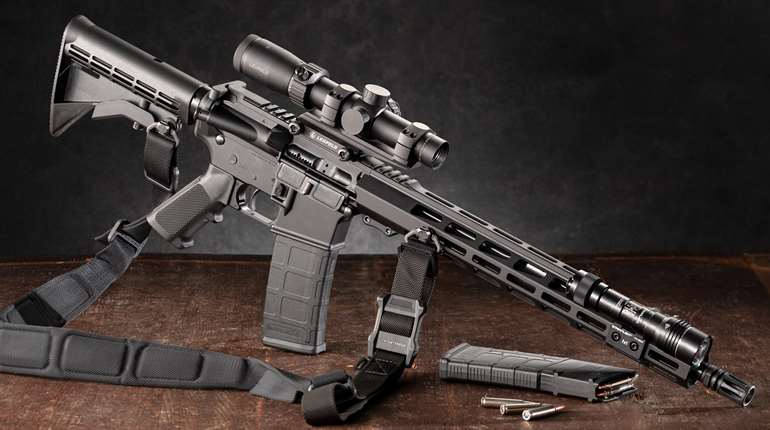
 Since the main tube of this optic is too short for conventional scope rings, it utilizes Trijicon mini-ACOG-style mounts that affix directly to the underside of the housing. The included mount yields a height-over-bore of 1.56 inches, but there is a plethora of other heights available for those seeking customization. As this height works well with the AR-15, I mounted it to a .300 BLK-chambered carbine for testing.
Focusing the reticle revealed such an extraordinarily wide adjustment range that I had to incorporate it into the length specification. Turret clicks were remarkably positive, distinct and tight.
The illuminated reticle’s top setting was bright enough for use in broad daylight, but the others were so faint that it was difficult to tell if the unit was even on; this is undoubtedly to make them more user-friendly in pitch-black conditions.
After zeroing with subsonic ammunition at 100 yards, there was still 37 MOA of elevation left to work with, which put the scope close to a perfect mechanical zero. This helped free the scope of any aberrations, as the erector tube was nearly perfectly aligned within its outer housing. Tracking seemed to be spot-on when shooting “the box,” and the adjustments were repeatable, which was confirmed by clicking back to the 100-yard zero and re-engaging the original target.
The scope’s short length leaves plenty of rail space available for the supplementary addition of clip-on thermals, lights and other accessories. That’s the trouble with technology—although each individual piece may get smaller, it seems like we end up carrying more of it. eotechinc.com