2/1/2013
Movement should be a critical part of any defensive plan. However, some serious thought should go into the techniques used when moving and shooting a carbine or, in fact, any defensive firearm. The problem is that we train on a square range, which is usually nice and flat and devoid of any obstacles that can trip us up. In the real world, we have to deal with uneven ground surfaces that can be strewn with all sorts of objects that can get in our way. For this reason, some thought should be devoted as to how we can move effectively and quickly.
Another concern regarding movement is that improper movement can spoil our aim. Since it is often a good idea to lay down a covering fire as you move to new, or better, cover, accurate fire is critical. Conventional walking, or running, can really cause the gun sights to dance around. Fortunately, there are ways to minimize this.
When moving forward, we often suggest that the shooter use the “Groucho method.” Unfortunately, many younger shooters don't have a clue who Groucho Marx was, let alone have ever seen one of his old movies and his distinctive style of walking. So let me explain the technique as it applies to the defensive shooter.
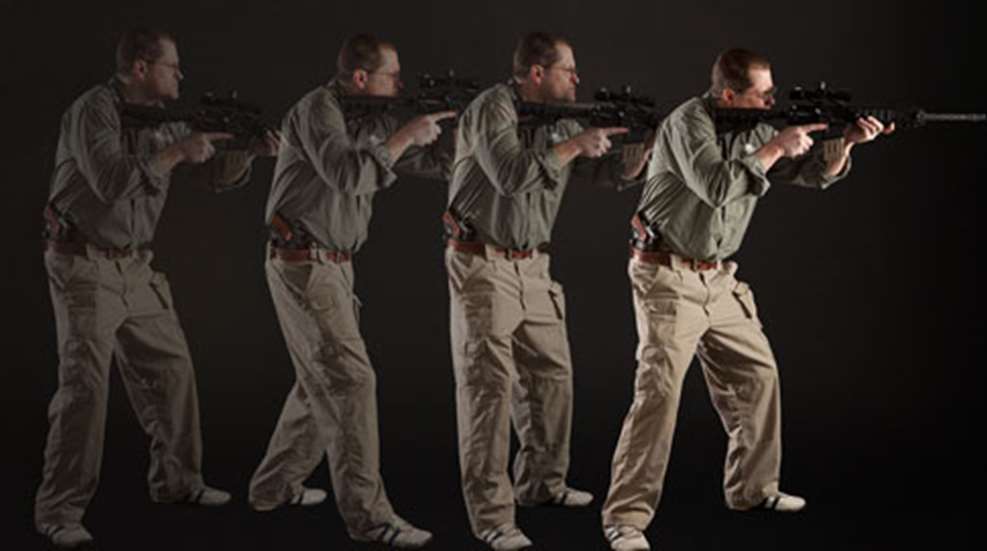
The shooter stands in the modern defensive posture, with the body leaning slightly forward, knees bent just a bit and feet about a body-width apart. To move forward, one simply maintains this athletic posture and steps out with the heel contacting the ground first, followed by the toe of the foot. Heel and toe, heel and toe, is the way to proceed and keep the sights on the target. Keeping the knees slightly bent is an important part of this maneuver.
To move to the side, one maintains the defensive posture and takes a regular step to the side with the lead foot (the foot closest to the direction of intended travel), while the other foot takes about a half step in the same direction. Using this method, a defensive posture is always maintained and one avoids the mistake of allowing the feet to ever be close together. With the feet close together, it is much easier to lose your balance and/or be knocked down. It also keeps you from crossing your legs, which is a good way to get tripped up. As you move to the side, the thought should be “Big Step, Little Step.”
If at all possible, moving backward should be avoided. The more you move backward, with eyes on the threat, the greater the chance of ending up flat on your back. Still, backward movement may sometimes be necessary.
To move backward effectively, the stepping technique is reversed from that of the forward movement. We step back with the toe of our foot and then bring the heel down. This movement should be accomplished as slowly and easily as possible, allowing the toe of your foot time to detect any objects that might be in the way. It is also important to know if the ground behind you is about to fall away, or rise.
A good way to practice this movement technique is to start on a square range with an unloaded carbine. In fact, an unloaded carbine is critically important until one gets the movements down.
The drill is simply to move in a square while keeping the carbine sights on a target. As you move forward, it's heel and toe. Moving backwards, it is toe and heel. Moving sideways, the method is big step—little step. And always remember to keep the body in the defensive posture, leaning slightly forward with the knees slightly bent.
Once you have practiced this method with an unloaded carbine and feel comfortable with it, it is time to try the exercise with live fire. Just remember to move slowly, think about what you are trying to accomplish and keep safety foremost in your mind.
After this drill feels comfortable to you, it is time to try it in the confines of your home. Again, your wife and family will appreciate the fact that your carbine is empty during practice. Maneuver around the rooms of your house. See what it's like to have to deal with furniture, the kids’ toys, rugs, the family pet and whatever other obstacles that present themselves. You will probably quickly realize that moving with your carbine is not as easy as you might think.
Practice will help you get the techniques down. And, obviously, the same techniques work just fine for the times that you might be armed with a pistol or shotgun.
In the real world, we may have to move forward to the aid of a family member, or back up to create distance from the threat. And we may have to move to one side or the other to take advantage of protective cover. Keeping our sights and eyes on the threat, while moving safely and effectively is the goal. It just takes a little practice.
Most Popular