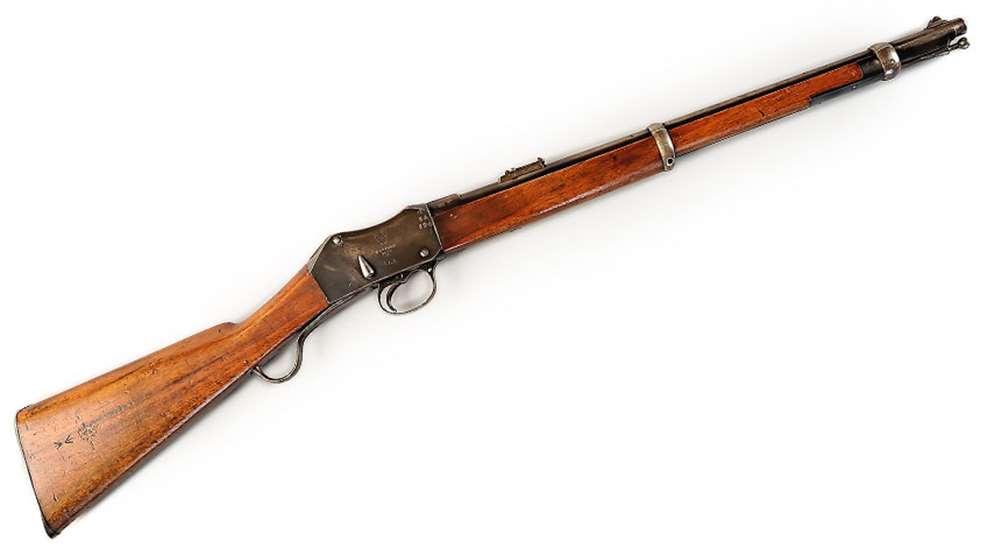
In the 1860s, at the dawn of the self-contained metallic cartridge era, the military armsmakers of Great Britain and other major powers decided to alter existing muzzleloading rifle-muskets into breechloaders.
Their reasons included saving production costs and buying time to permit experimentation. One such example was built on a combination of the Pattern 1853 Enfield and the Snider System, and was adopted in 1866. Although it remained in use with militia and colonial troops for a considerable period, it was replaced for Crown troops a scant five years later by a wholly new design: the Martini-Henry.
Unlike the Snider, which had a side-swinging breechblock, the new gun was a lever-action, single-shot, falling block that incorporated design elements by American Henry O. Peabody, Swiss Friederich von Martini and Scotsman Alexander Henry, among others.
To work a Martini-Henry, the shooter simply lowered a lever beneath the wrist of the stock, causing the breechblock to drop forward and expose the chamber. A formidable .577-450 bottlenecked cartridge was then inserted into the chamber and the lever closed, readying the rifle to shoot. Although the gun did not possess a safety, it did have a teardrop-shaped indicator on the right side of the action that allowed the user to determine whether or not the mechanism was cocked.
Initial versions were in the form of a long rifle primarily for infantry use, but early on it was determined that a short carbine for cavalry and artillery use was also in order. The answer appeared in September 1877 in the guise of the IC1 Cavalry Carbine, its official cognomen being “Carbine, B.L., Rifled, with Cleaning Rod, Martini-Henry, (Mark I).”
Employing the same receiver as the Mark II Martini-Henry rifle, this handy piece measured 37.6" long (some 16.4" shorter than the infantry rifle) and weighed a manageable 7 lbs., 8 ozs.
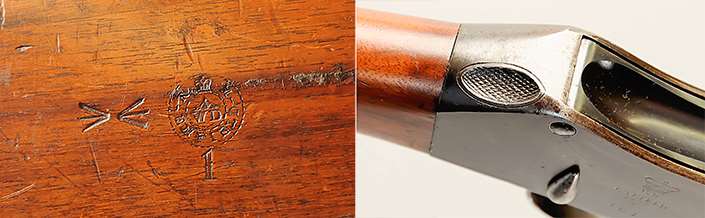
Like the rifle, the carbine had a checkered indention on the top right of the receiver’s rear portion that allowed the trooper to easily rest his thumb, thus keeping it from wrapping around the wrist of the stock where it could bash him in the nose under the stout recoil of the .577-450 round.
To also help ameliorate this problem, a special load was developed for the lighter carbine having a 410-gr. projectile, which was 70 grs. lighter than the 480-gr. projectile used in the standard infantry cartridge. The powder charge was accordingly reduced from 85 to 70 grs.
An abbreviated ladder-style rear sight was graduated to 1,000 yds. and a small blade front sight was protected by flanking wings to allow the gun to be more easily inserted into a saddle bucket.
Two years after the introduction of the carbine, complaints arose that the rear sight was snagging on the saddle gear, which resulted in the addition of a leather sight cover fixed to the stock by means of a pair of screws.
The Martini-Henry Cavalry Carbine proved to be handy, rugged and reliable. One added attribute was that the same basic platform could be transformed into an artillery carbine by the simple substitution of a front barrel band incorporating a bayonet lug and by the addition of sling swivels.
The adoption of the .303 British round in 1889 caused a revamping of the Martini-Henry carbines into .303 Metford and .303 Enfield versions. They were ultimately replaced by .303 Lee-Enfield repeating bolt-actions by the beginning of the 20th century.
The example we see here is in NRA Excellent condition (Antique Gun Standards) and maintains a large degree of original finish. As well as the royal Victorian crown and cypher, and “Enfield 1877,” markings on the receiver include a broad arrow surmounting the initials “SA,” indicating the carbine saw some service in South Australia.
Martini-Henry Cavalry Carbines are not as plentiful on the collector market as are the rifles, so a piece such as this one is easily worth $2,500.
Gun: Mark I Martini-Henry Cavalry Carbine
Manufacturer: Royal Small Arms Factory Enfield
Chambering: .577-450
Manufactured: 1877
Condition: NRA Excellent (Antique Gun Standards)
Value: $2,500
Most Popular