Despite the increasing number of serious shooters who possess advanced skills, few well-known shooting drills actually challenge the shooter, balance skills in a proportional manner, and are simple to administer.
Enter the "10 Second Showdown." This drill is a simplification of an earlier drill I had designed for highly skilled special operations and SWAT-type shooters. I was looking for a single drill that covered a wider range of tasks and skills than the typical fixed-yardage drill where a shooter stands in place. The 10 Second Showdown (10SS) brackets shots from a long residential or law enforcement car 13 yards down to an urgent 3- to 4-yard immediate threat shot. It heavily favors practical accuracy with severe penalties for loose hits. The drill incorporates a draw, a reload, movement, pairs, failure-to-stop sequences, and shooting on the move. That is a lot going on within 10 shots and, optimally, within 10 seconds, so the drill is both exciting and demanding.
Here's how it works. A holstered shooter begins facing a single IDPA target at 13 yards with one round chambered and one round in his or her magazine, with another magazine of eight on the belt. For shooters on ranges where silhouettes are not permitted, an innocuous 8" circle and a 3 x 5 card may be substituted for the respective scoring zones. On the buzzer, a shooter draws and fires a pair to the center of the target. The shooter then conducts a slidelock reload while on the move to the 10-yard line, firing another pair once at the 10. The shooter then moves as quickly as possible to the 7-yard line and fires two shots to the center followed by one to the head—the classic Failure Drill. Once the head shot is downrange, the shooter steps off and fires another failure drill while shooting on the move, completing the drill. 
The drill is scored in IDPA style, time plus penalties, with outside hits adding one second per point down. However, the adjusted time is then translated to a numerical score on the traditional 0-100 graded score style. A time of 10 seconds equals an "A" at 90 points, and every tenth of a second faster adds a point, while each tenth slower subtracts a point.
It is simple to visualize the course of fire as a scenario that armed professionals might find themselves in, closing in on a fluid situation, halting to draw and fire, stepping to cover to re-engage or regain an angle to the target, etc. While that may be an appropriate context for some shooters to relate to, the 10SS is not really meant as a scenario-based drill. It is foremost a technically focused exercise to combine a number of shooting challenges with movement into a single compressed exercise.
After years as a trainer and being around highly skilled shooters in diverse settings, I have learned that a shooter’s ability, when allowed to plant and mentally/physically prepare for a drill, often differs from his ability when coming out of sudden movement and on demand. I strongly believe that the shooter’s ability when suddenly stepping into position is a better measure of "on demand" performance than more fixed tasks that allow an uncharacteristically prepared stance. Some shooters must drop into an exaggerated squat or unnatural, wide-legged brace, shift weight and mentally prepare himself for a high level of performance. The 10SS discriminates against this approach and is merciless in its demand for simple, clean execution in a flow.
The 10SS discriminates against this approach and is merciless in its demand for simple, clean execution in a flow.
The showdown has been in active validation for a few years now. I am confident that the 10-second marker is appropriately placed as a solid "A" grade, and is a level of achievement for the high intermediate level defensive shooter or armed professional. It is a worthy goal that will not come easily for many. I suspect the first clean run in under 10 seconds will be a cherished memory and milestone achievement for most shooters. However, nothing about the drill places 10 seconds out of the reach of any shooter of basic skill and physical mobility.
Note also that the scale maxes out with 100 points at nine seconds. This is intentional. In validation with champion level shooters, it became clear that the top one percent can certainly do it faster. It also became clear that those same shooters tend to be in the high 90 scores when shooting cold/on demand, or when shooting to ensure that everything goes right as opposed to "go for broke" speed. The places and manner of shaving time to get under nine seconds also lead to shortcuts, less reliable performance, and may create bad habits. The drill rewards clean, repeatable execution at the expense of diminishing returns in raw time.
The drill rewards clean, repeatable execution at the expense of diminishing returns in raw time.
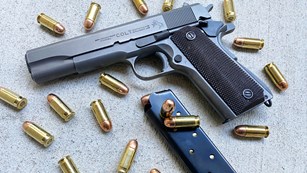
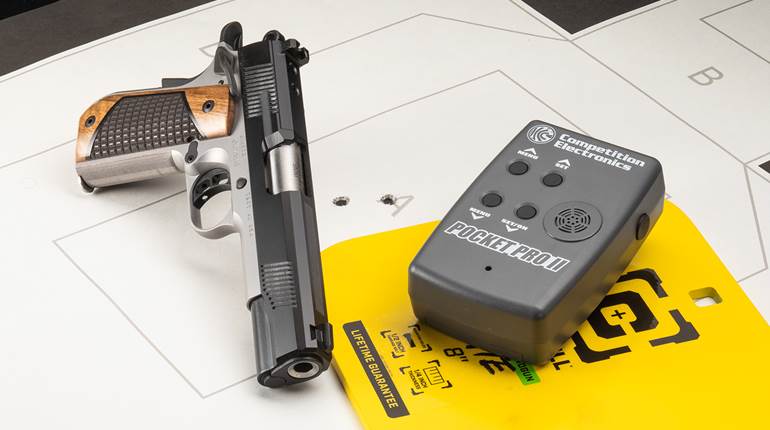
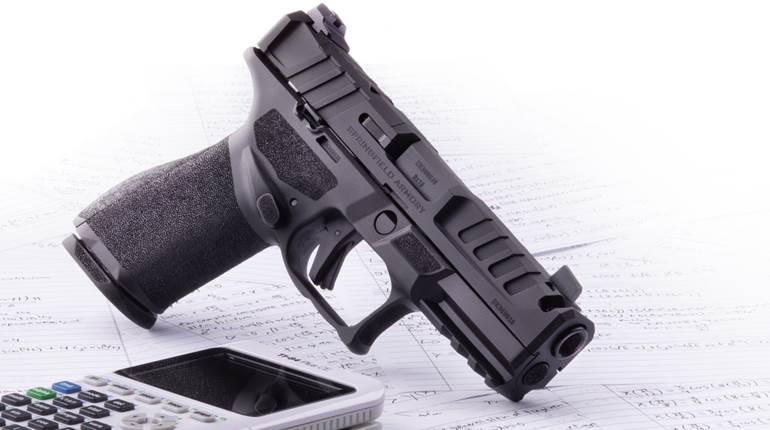
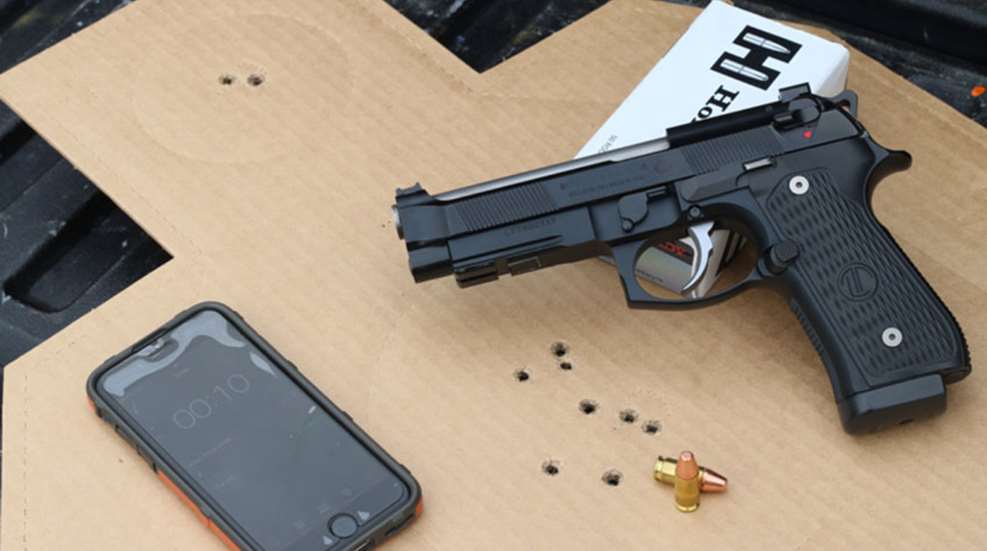
The drill seems to be relatively handgun neutral, with modest advantage between a midsize carry pistol and a larger service or competition model. Double Action/Single Action (DA/SA), striker-fired, and single-action pistols have all been used for perfect scores. I’ve shot the 10SS using everything from vintage World War I-era 1911s to yet-to-be released new red-dot-equipped pistols, and my consistency and execution is a much larger variable than the pistol. My current personal best is with the Beretta Elite LTT, but I’ve logged scores closely behind with a variety of pistols.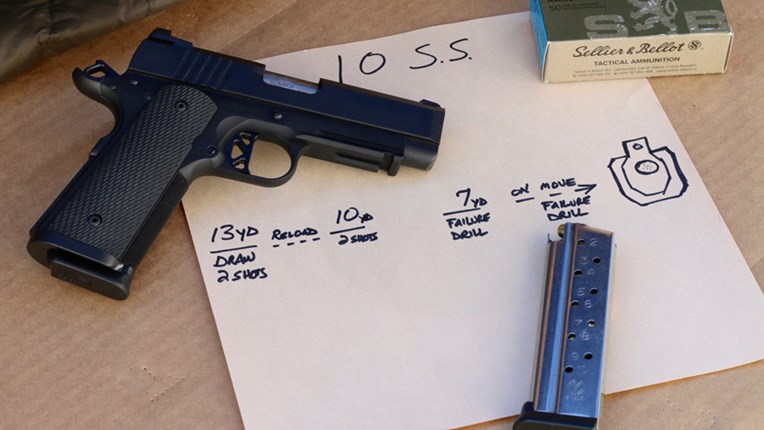
There are two caveats: revolvers and subcompact hideout pistols. These two categories tend to require modification to the basic layout. With both wheelguns or pocket/ankle-sized single stack firearms, I change the reload to be between the 10 and 7 yard lines to account for the reduced capacity, and look at 12 seconds (including penalties) as the modified "A" grade to account for the additional time each platform typically requires.
The showdown is not a great exercise for new shooters; there are too many moving parts that might overtax a newer shooter and lead to problems. The showdown can be of value to a new CCW holder broken into segments or conducted with close supervision and no time pressure.
I often use the 10SS as one of the final exercises in classes for advanced shooters and more experienced law enforcement, The first run through can be daunting, but once they are comfortable with the basic flow of tasks, the more skilled shooters love it.
Give the 10 Second Showdown a try. It will quickly illustrate where you may need some work to improve and will be among the most exciting 10 rounds you've fired.
Scoring (time adjusted after penalties)
Adjusted Time Score
9.00 100
9.1 99
9.2 98
9.3 97
9.4 96
9.5 95
9.6 94
9.7 93
9.8 92
9.9 91
10.0 90
10.1 89
10.2 88
10.3 87
10.4 86
10.5 85
11.0 80
11.5 75
12.0 70
12.5 65
13.0 6
Most Popular