Ever since a 1989 Executive Order restricted the importation of specifically named semi-automatic rifles into the United States, certain affected models have achieved near legendary status—partly because they had a well-deserved reputation for performance in international circles and partly because they became expensive and difficult to obtain. The fact that later-modified iterations remained available for a time afterward did little to suppress the appetite among hardcore military rifle aficionados for the genuine article with all of its original military characteristics.
No series of rifles better represents the case than the SIG 550 series. After deciding in the late 1970s that its delayed-blowback, roller-locking 530 series, a descendant of the larger-caliber Sturmgewehr 57, was too heavy, overly bulky and too costly to produce for the competitive world market, SIG set about to design a new rifle and in so doing applied the innate Swiss penchant for precision manufacturing to an operating system that had proven soldier-proof in the grittiest battlefield conditions all across the globe: the Kalashnikov long-stroke gas piston.
The resulting select-fire SIG 540 series—initially chambered for a proprietary cartridge similar to today’s 5.56x45 mm NATO, but that the Swiss believed to be superior—was refined to become the Swiss Arms 550 series. The 550 was engineered with a series of features thought to be ideal for the Swiss citizen soldier and that would become equally desired by all those fortunate enough to later purchase commercial, semi-automatic versions. It featured robust construction with a beefy bolt assembly, massive extractor and fixed ejector. Simple disassembly and design and construction details were aimed at unfailing service in adverse conditions. It incorporated a 20-inch barrel and side-folding skeletonized buttstock for compactness. A unique trigger design, integrated bipod and precision iron sights—with a rear diopter that quickly adjusted for shots out to 400 meters—gave it excellent accuracy. In 1990, the 550 series was finally accepted officially into Swiss military service, by then chambered for the NATO-standard SS 109 cartridge, and appropriately bearing the designation of Stgw 90.
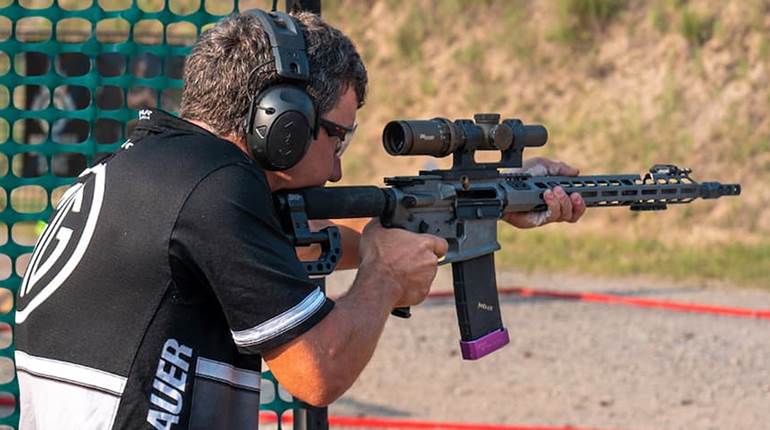
Fast forward to 2007 when SIG Sauer, the U.S. arm of the now privately held concern of German and Swiss factories, announced the new SIG 556, a 550-based semi-automatic-only action with a machined-aluminum lower receiver that accepted AR-15-type magazines. It was good news to be sure as the new gun possessed the same proven operating system as the original Swiss rifles. But what would otherwise have been music to the ears of anyone who had ever wanted a 550-style rifle and had failed to snap up a pre-ban example was muted somewhat when it became apparent that the new gun departed substantially from the original. Most obvious was its AR magazine capability—a practical concession that could be dismissed in light of the exorbitant cost of original Swiss magazines—but not so understandable were changes that true Swiss rifle fanatics saw as entirely unnecessary or downright unexplainable.
For instance, the buttstock was mounted to an AR-style buffer tube with, of all things, a telescoping AR-style stock. And available fore-ends included either an aluminum quad rail or a polymer version that looked nothing like the distinctive tapered Swiss originals. Add to that that the gun was all-black and the result was more like that of an AR and less like that of a Swiss rifle—at least externally. That the new 556s were fine guns internally and that they ran well was not the point for the Swiss rifle faithful. For them, only an original 550-style rifle would do, and in early 2009 it was announced that something closer to that ideal would soon be on the way. The 556 Classic marked the first time a Swiss 550-style gun had become available to American consumers in any significant numbers during the past 20 years. Best of all, the earliest examples came with actual Swiss side-folding buttstocks and featured diopter rear sights. But the Classic, as close as it was, didn’t fully satiate diehard Swiss rifle fans. It was still an all-black gun, and it still lacked some of the details that set the Swiss rifles apart from most other military guns.
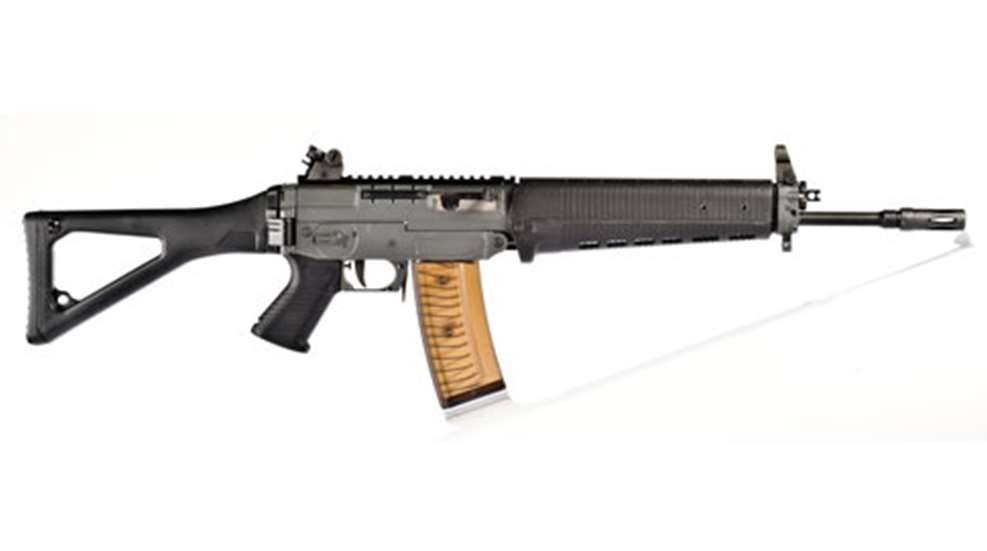
The solution finally appeared earlier this year when SIG released the 551-A1. That gun comes closest yet to the appearance and characteristics of the original Swiss 550-series rifles. Not only does it accept genuine SIG 30-round translucent-polymer magazines—which, because they require a hook-and-rock motion for insertion means the original-style ambidextrous paddle magazine release is present at the front of the trigger guard—but, perhaps best of all, the gun now comes in the right color. The upper and lower receivers are finished in the traditional “Swiss gray” that has long been the hallmark of genuine 550-series guns. Naysayers may dismiss that the lower is a machined aluminum forging rather than a stamped-steel part or that the gun doesn’t have the original style Swiss takedown pins; but, for the most part, the 551-A1 finally lays to rest the long-harbored angst for those who’ve always wanted a “true” 550-series gun.
As if that were not enough, a 551-A1 lower assembly is available separately, and, just when it seemed 550 series development had peaked, an all-new model is available. The 556xi has removable-barrel capability, a charging handle that can be swapped from the right to left side of the gun, ambidextrous controls and a Swiss side-folding stock.
Because of their quality, unfailing performance and exotic European origins, the SIG 550-series rifles will always command the respect those who seek out examples of the world’s finest semi-automatic rifles.
Most Popular