From its inception as a Canadian firm offering high-capacity M1911-based frames to its current incarnation as an American-based company, having recently relocated to North Carolina, Para USA (formerly Para-Ordnance) has always been the company that takes a different approach to the M1911 pistol.
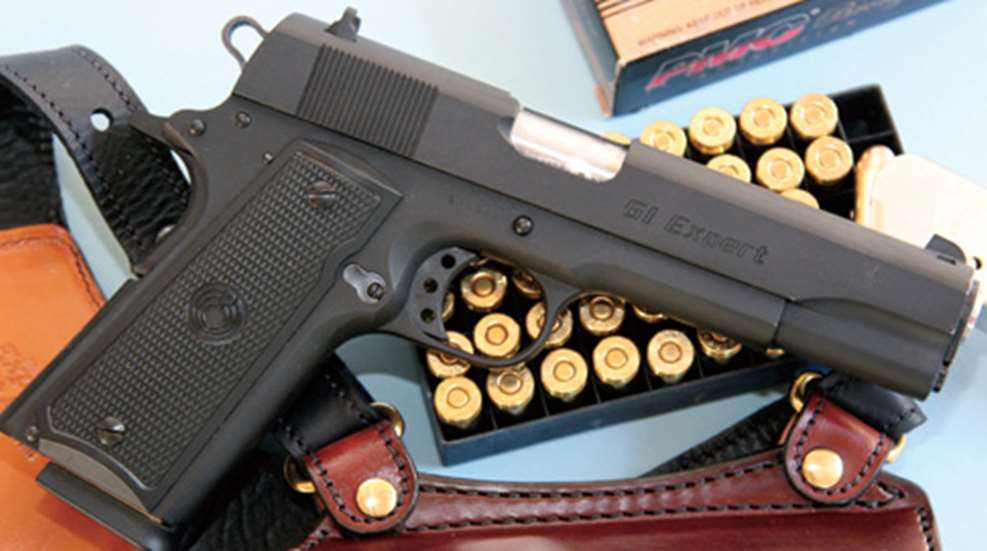
In these tough economic times Para USA has chosen to offer a basic pistol that dispenses with many of the expensive niceties that have become de rigueur in recent years. For the most part, the G.I. Expert has only the M1911 refinements famously specified by Col. Jeff Cooper—a trigger you can manage, sights you can see and a dehorning job.
The G.I. Expert eschews rear-of-slide checkering, wooden grip panels, a high-sweep beavertail grip safety tang, night sights and an extended thumb safety or accessory rail. That may seem like a lot until you realize that none of those things make a gun go bang or affect its accuracy. They are comfort features, which may help make shooting easier, but don’t get at the core of pistolcraft.
Why might buyers be drawn to the G.I. Expert? First, there is simply nothing on it that hasn’t endured decades of real-world testing. Its one-piece guide rod and solid barrel bushing are just such examples. Second, it departs from the traditional 20th century military M1911A1 only in areas where such changes can be justified, including: the three-dot sights, a match trigger, a speed hammer, dehorned edges, a high-cut grip frame and a lowered and flared ejection port.
But the most obvious appeal of the G.I. Expert is affordability. Instead of having to make a large outlay of cash, you can put down a relatively modest sum and then modify the pistol as your taste demands and your bank account permits. In the meantime, you’ll have a fully functional, highly serviceable gun that you can use and enjoy right now.
The G.I. Expert’s three-hole blackened aluminum match trigger has a clean, crisp pull of only 3 pounds, 14 ounces and is equal to those found on guns costing three or four times as much. It is likely aided by the short lock time afforded by the speed hammer. Although some might see it as an add-on, a speed hammer is just a lightly constructed hammer that moves faster yet retains enough mass for reliable primer ignition.
The sights consist of a front post and high-profile rear unit in a three-dot arrangement. They are quickly acquired, simple and sturdy. Despite the rear unit’s height, it is surprisingly smooth at the edges and did not snag clothing when the pistol was drawn from concealment.
The dehorning of the entire pistol is subtle but effective. Visually, it does not soften the lines, yet the edges feel much less sharp.
Other enhancements on the G.I. Expert include the high-cut grip frame and the lowered and flared ejection port. The former makes the gun more comfortable in virtually any hand, and the latter keeps brass from getting dinged and dented. It acknowledges the importance of being able to reload ammunition (especially today) and is a logical enhancement that is also industry-standard.
Shooting the G.I. Expert was predictable, in that it feels and shoots exactly like a good M1911 should. It sits well in the hand, the trigger breaks cleanly and the gun rolls up in the hand with an easily manageable level of felt recoil.
Accuracy was satisfactory, though it showed some load preference. There was one failure to go into battery early in testing. After that, the G.I. Expert perked along without incident.
Were there things we didn’t like about this pistol, refinements that we missed after getting spoiled by pricier guns? A few.
The frontstrap is slippery and the gun twists in the hand, especially if the shooter is perspiring. Also, we weren’t crazy about the Para Kote finish. It looks good out of the box and resists reflecting glare, but it began to wear after only a few presentations from the holster.
Refinishing these days with the variety of surface treatments available, including do-it-yourself spray-and-bake products, is an easy fix, but still, we’d like a more durable out-of-the-box finish.
That notwithstanding, the G.I. Expert is quite a good gun that is very hard to dislike. After all, it is simply the pistol designed by John Browning incorporating the tweaks suggested by Jeff Cooper, offered at an affordable price. Arguably, it has everything you need, and nothing you don’t.
Manufacturer: Para USA, Inc.; (704) 930-7600; Para-usa.com
Caliber: .45 ACP
Action Type: Recoil-operated, center-fire semi-automatic pistol
Frame: Carbon steel
Barrel: 5"
Rifling: Six-groove, 1:16" LH twist
Magazine: Detachable box, eight-round capacity
Sights: Three-dot, drift-adjustable for windage
Trigger Pull: Single-action; 3 lbs., 14 ozs.
Overall Length: 81⁄2"
Width: 13⁄8"
Height: 53⁄4"
Weight: 39 ozs.
Accessories: Plastic case, spare magazine, owner’s manual
Suggested Retail Price: $599
Most Popular