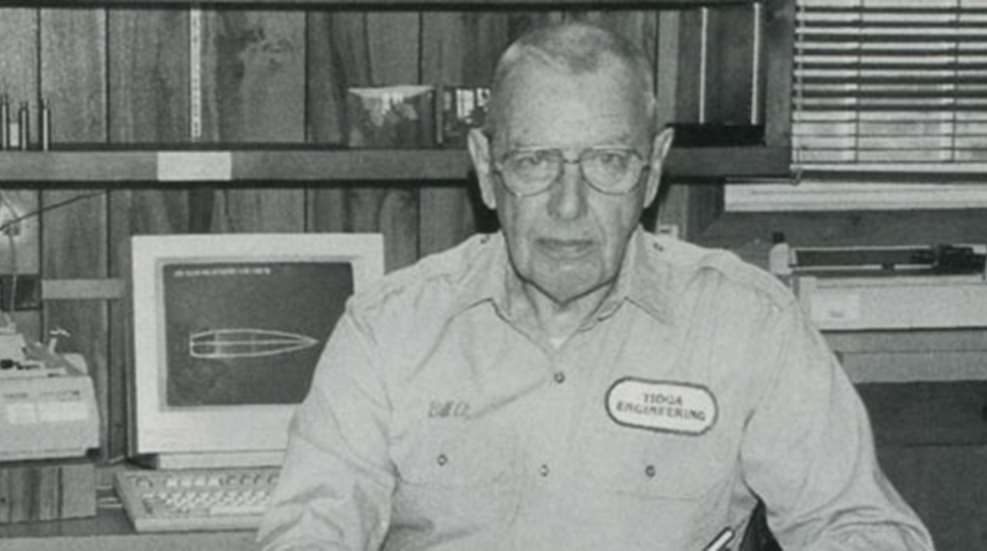
American Rifleman’s longtime ballistics editor, a leading figure in firearms and ballistics for more than half a century, William C. Davis, Jr., died on March 4, 2010, at the age of 88. Davis wasn’t just one of the most brilliant and accomplished ballisticians and firearms engineers of the 20th century, he was a shooter’s shooter, having qualified expert in rifle, carbine and pistol in the Army. He was also a Lifetime Master in NRA Smallbore Rifle and held a Class AA rating in NRA Hunter Pistol Silhouette. His knowledge was not merely theoretical; it was practical and applied frequently.
Davis’ first article for American Rifleman, “Bullet Design,” appeared in the July 1949 issue. Throughout the next 53 years, he wrote more than 50 articles for American Rifleman, on topics ranging from “How To Calculate Ballistic Coefficients” to “Handloading the .244 H&H Mag.” Davis became an American Rifleman contributing editor in 1974 and was named ballistics editor in 1986. He and his partner at Tioga Engineering, Charlie Fagg, answered thousands of letters sent to NRA’s “Dope Bag.” Trust me, when you received a letter back from Davis or Fagg, you had the best answer possible. Davis would apologize for the delay in answering (he was always busy with Tioga’s paying clients), but a more thorough answer to even the most basic or wacky ballistics question would follow. He did it out of his love for shooting and an appreciation for NRA, not for financial gain.
A lifelong handloader, he was the author of NRA’s “Handloading” published in 1981, and as Bill Askins wrote in the book’s foreword, “Bill Davis was clearly the best person to undertake this massive endeavor.” Davis also contributed to the “Encyclopedia Britannica,” writing the “Ammunition” section. Among his other accomplishments, he wrote one of the first exterior ballistics computer programs in BASIC usable by the average shooter—which he offered free to NRA members. It was one of 14 computer ballistics programs he wrote.
Born in 1921, Davis graduated from Shinglehouse High School in Pennsylvania in 1937 and then graduated from St. Bonaventure University in New York in 1941 with a degree in physics and mathematics. He joined the Army in 1942 as a private and rose to the rank of captain by the time he left in 1946. He returned to St. Bonaventure and taught there until 1951, at which time he became an ordnance engineer for the U.S. Army. He worked at Aberdeen Proving Grounds, Frankfurt Arsenal and Rock Island Arsenal through the course of his 23-year career. Among his many professional accomplishments, Davis served as the U.S. representative at the Pendine Trials of 1953, which led to the adoption of the .30 Light-Rifle Cartridge as the 7.62x51 mm NATO, the first standardized NATO cartridge.
Davis was also instrumental in the ammunition side of the .223 Rem./5.56x45 mm NATO cartridge and the AR-15/M16 rifle family while at Frankford Arsenal. As reported in “The Black Rifle,” Davis was “given the ad hoc title of ‘AR-15 Project Director’ for the commanding officer, and directed by him to set about the unenviable task of preparing a technical data package for ammunition procurement which would satisfy the requirements of the various users.” It was Davis and his team that identified many of the early ammunition issues with the AR-15/M16, including primer sensitivity and cyclic rate issues due to high port pressures; they also diagnosed and offered solutions to the ill-fated change to ball-type propellant. He appeared before the U.S. House of Representatives Armed Services Special Subcommittee on the M16 rifle program.
Davis retired from government service in 1972 and set up shop as a self-employed firearm and ballistics consultant, evaluator, expert witness and engineer. He founded Tioga Engineering Co. in Wellsboro, Pa., in 1980 and retired from it in 2007.
In the 1980s he volunteered his time and effort in concert with Dr. Louis Palmisano to develop the Very Low Drag (VLD) bullet for the U.S. Shooting Team, which resulted in a win for the U.S. international team in 300-meter competition and commercialization of the bullet.
In recent years, Davis didn’t contribute as regularly to the magazine, but we kept him on the masthead as ballistics editor in recognition of his incredible contributions, and to know that we had him just a phone call away. Davis was always congenial to the staff, regardless of how simple (to him anyway) the question put to him was. His legacy of brilliant service to the U.S. military ensured our troops had the best small arms ammunition available to them, and he left a huge legacy to accuracy-minded rifleman and handloaders.
Davis’ first wife, Marguerite, preceded him in death in 1996, and he is survived by his wife, Mary Walker Davis, his daughter, Ann Davis Elliott, and three grandchildren.
Most Popular